We’re guessing most of our readers are familiar with Theodore Roosevelt’s “New Nationalism” speech, which he delivered shortly after returning from his African scientific expedition in Osawatomie, Kansas on August 31, 1910.
While the speech is likely his most well-known instance of using the word “nationalism,” Roosevelt actually only used the word “nationalism” just four times, all in the span of two paragraphs near the end of the roughly six-thousand-word speech.
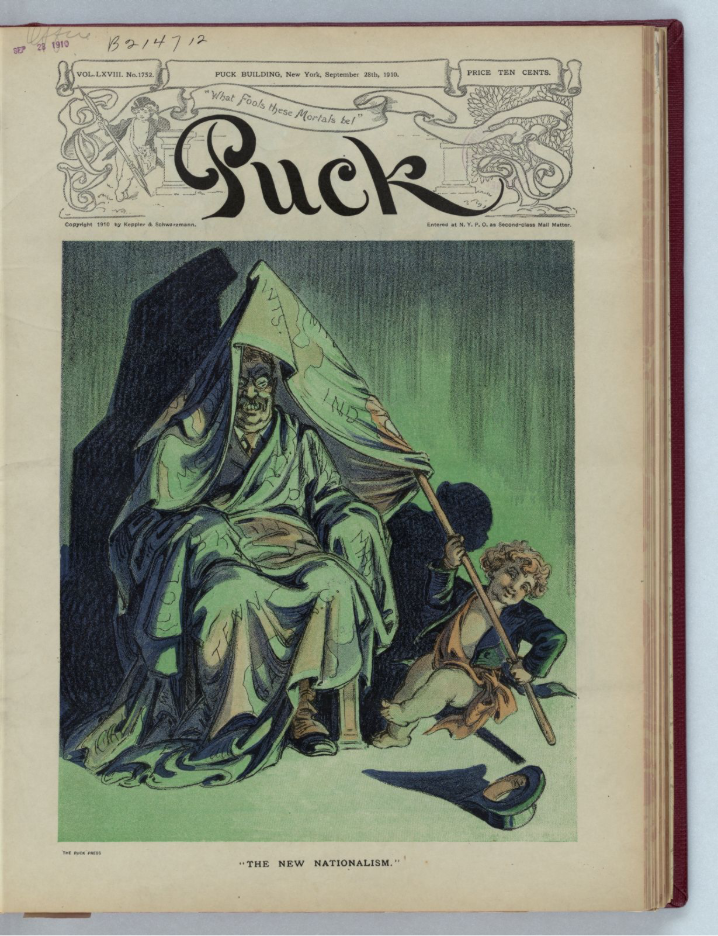
In three of those instances, Roosevelt used the word “new” before nationalism, arguing that the United States needed a “new nationalism” that put “national need before sectional or personal advantage.” As part of this new nationalism, Roosevelt emphasized the executive power “as the steward of public welfare.”
But Osawatomie, Kansas, was hardly the only time Roosevelt spoke or wrote about nationalism, although it was one of his more sensational speeches, at least from the perspective of the press. (You can read his handwritten response to various criticisms here in the digital library.)
Rather, Roosevelt reflected on nationalism and patriotism throughout his political career. And in this Monday’s Substack post, we’re going to delve into his conception of nationalism, looking at examples from other Roosevelt speeches and letters about national identity that are less well-known than his “New Nationalism” speech.
American Nationalism, or What Roosevelt Called “Americanism”
Many of the instances of Roosevelt’s other references to nationalism occur in the context of what he called “Americanism.” Roosevelt himself was staunchly American and argued against hyphenated Americans throughout his entire political career, in his own estimation. (He believed in only one kind of hyphenated American: American-American!)
Roosevelt thought immigrants should focus on their identity as Americans, rather than on the identity of their country of origin. As he argued in a 1918 manuscript later published in the Metropolitan, “We must all of us be Americans, and nothing but Americans . . .”
While this might be one of Roosevelt’s more succinct lines about Americanism, it was hardly his first, as can be seen by the examples below.
“We want to make our children feel, as they ought to feel, that the mere fact of being American citizens makes them better off than if they were citizens of any European country. This is not to blind us at all to our own shortcomings; we ought steadily to try to correct them; but we have absolutely no ground to work on if we don’t have a firm and ardent Americanism at the bottom of everything.” ~Letter to Osborne Howes on May 5, 1892
“We welcome the German or the Irishman who becomes an American. We have no use for the German or Irishman who remains such. We do not wish German-Americans and Irish-Americans who figure as such in our social and political life; we want only Americans, and, provided they are such, we do not care whether they are of native or of Irish or of German ancestry.” ~Article in The Forum, 1894
“Americanism is a question of spirit, conviction, and purpose, not of creed or birthplace.”~American Ideals, 1897
“[T]he one absolutely essential quality which we must bring to every problem and to every deed and without which true success is impossible, is intense Americanism – to be American in heart, in soul, in spirit, and in purpose.” ~Letter to Charles M. Howe on November 25, 1903
“Either a man is an American and nothing else, or he is not an American at all.” ~Speech delivered at Forest Hills, Long Island, July 4, 1917
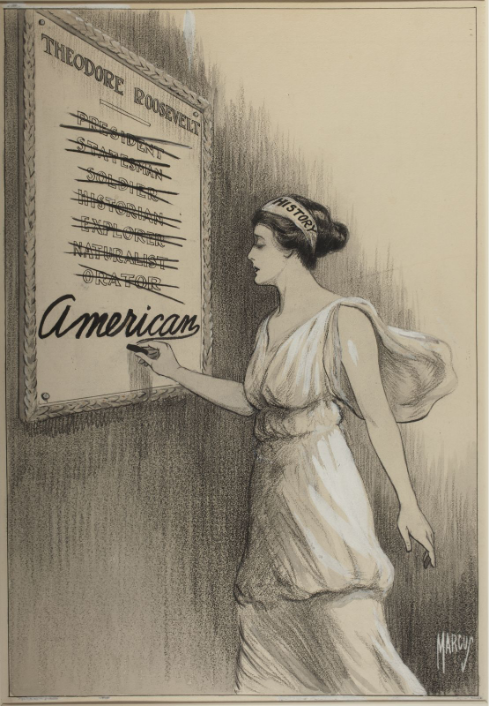
Roosevelt’s promotion of Americanism is one of his most enduring legacies. As depicted in a memorial cartoon below, the American public viewed him first and foremost as an American.
Nationalism in Other Countries
But Roosevelt also discussed nationalism in other countries like in Japan and Greece. As he noted in a January 1907 letter to Anna Cabot Lodge, wife of his friend, Senator Henry Cabot Lodge, “The Japanese, unlike the Greeks, were able to transform their spirit of intense but particularistic patriotism into broad national patriotism, and so they have been formidable as a nationality in a way in which it was wholly impossible for the Greeks ever to be.”
Roosevelt even delivered an entire speech about nationalism in 1916 entitled “Nationalism in Literature and Art.” In this speech, Roosevelt examined the literature and art the French people had created by being “content to be a Frenchman and nothing else” and believed American creatives should approach their art in the same way.
As Roosevelt said, “France has helped humanity because France has remained French. There is no more hopeless creature from the point of view of humanity than the person calls himself a cosmopolitan, who spreads himself out over the whole world, with the result that spreads himself out so thin that he comes through in large spots.”
Although many times Roosevelt focused on political nationalism, here he emphasized cultural and social nationalism, arguing in favor of the unique gifts that different nations can provide by focusing on their identity, rather than on a more global perspective.
Roosevelt even said that a mere political nationalism wasn’t sufficient, and that Americans needed a cultural and social nationalism as well: “This means that here in America, if we do not develop a serious art and literature of our own, we shall have a warped national life.”
As Roosevelt concluded his speech by saying, “American work must smack of our own soil, mental and moral, no less than physical, or it will have little of permanent value.”
Nationalism as It Related to Internationalism
While Roosevelt often focused on Americanism and patriotism, he did occasionally comment on the connection between nationalism and internationalism, particularly in contexts like the Monroe Doctrine.
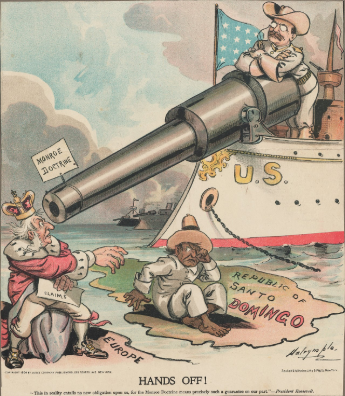
In 1896, he gave a speech about the Monroe Doctrine as police commissioner in which he stated, “The nation that is not imbued with nationalism is not going to do much toward elevating the standard of mankind in general.”
After the outbreak of World War I, however, Roosevelt mentioned the connection between nationalism and internationalism much more frequently.
In Roosevelt’s mind, a country had to focus on its nationalism first to order to be able to aid other nations. As he wrote in Fear God and Take Your Part, published in 1916, “Patriotism, so far from being incompatible with performance of duty to other nations, is an indispensable prerequisite to doing one’s duty toward other nations.”
Roosevelt likewise gave a speech in Lewiston, Maine, in 1916 where he made a similar argument, as his sister Corinne Roosevelt Robinson mentioned in her book, My Brother, Theodore Roosevelt: “The policies of Americanism and preparedness taken together mean applied patriotism. Our first duty as citizens of the nation is owed to the United States, but if we are true to our principles, we must also think of serving the interests of mankind at large.”
Countries and Peoples Excluded from Nationalism
Although Roosevelt is revered by both left and right for being distinctly American and promoting American values, his concept of nationalism also had a dark underbelly. Like other social Darwinists of the time, Roosevelt believed some people weren’t “ready” to self-govern and exist as a nation.
He felt this way in particular about the Philippines, which he delineated in a 1904 letter to Harvard University president Charles W. Eliot. As Roosevelt wrote, “The Filipino does not need in the least to be taught that he is to aspire to a national government.” Rather, in Roosevelt’s mind, the Filipinos needed to “practice justice to himself and to others.”
Roosevelt even believed that the Filipinos should be discouraged from trying to establish a nation or focusing on self-government. In fact, he considered discouraging self-government among the Filipinos as the best example of “American statesmanship in the islands.”
Roosevelt had similar beliefs about the Indigenous tribes in the United States and even tied American nationalism to frontier expansion, arguing in The Winning of the West, “Thus the Americans began their work of western conquest as a separate and individual people, at the moment when they sprang into national life.”
A Lifelong Passion to Promote Undivided American Nationalism
Although some aspects of Roosevelt’s understanding of nationalism don’t age well in the twenty-first century, there can be no doubt that he cared about American nationalism. And it was something he thought about until the day he died.
Just a month before his death, Roosevelt wrote George Haven Putnam in December 1918, “I do not care to go on any board or into any organization of any kind at present, more especially as I am spending all my endeavors to secure in this country a spirit of undivided American nationalism, based on an Americanism which disregards all questions of national origin and which treats this as a new nation . . .”
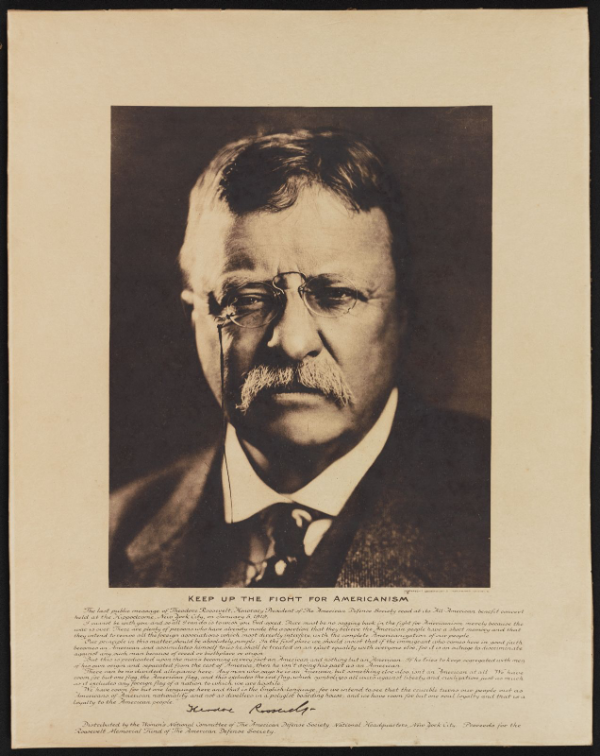
We’ll conclude with this memorial photograph from 1919 below that encapsulates Roosevelt’s sentiments about nationalism well: “Keep up the fight for Americanism.”