
A Day at the Circus
The Big Stick at the Big Show

(We have a lot of content on our original website blog at theodorerooseveltcenter.org that you may not have seen. Dr. Hansard has adapted the following material from one of his own posts from a few years ago.)
On Thursday, April 1, 1897, Theodore Roosevelt wrote a letter to his sister Corinne discussing various family affairs. He also let her know that he was planning a family visit to the circus on the 10th. (Perhaps this was partly to celebrate Archie’s birthday on the 9th?) He asks her to come along and bring her children. (As far as his own children go, Ted was in the midst of being punished for naughty behavior, and was being kept from seeing some of his cousins again, but TR does not make it clear whether or not Ted was to be excluded from the circus outing.) Although we are not certain if they actually visited on that day – or indeed, at all – let’s assume they were able to make the arrangements as Roosevelt planned. What would a day at the circus have been like for the Roosevelt family?
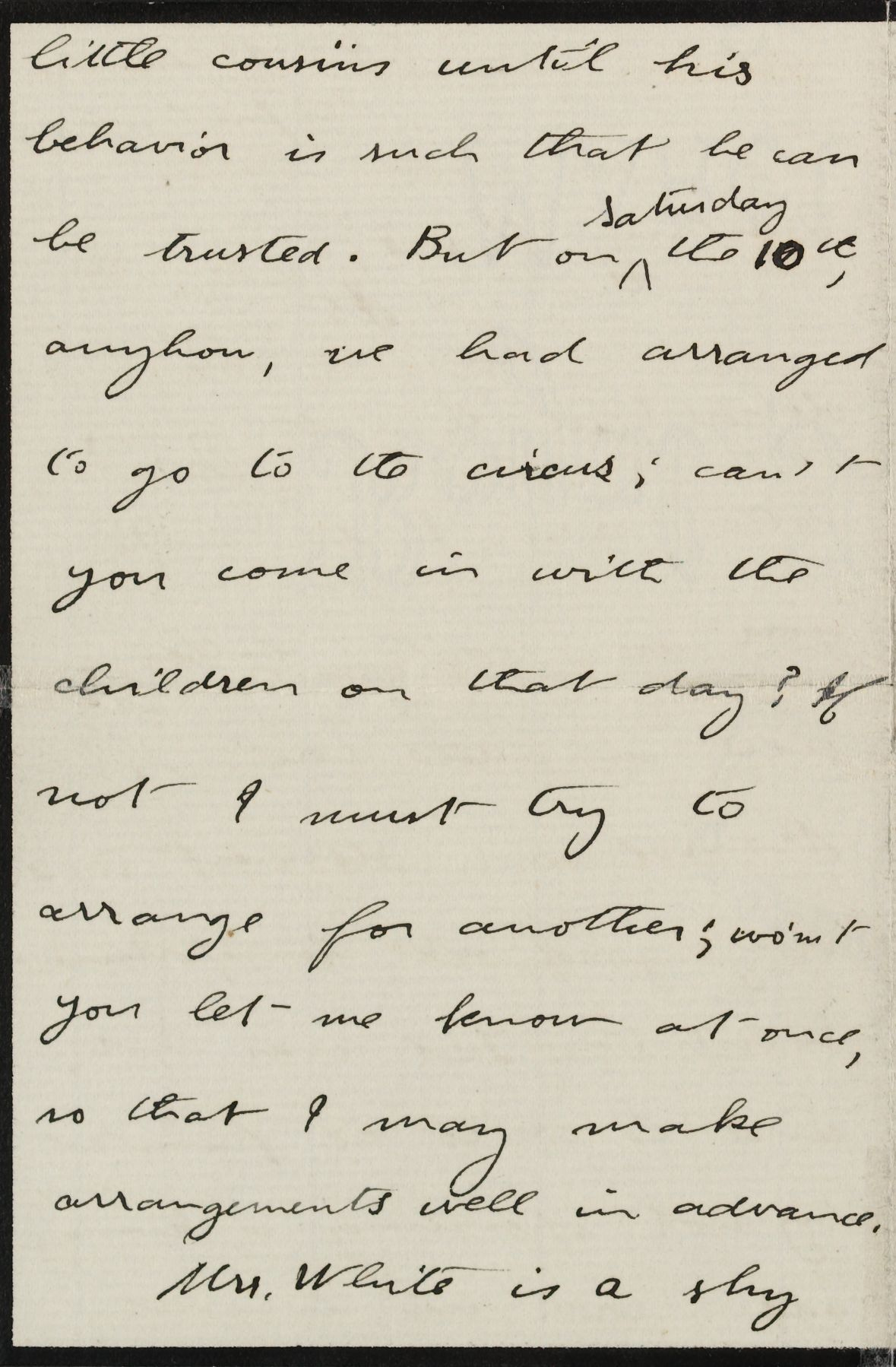
In the Gilded Age and Progressive Era, the traveling circus was by far the most important and beloved form of popular entertainment. “Circus Day” was a yearly holiday on par with Christmas or Independence Day. Businesses and schools would shut down, and customers would travel in from miles around to take in the spectacle. People would begin arriving at the railroad depot before dawn to watch the circus train roll in and be unloaded, a spectacle in and of itself, and to watch workers erect the “great canvas city.” Many would also stay long after the performances had ended to watch the circus be rolled up and packed away, an entire encamped army of over a thousand people and hundreds of animals, carrying literal tons of food and equipment, managing to disappear themselves less than a day after they had arrived.
The circus the Roosevelt family would have visited was the Barnum and Bailey “Greatest Show on Earth.” Barnum and Bailey was formed in 1881 when the two managers decided to merge their shows rather than compete with each other. In combining the outsized showmanship of P.T. Barnum and the shrewd managerial skill of James A. Bailey, the Barnum & Bailey circus quickly became the country’s premiere entertainment. (The Ringling Brothers company purchased the show in 1907 following the death of Bailey, and in 1919 merged the two, creating Ringling Brothers & Barnum and Bailey.)
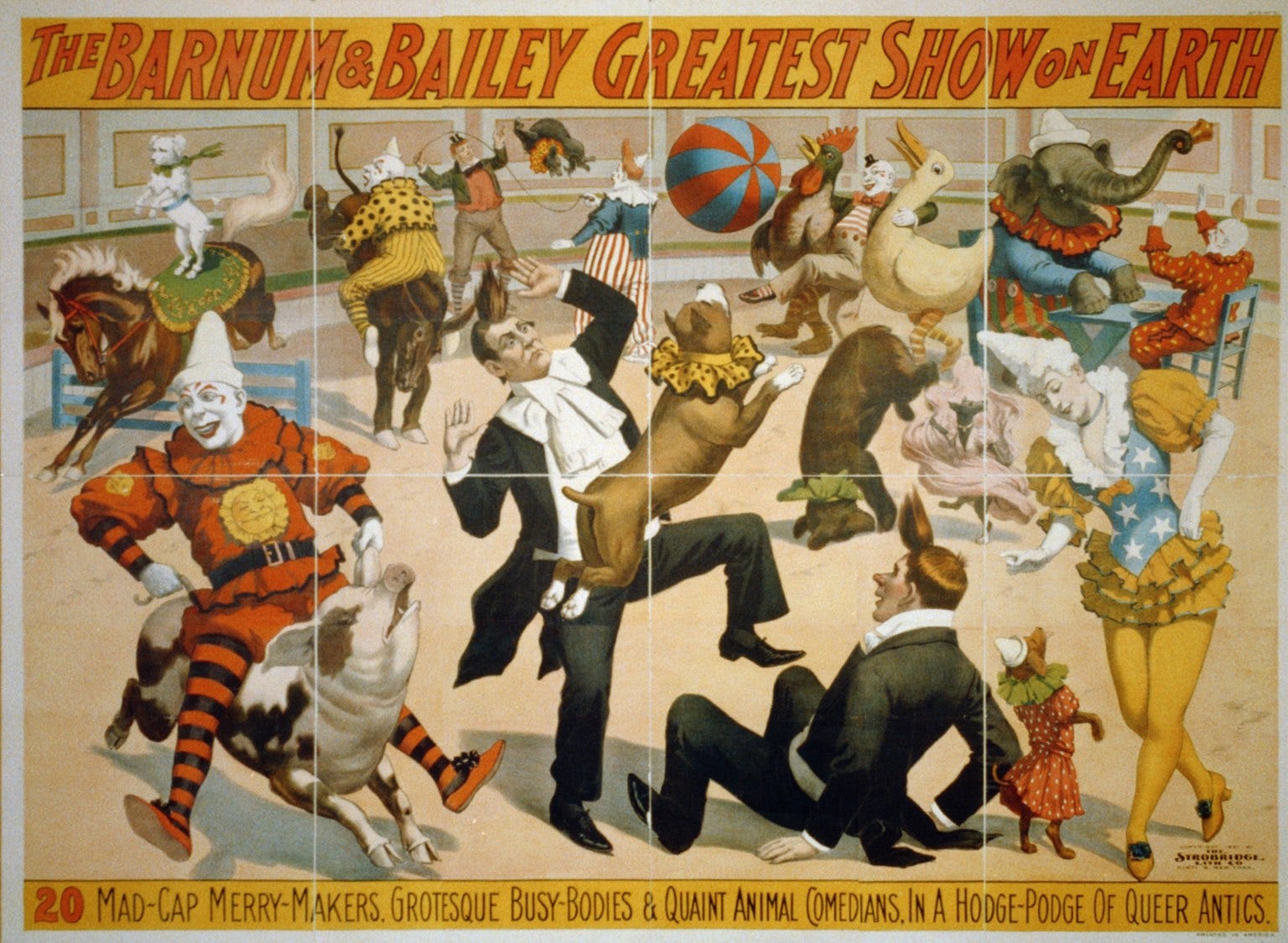

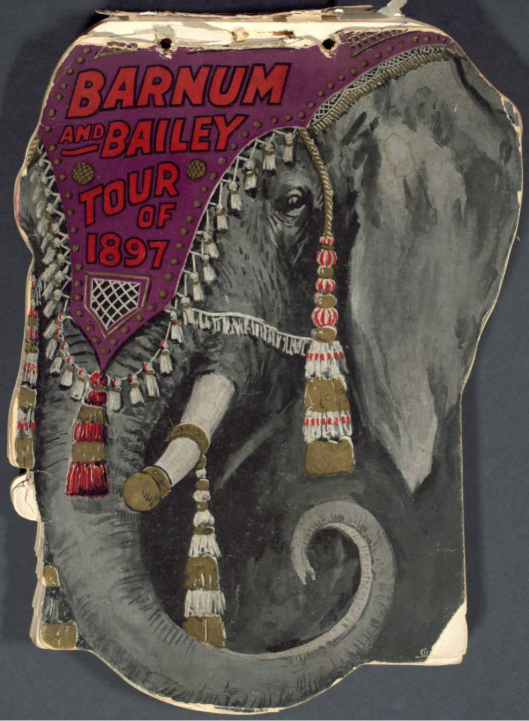
It was in fact on the day that TR wrote to Corinne, April 1, that Barnum & Bailey had opened for the 1897 season in Madison Square Garden. The big show that year featured eighteen different displays, many of which made use of dozens of performers and animals. From clowns to trick riders, from herds of elephants to acrobats and tumblers, from trained goats to tightrope walkers to hippodrome races, the Barnum & Bailey 1897 featured entertainments of such magnitude that had never been seen – of course, they said that every season, but it was usually true! Circuses refreshed and expanded their offerings every year so that people would continue to visit every season.
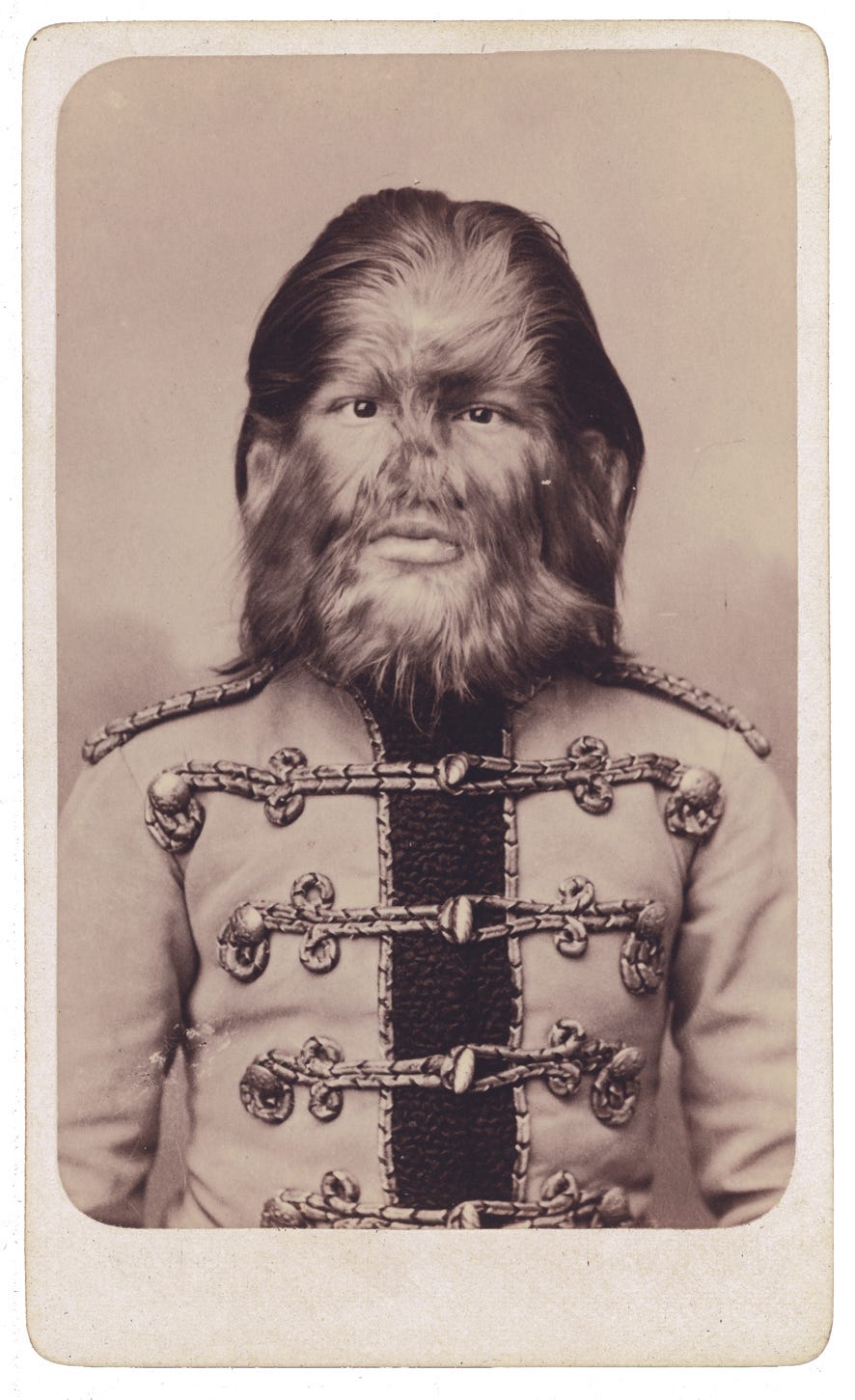
Although there was no train to watch – the circus began the season in New York and then began its travels - the Roosevelts would have arrived long before the big show began, so as to take in the many other attractions the circus offered. At the side show, they would have seen people with unusual bodies, like “Jo-jo the Dog-Faced Boy” (real name Fedor Jeftichew), people with unusual talents, like sword swallower Delno Fritz, and people who simply made merriment, like puppeteers Barry and Ella Gray. The menagerie, which held both performing animals and those meant specifically for display, was a place for education of both children and adults. Although the most “exotic” animals, like the elephants, giraffes, and lions, were the biggest highlights, other animals you might not imagine were quite popular as well. The pelican, for example, was frequently visited by those who wanted to teach about it as a Christian symbol – it was believed that the mother pelican would “vuln” itself – biting its own breast to sustain its young with blood, not unlike Christ.

Plenty of spending money was required, as tickets to the various attractions were not the only expense. For the children, TR would have purchased confections from the candy “butcher,” as they were called. For refreshments, pink lemonade and ice cream and a host of other sweet treats were available, as were more substantial offerings like coffee (which TR famously drank by the gallon) and sausages, Hamburg steaks, etc. They would have purchased balloons, toys, and other souvenirs from vendors that worked on a system called “privileges” – they paid a fee to the circus to operate on the lot, essentially paying for the “privilege” of hawking their wares to the throngs of customers that came through. Just as is the case with most popular entertainments today, there was a lot to do in addition to the main attraction!
Thanks to the wealth of historic records, we know not only about the general experiences that the Roosevelt family would have had on their day at the circus, but we know the exact performances they would have had the pleasure to see. During this period, most circuses compiled and printed what was called a route book for each season. A type of yearbook, route books listed the circus’ personnel, the places traveled to, the program, and often included a daily dairy narrating the season’s events. The Barnum and Bailey diary entry for the day of April 10, 1897 reads as follows:
SATURDAY, April 10. Weather clear. Business big.
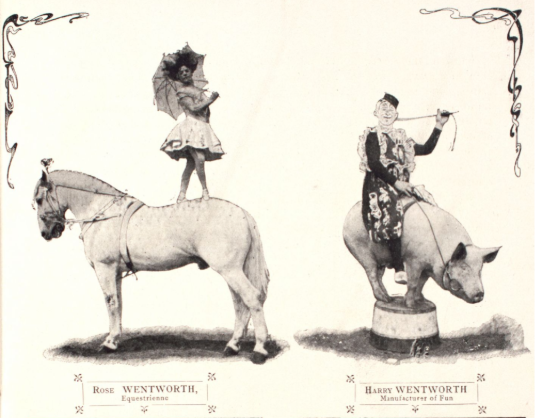
Before ten o’clock this morning every seat had been sold at the box office for both performances, and at both afternoon and night shows thousands were turned away unable to gain admission. Rose Wentworth’s somersault act, Caban’s football dog, the aerial performances of the Zedoras and the 70-horse act prove especially popular features. Reno Trio, Lorella Bros. and John White close.
These acts that were mentioned by name were spectacular indeed. Rose Wentworth was quite a multi-talented performer - a bareback rider, acrobat, contortionist, and clown. (Her husband Harry also did all the same but the horseback riding, but he made up for it with other trained animals, including an elephant and a pig!) Wentworth was billed as the only female equestrian performing somersaults while on horseback, and she could perform many other astounding feats as well. Circus advertising materials generally have to be taken with more than a few grains of salt, but in this case, it may have been true. Whether or not she was the only one, it was still the kind of feat one could only see at the circus! Equestrian acts were the beating heart of the circus – in fact, the standard size of a circus ring is 13 meters (or 42 feet, not an exact conversion) in diameter, because it was discovered that was the size required to perform while standing on the back of a horse galloping in a circle!
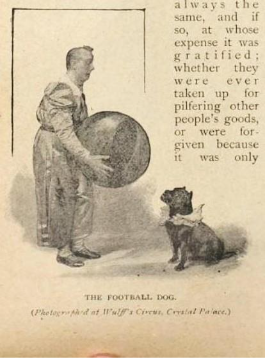
Charles “Charley” Caban was a clown who also had a dog act, which was not uncommon. (In earlier years, he also had an elephant and ponies!) Caban was in particular the leader of one of the groups of “fools” that presented throughout the show as a “Clever Pierrot.” A “Pierrot” is a stock character in clowning who is often a sad clown and a fool, whose trusting nature leads to his downfall. The word “clever,” then, was meant in a mocking way. “Pierrot” was one of the most popular types of clowns in both Europe and America. As for the trained dog, they often performed side by side with clowns. “Football dogs” were those who could “control a football with as much dexterity as the best international plater who has ever won his cap; indeed, they are far more important in the eyes of the audience than their masters, who simply bounce the ball as a preliminary to the dog-manoeuvres.” The “football” in question was more like a beach ball, but the act was enjoyable regardless! In general, trained dogs were and are an important part of popular entertainment throughout America’s history. There is a reason we still today use the phrase “dog and pony show” to refer to an elaborate and extravagant presentation!
The Flying Zedoras (this was not their real name, but a stage name) were an aerialist troupe most famous for a stunt called “Alar the Human Arrow.” One of the performers would be shot forty feet into the air from a giant crossbow, crash through a paper target, and be caught by another aerialist swinging upside down on the trapeze. This act was a wonder to behold, and very popular, but also extremely dangerous. During the opening stand in the previous year, the crossbow malfunctioned and the performer, Mary Murphy, was knocked unconscious. She fell from her platform, but thankfully was caught by another one of the performers. Either she or another member of the “family” continued to perform the act in 1897, and met with accident at least once more.
The act that closed the show consisted of clowns (the Reno Trio), dancers (the Lorella Brothers), and trained dogs and monkeys (Prof. John White). There was also likely a musical performance. Because people so often stayed after the main show was over to watch the circus be dismantled, circuses instituted evening performances, which allowed them both to charge extra money for additional tickets, and to keep more people contained rather than milling about as the men tried to do their work. (Of course, the show was not traveling during its opening stand, so the evening performance would not have been necessary for this reason, but occurred all the same.) The listed acts closed out the show many times that season, so they must have been quite popular!
With sweet and savory treats galore, an astounding side-show, feats of daring, hilarious fools, beautiful performers, exotic animals, and more, a day at the circus in 1897 was the experience of a lifetime – except if you planned for it, you could do it every year! All I know is, we can only hope that little Ted had behaved himself enough that he got to attend along with the rest of the family!
I enjoyed this blog! Thank you. An additional tie between the Roosevelts and the circus came while young Edith Carow attended Miss Comstock's School in New York City. From "Edith Kermit Carow" by Sylvia Jukes Morris: "One of Edith's classmates was the granddaughter of P.T. Barnum, and when the old showman brought his circus to the Hippodrome she became the most sought-after girl in school. "