
An Assassination Attempt
It Takes More Than A Bullet To Stop A Bull Moose

On October 14, 1912, former president Theodore Roosevelt, campaigning for a nonconsecutive third term under his newly-established third party, was very nearly killed by a bullet from a madman on his way to deliver a public speech in Milwaukee, Wisconsin.
Shortly after the end of his second term in 1909, Theodore Roosevelt left on an African safari and European tour (where he delivered his beloved “Man in the Arena” speech). He did so for a few reasons. One was to give his hand-picked successor, William Howard Taft, space to establish himself. Another was the opportunity to undertake the scientific work of gathering the thousands of specimens of flora and fauna required to open the National Museum of American History. Of course, simply escaping the stresses of politics, especially the Republican infighting, was surely also a good reason.
While in Africa, Roosevelt was practically unreachable, but while in Europe, he was met by several of his closest advisors and friends, who informed him that that rift in the Republican Party had only gotten worse. The worst issue was perhaps the Ballinger-Pinchot affair, a dispute regarding issues of protected lands that led to the firing of Chief Forester Gifford Pinchot for insubordination. Roosevelt felt the firing of Pinchot, with whom he had fought side by side to conserve America’s forests and manage them scientifically, as nothing but the deepest betrayal, both politically and personally.
The split in the Republican party was along a more or less conservative versus liberal fault line. Roosevelt led the liberal wing, as he had clashed with party politicians from the beginning of his career. He returned to the United States in the summer of 1910 eager to spread a liberal, even radical, Republican message. The culmination of this “campaign” (he was not yet actively, openly running for president at this time) was his “New Nationalism” speech in Osawotamie, Kansas. Among the policies, considered radical for the time, that Roosevelt campaigned for in this speech were workman’s compensation, labor laws that would protect women and children, a graduated income tax, and even an inheritance tax.
Due to Roosevelt’s proselytizing, the split in the Republican party – and in particular between Roosevelt and Taft – only grew worse. Roosevelt became particularly furious over the federal lawsuit against U.S. Steel as an illegal trust in 1911. The reasons for his fury were many. He had approved U.S. Steel’s purchase of its competitor, the Tennessee Coal, Iron, and Railroad Company, during his presidency. He distinguished between “good” and “bad” trusts. He felt his actions were being undone, not just in this case, but in many others. Perhaps he even felt that Taft was overshadowing him as a trustbuster. (Taft was in fact a much more vigorous trustbuster than Roosevelt, bringing more than twice as many lawsuits in that regard. Roosevelt had preferred to negotiate and regulate.)
By February of 1912, Theodore Roosevelt had officially put his hat in the ring, seeking the Republican nomination for president. He had remained massively popular with the American people. Twelve states held the nation’s first presidential primaries that year; Roosevelt won nine of them. He received the most votes and by far should have received the most delegates, but President Taft still received the nomination through the party machinations of the caucus and convention systems.
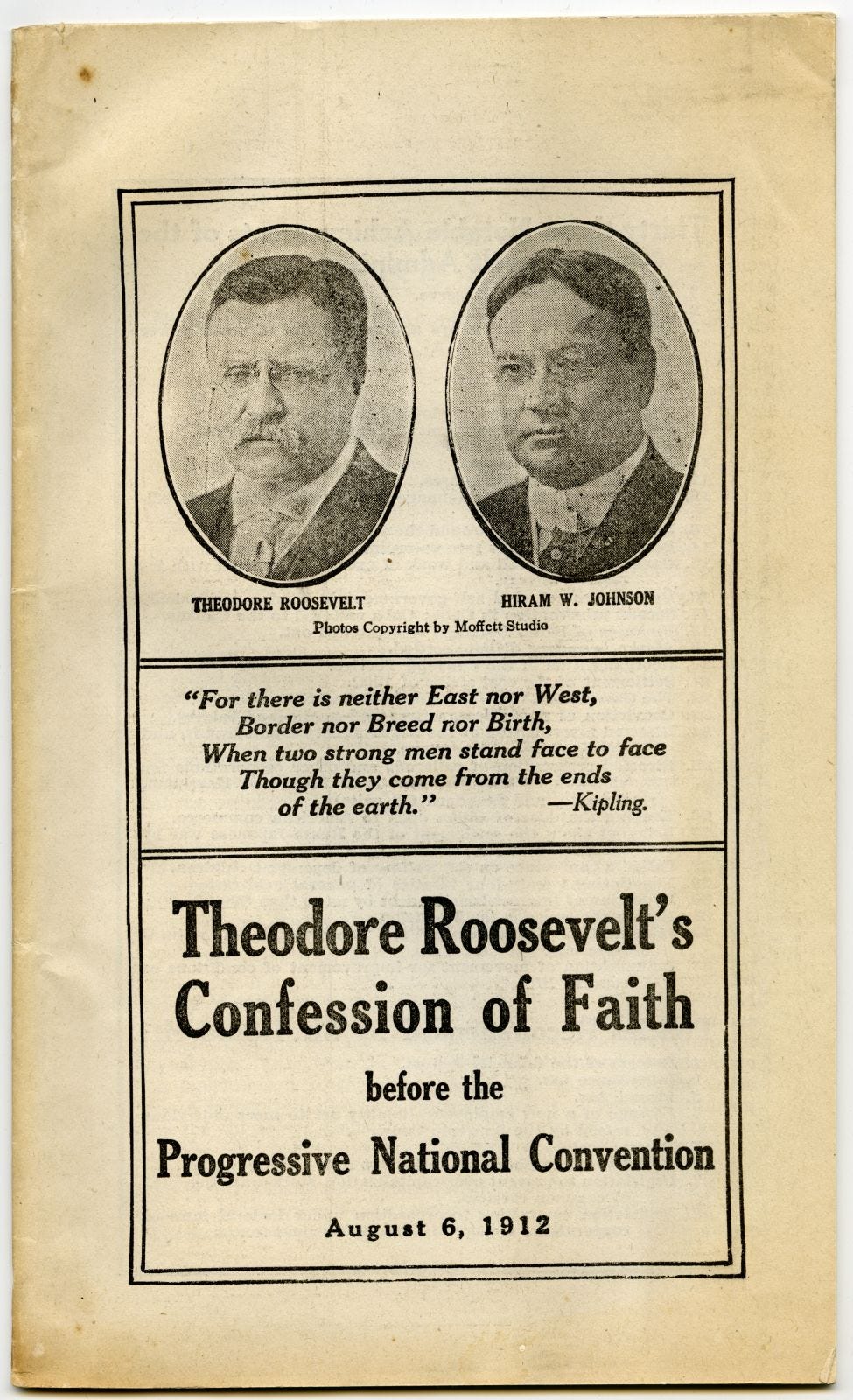
Taft’s nomination was what finally tore the Republicans in two. Roosevelt and his supporters walked out of the convention to form their own party, the Progressive Party, popularly known as the “Bull Moose” Party due to Roosevelt’s statement to a reporter that he was “fit as a bull moose.” In his August 6, 1912, speech accepting the party’s nomination for president, “My Confession of Faith,” Roosevelt angrily denounced the entire two-party system as outdated, corrupt, and inept. He argued that it no longer served the people, that politicians were not enacting the will of the people. Delivering a message of popular sovereignty, Roosevelt painted himself as the only man of the people, the one who could through his experience and vigor cut through the red tape of party machinery and break down judicial roadblocks, making the presidency, the Congress, the courts, and the Constitution serve the people once more. “We stand at Armageddon, and we battle for the Lord,” he concluded.
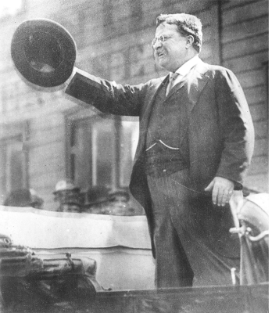
On October 14, 1912, Roosevelt arrived at a campaign stop in Milwaukee, Wisconsin. He attended a dinner as a guest of the Gilpatrick Hotel. At the conclusion of the event, he exited the hotel and climbed into an open-top automobile to be conveyed to the Milwaukee Auditorium to deliver his campaign speech. As he waved to the crowd, he was shot almost point-blank in the chest by a would-be assassin.

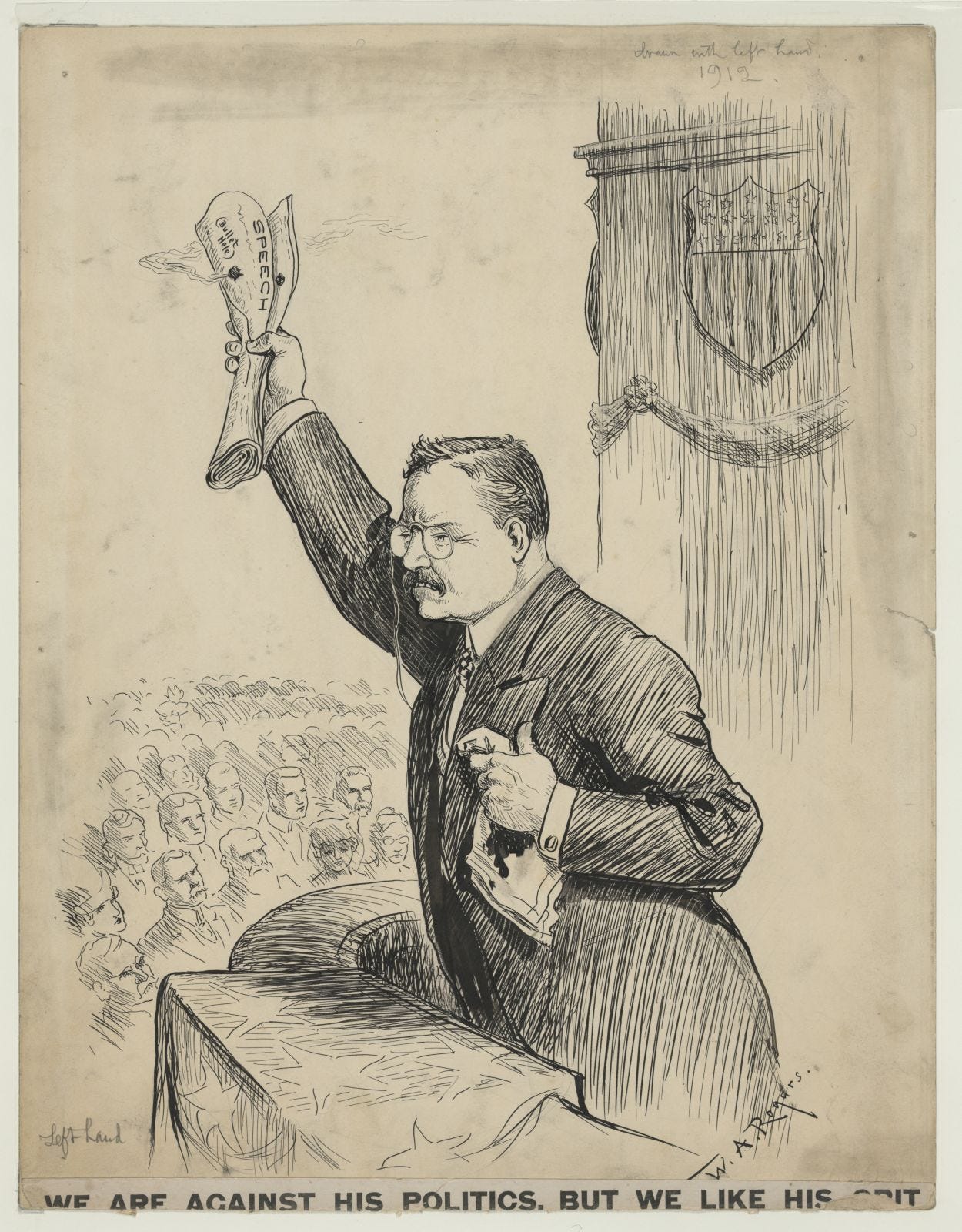
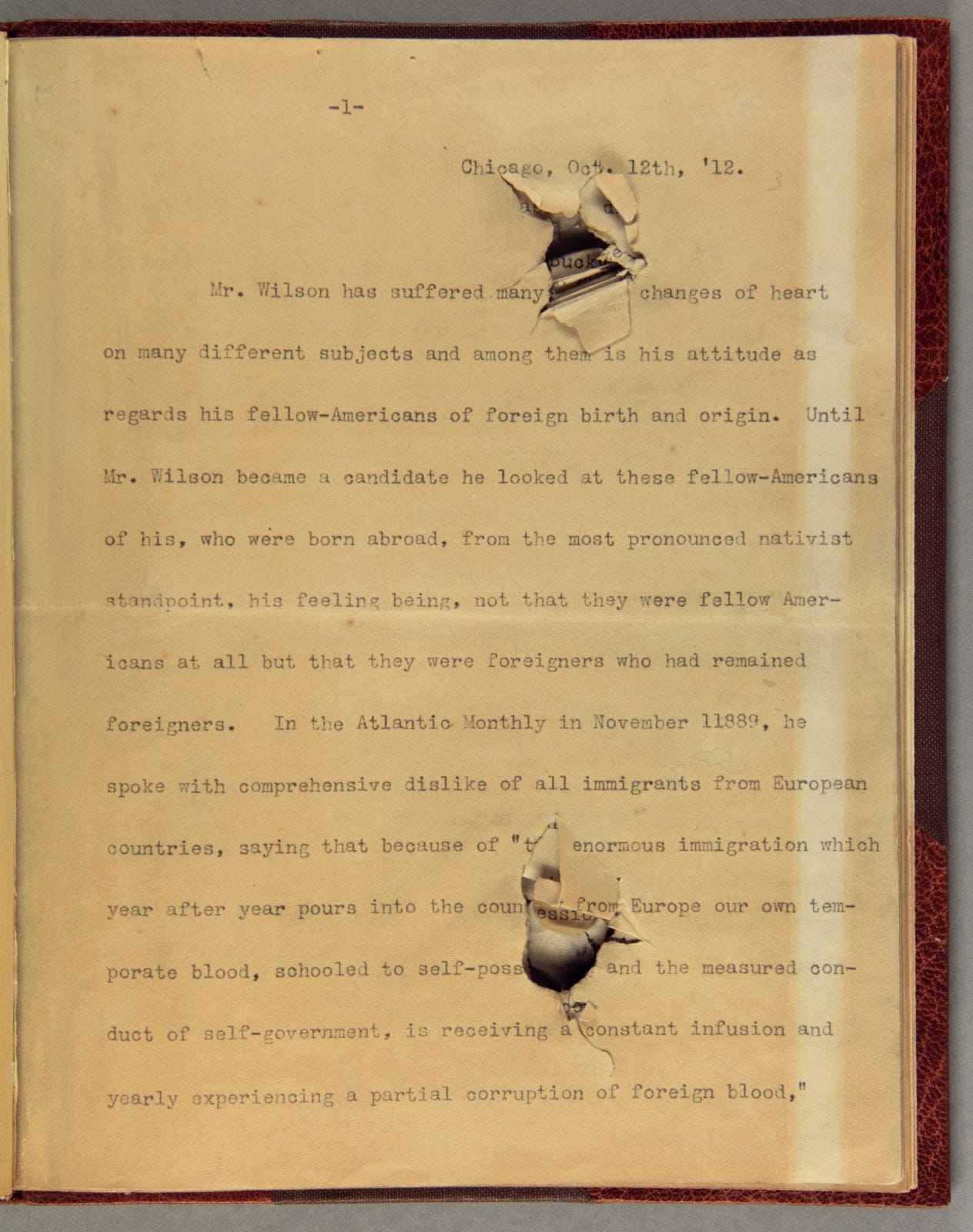
The bullet had to pass through several layers before stopping. Firstly, he had his fifty-page speech folded over in his breast pocket. More importantly, his steel case for his eyeglasses slowed the bullet immensely, before it finally lodged itself in Roosevelt’s chest muscles. Roosevelt immediately coughed into a handkerchief to find out if he was hemorrhaging blood. He was not and thus knew that the bullet had not penetrated his lungs. And, so, he did the thing one would expect Roosevelt – but absolutely no one else – to do; he insisted on giving his speech.
Upon arriving at the auditorium, Roosevelt did not deliver the speech he had intended (perhaps because there was a hole in it?) and instead spoke (mostly) extemporaneously. “Friends, I shall ask you to be as quiet as possible,” he began. “I don’t know whether you fully understand that I have just been shot; but it takes more than that to kill a Bull Moose.” He told the crowd he would not be able to speak very long. By the time he had finished, he had spoken for nearly ninety minutes, blood seeping from his chest all the while (although that had been obscured from the audience by his clothing).
The speech Roosevelt had intended to give, the one that slowed the bullet, was primarily a polemic against his Democratic opponent, Woodrow Wilson. It explained their differing opinions on immigrants and immigration, and what Roosevelt perceived as Wilson’s flip-flopping on that issue. Although Roosevelt did still make attacks against Wilson in the extemporaneous speech he gave, he shifted his focus to several other issues. For example, he attacked the press, which he blamed for fanning the flames of hate against politicians:
Friends, I will disown and repudiate any man of my party who attacks with such foul slander and abuse any opponent of any other party; and now I wish to say seriously to all the daily newspapers, to the Republicans, the Democrat, and Socialist parties, that they cannot, month in month out and year in and year out, make the kind of untruthful, of bitter assault that they have made and not expect that brutal, violent natures, or brutal and violent characters, especially when the brutality is accompanied by a not very strong mind; they cannot expect that such natures will be unaffected by it.
He also spoke of issues related to trust busting, labor laws, and other issues on the Progressive Party platform.
When Roosevelt finally agreed to be treated, doctors in Milwaukee and then Chicago chose not to remove the bullet from his chest, perhaps fearing that he might suffer a similarly agonizing death as President James Garfield had in 1881. It turned out to be the correct choice. A few months after the shooting, he told his friend Charles G. Washburn that he did not mind the bullet any more than if it were in his waistcoat pocket.
What kind of man would commit this terrible, unconscionable act? As a young child, Johann (later anglicized to John) Schrank immigrated to the United States, where he was raised by his aunt and uncle in their tavern on the Lower East Side of Manhattan. He took a keen interest in learning about the history of American politics, especially the Founding Fathers. Schrank eventually took over the tavern but then suffered a series of personal tragedies – the death of his young girlfriend in 1904, the failure of the tavern in 1906, the death of his aunt in 1907, and his uncle in 1911. Already a reserved and withdrawn man with few friends, with a family history of mental illness, Schrank suffered a serious breakdown.
Schrank followed the 1912 presidential election closely, and when Roosevelt announced his candidacy, Schrank began experiencing hallucinations. He believed that Roosevelt must be stopped, and that he must be the one to do it. He borrowed a sum of money, bought a gun, and traveled to Roosevelt’s campaign stop in New Orleans, Louisiana. Unable to kill him there, he followed Roosevelt, stop by stop, all the way to Milwaukee, where he finally got his chance. After firing, Roosevelt’s stenographer Elbert E. Martin tackled Schrank and disarmed him. Roosevelt insisted that the crowd not harm Schrank, and that he be taken into custody.
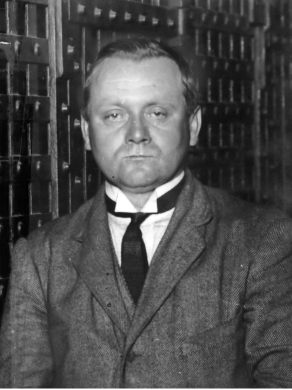

When he was first arrested, Schrank immediately claimed his motive was an opposition to a president serving a third term. Upon further interviews and investigation of his personal writings dating back years, Schrank’s reasoning became less reasonable. The ghost of William McKinley had visited him in a dream, Schrank said, and commanded him to avenge his death. Testimony from those he had interacted with in the months before the assassination painted him as awkward, even unstable. Ultimately, Schrank would be diagnosed with schizophrenia and committed to a mental hospital in 1914, where he lived the remainder of his life, dying of pneumonia in 1943 at age 67.
Despite his popularity, and the solidification of support for him following the assassination attempt, Roosevelt’s 1912 campaign was ultimately unsuccessful – the result was a split in the Republican vote that led to the election of Democratic candidate Woodrow Wilson. Roosevelt died in his sleep in 1919 at the age of 60 at his home on Long Island, Sagamore Hill. There is no evidence that the embedded bullet contributed to his death – he’d suffered much worse in the ensuing years.
The undershirt that Roosevelt was wearing that day is currently on display in the Visitor Center at the South Unit of Theodore Roosevelt National Park in Medora, North Dakota. The overshirt, the speech, and the eyeglasses case are held in the collections of the Theodore Roosevelt Birthplace National Historic Site in Manhattan, New York City, New York.
Excellent post!