
Billy Possum
A Failed Follow-Up

(We had a lot of content on our original website blog at theodorerooseveltcenter.org that you may not have seen. Dr. Hansard has adapted and updated the following material from one of his own posts from a few years ago.)
All of us are familiar with the Teddy bear, perhaps the most ubiquitous plush toy of the twentieth century. But have you ever heard of its failed successor, Billy Possum?
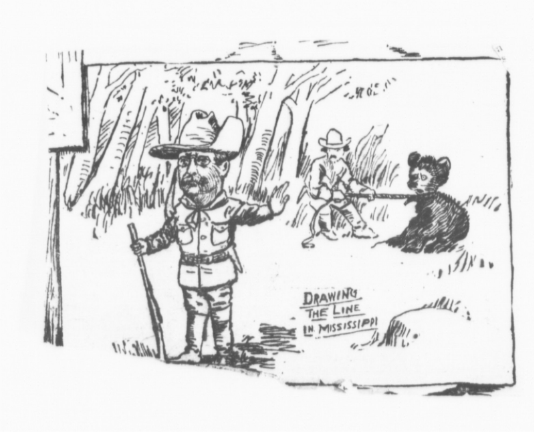
First, a brief recounting of the story of how the Teddy bear came to be, for those who may not be familiar. In November 1902, President Roosevelt was invited on a hunting trip in Mississippi by Governor Andrew H. Longino. Roosevelt and several other guests hunted from a blind, waiting for their attendants to rouse a beast for them to kill. Holt Collier, a renowned outdoorsman who was in charge of organizing the hunt, had difficulty getting a bear within range of the blind. Eventually Roosevelt and others broke for lunch, and the camp was still empty when Collier brought a bear to the designated spot. After a lengthy chase and struggle with the hounds, Collier finally subdued a bear and tied it to a tree for Roosevelt to shoot when he returned. Roosevelt did return not long after, but found the thought of killing the bear unsportsmanlike and refused to shoot it (although he did order that someone else put it out of its misery).
Political cartoonist Clifford Berryman depicted this event in a piece he titled “Drawing the line in Mississippi,” that was published in the Washington Post. Some saw the cartoon as an allegory for Roosevelt’s stance against lynchings in the South. But potential symbolism aside, many readers took the story at face value – and felt Berryman’s little bear cub was charming – and the cartoon deflected some of the negative press generated by Roosevelt’s embarrassing and controversial hunting trip. Morris and Rose Michtom, confectioners in Brooklyn, were inspired by this popular cartoon to create a plush toy they called “Teddy’s bear,” placing it in their shop window. Customers began to ask for their own bears, and the Michtoms soon began mass-producing them. The rest, as they say, is history!
Roosevelt remained a popular figure – and there can be no doubt that the Teddy bear phenomenon contributed to this – but he could not remain president forever. In 1904, Roosevelt made a promise not to seek a third term in 1908 – a promise he came to regret, but to which he adhered. He chose as his successor William Howard Taft, his Secretary of War, as well as former Governor of both Cuba and the Philippines. Taft was a close advisor to Roosevelt, was known as a skilled administrator, and the two shared similar political views. Because Roosevelt had handpicked him, Taft easily earned the Republican nomination at their convention in June 1908. Although his Democratic competitor, “the Boy Orator” William Jennings Bryan, campaigned aggressively against him, Taft defeated Bryan handily that November.
Following the election, president-elect Taft and his family traveled to the state of Georgia to vacation there for the holiday season. The Tafts enjoyed Christmas, especially the hustle and bustle of shopping for gifts and feasting on prize turkeys. While they spent their time primarily in Augusta, civic boosters in Atlanta arranged for Taft to visit their city before he returned to Washington, D.C., to take office. And so, in early January 1909, Taft and the Atlanta Chamber of Commerce began to work together on the details of his visit, scheduled for the 15th.
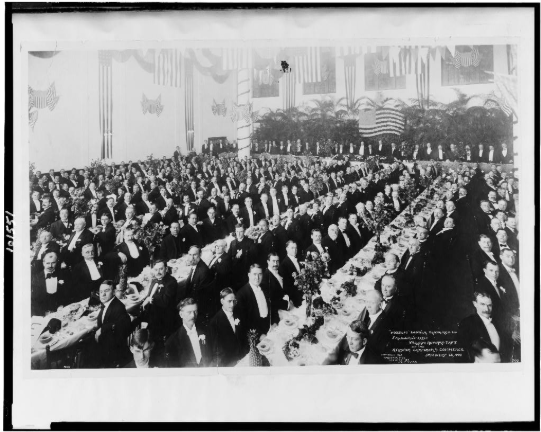
Perhaps the most important detail to be decided on was the menu. It was not a prize turkey that Taft would feast on in Atlanta that holiday season, but an eighteen-pound roast possum served with sweet potatoes and persimmon beer! The banquet’s six hundred other visitors were also served possum, as well as wild turkey, quail, and sliced watermelon. Although it was a common dish in the Southern states, especially among Black Southerners, it is not exactly clear where the idea for this possum dinner first originated – with Taft, or with the high society of Atlanta. Some newspapers claimed that it was Taft himself who suggested that “’possum-n-’taters,” as the dish was commonly known, be served at the banquet honoring his visit. But an account from Playthings magazine, a trade paper dedicated to toys and games, claims that the idea came from the hosts of the dinner. In fact, it makes the claim that the first to suggest the idea for the entrée, perhaps jokingly, was Asa G. Candler (The Teddy Bear Men, Linda Mullins, 101). Candler was at that time the president of the Chamber of Commerce in Atlanta – he was also the founder of the Coca-Cola company!
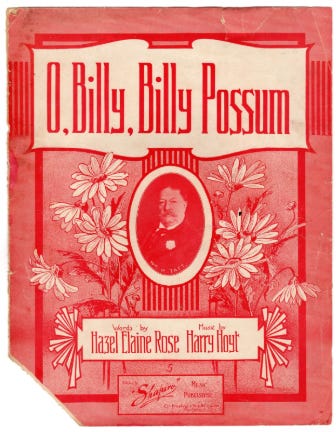
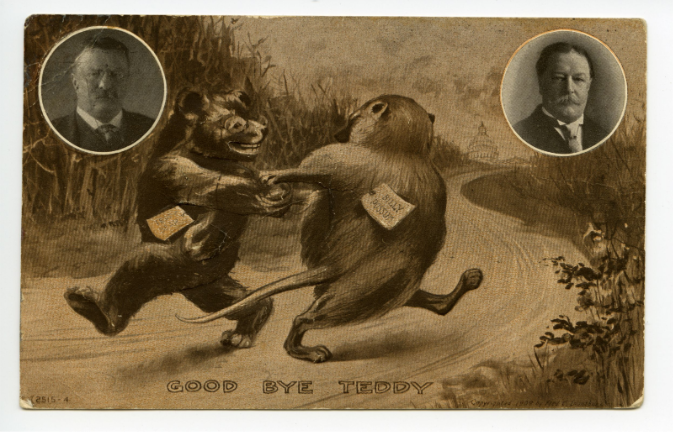
Regardless of whose idea the dinner was, the evening was an occasion of political theater, and entrepreneurs saw in that occasion a golden opportunity. In advance of the event, cartoonist Lewis C. Gregg had conceived of the idea of “Billy ‘Possum,” a character who would be designed to replace Theodore Roosevelt’s “Teddy Bear.” When the feasting was finished, Candler presented Taft with a plush toy possum, and Taft was decidedly amused. Soon after, and with Taft’s blessing, companies began mass-producing all manner of Billy Possum merchandise. Not only were there plush dolls, but there were postcards, sheet music, brass buttons and figurines, flatware, china pitchers, puzzle games, and more! Billy Possum, the boosters and businessmen all said, would soon be sweeping the nation.
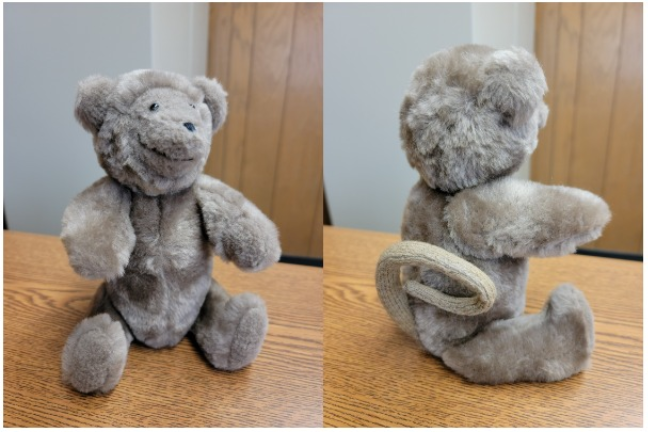
Clearly producers hoped they would be able to manufacture a craze on the same scale as the Teddy bear. Many companies probably feared that Teddy bears would stop selling once Roosevelt had left office. They made it clear that with the transition from Roosevelt to Taft, children should also transition from Teddy bears to Billy Possum. Take these song lyrics, for example:
Some time ago I had, you know, a little Teddy bear;
And with him I would always play, for no one else I’d care.
But in November nineteen eight, it seems a funny thing,
I said “Good-bye” to Teddy, now to someone else I sing.
Oh! Billy, Billy Possum, now you’re all the rage;
You look nicer in my arms than in a wire cage.
Teddy Bear has had his day, but you my dear, are new;
Oh! Billy, Billy Possum, it is me for you.
But the fact that this ‘craze’ was manufactured was a problem. The story of the Teddy bear had happened and been spread more or less organically. There is also the fact that the Teddy bear story depicted a compassionate and thoughtful Roosevelt, whereas depictions of Billy Possum were often hostile or rude toward the Teddy bear (and by extension, Roosevelt himself), sometimes to the point of poor taste. Whatever the reasons, by the Christmas season of 1909, Billy Possum’s time in the spotlight had already come and gone.
In the present day, however, Billy Possum merchandise is rare and highly sought after, appreciated in its own right as an important part of political and cultural history. In this change, we might see a parallel in Taft himself, who was at the time overshadowed by the more popular and more outspoken Roosevelt, but whose policies and accomplishments during his one presidential term are now appreciated by historians who can evaluate their significance in hindsight.
Interesting history, thanks.
You would have thought they could have chosen something more cute and cuddly for Taft!