
Directors' Update
The Ins and Outs of Cataloging

Hello everyone, and happy summer (Hopefully I can say that now that it’s June, right? Dickinson has been getting massive rain and temperatures in the 40s within the last couple weeks, so it hasn’t felt like summer for too long)!
This Substack entry will be a little different—instead of getting some reflections on TR and the past from Dr. Hansard, you’ll be getting a little look behind the scenes at what’s going on at the TR Center in the present from the Co-Directors!
Let’s start with two updates on the digital library.
We have a fantastic new addition: The Moore Chronology, which is part of the TRA Collection. Executive Director John Gable commissioned Dr. Robert Moore to compile a day-to-day chronology of TR’s life. You are going to love exploring this, and we’ll make more of it in future Substack blogs. Thanks so much to the Theodore Roosevelt Association for making this resource available!
As of the end of May 2025, nearly 113,000 items have received some level of cataloging in the TRC database. Of those, about 100,000 have been reviewed for accuracy and completeness. At present, the TRC Digital Library has around 107,500 items available right now in its online collections.
If you’ve been keeping an eye on the TRC for a while, none of that will sound too out of the ordinary, but if you’re a newer follower (welcome, by the way!) you might be wondering what some of that means.
“Cataloging” is the process of adding metadata to items. This has traditionally been everything from Title, Creator, and Recipient as well as detailed Descriptions and Subject Headings—adding all the sorts of information that describes an item and helps people be able to find it and know whether it might have information that they’re interested in.
Earlier this year we introduced a sort of “mini-cataloging” that we’ve been having students and volunteers help us with. This “mini-cataloging” specifically targets a smaller set of fields that require a bit less training and expertise to create by adding Titles, identifying Dates, and sorting items into time Periods. While these “mini-cataloged” items are still waiting for full Descriptions, Annotations, and Subject Headings, the fields that our volunteers and student workers fill out allows these items to be made available and searchable much faster than they otherwise would be. (Before I jump ahead to the next step, I should say that the ‘proper’ names we give these classifications in our backend system are “Metadata Entry” and “Preliminary Metadata Entry”—it’s a little more official!)
We also made the decision to publish any item that has received some level of cataloging. You may have noticed that some items in the digital library have this orange “Cataloging in Progress” label
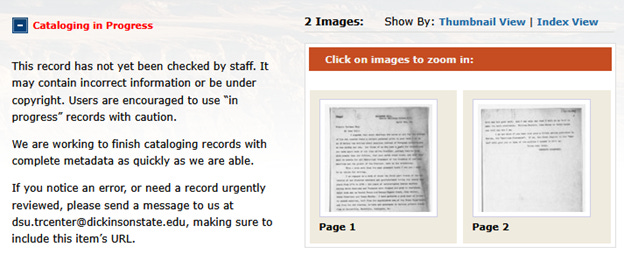
As the explanation says, records in this state have not gone through a full review process and may be lacking information in some fields. While we intend to make sure that these items receive the full cataloging as soon as we are able, we decided to prioritize making them available to people so that researchers and enthusiasts can more easily access them!
The final step of our process is for a staff member to review items for accuracy and completeness. While we do our best to make sure mistakes don’t sneak their way in while we’re cataloging, we’re working with a lot of letters and documents, subject headings can get left off, words can be misread, and typos invariably make their way in (even George B. Cortelyou, when serving as TR’s private secretary, wrote “Roosevlet” once or twice!).
Having a different pair of eyes review items also helps us smooth out some of the personal cataloging quirks that sneak in (some of us tend towards being wordier, others may be a bit sparing in writing Descriptions, and everyone uses Subject Headings a little differently).
Once an item has been reviewed, we tend to consider it fully complete—we’ll still go back and edit items on an ad hoc basis (especially ones that were cataloged towards the beginning of the TRC’s existence—our standards for how things should be described have changed over the years), but they’re assumed to be finalized.
Whew! That took a bit longer to explain than expected, but hopefully that gives a bit of an explanation into how we actually work with items here at the TRC and make them available in our digital library! With that out of the way, we can finally turn to looking at some of the other goings-on at the Center.
The TR Center sponsored a major conference at the Roosevelt Institute of American Studies (RIAS) in Middelburg, the Netherlands. Called “A Water's History of the United States,” it explored the way that rivers, streams, oceans, irrigation, canals, and other kinds of water have shaped the history of the United States. The partnership with RIAS is an important one. The Institute is home to a sizable archive, is a European hub for scholarship on the Americas, and is in the province of Zeeland, where the Roosevelts originally hailed from.
Watch out for upcoming events with other partners and friends:
May 31 – June 1: Rough Rider Reunion at Oyster Bay. Our own Dr. Hansard will be there to tell visitors more about the TR Center. He will also visit the Theodore Roosevelt Birthplace National Historic Site and the American Museum of Natural History in New York City. Watch our social media for pictures and video from Dr. Hansard’s adventure!
June 17-18: Association for Documentary Editing 2025 Annual Meeting. Co-Director Erik Johnson will be giving a lightning talk on the digital library.
June promises to be a busy month—we've got interns starting soon, we’re working on some new signs for our lobby area, and plenty of projects we’re excited to share more about soon!