
Directors' Update
Looking Back, Moving Forward

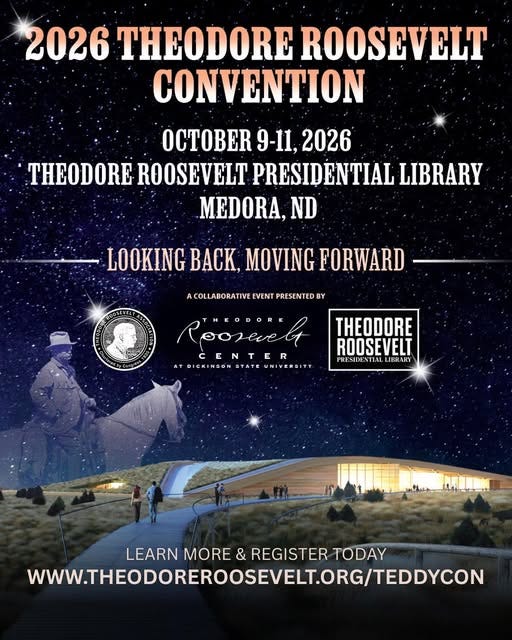
The Theodore Roosevelt Center is delighted to be coordinating the first ever TeddyCon with the Theodore Roosevelt Association at the Theodore Roosevelt Presidential Library. The whole TR universe will be in Medora for a brilliant event from 9 – 11 October 2026.
TeddyCon is a weekend event that is taking the place of the TR Center’s annual symposium and the TRA’s annual meeting. Or rather it is a convergence where we join forces to put on a remarkable gathering. There will be an exhibition hall, panels, keynote speakers, entertainment, and field trips around the Medora area.
We have announced the first speakers. It’s an all-female panel of biographers who will discuss how they craft portraits of historical figures including Theodore Roosevelt. It includes:
Dr. Kathleen Dalton, author of Theodore Roosevelt: A Strenuous Life
Candice Millard, author of River of Doubt: Theodore Roosevelt’s Darkest Journey
Patricia O’Toole, author of When Trumpets Call: Theodore Roosevelt after the White House
Dr. Lindsay Chervinsky, author of Making the Presidency: John Adams and the Precedents that Forged the Republic
The panel will be moderated by Dr. Stacy Cordery, the author of Alice.
This year’s theme is Looking Back, Moving Forward in celebration of TR’s enduring spirit and vision for America’s future. There is no better place to see that enduring spirit than from the new presidential library. Those coming will have the opportunity to view the brand new interactive exhibits and galleries.
But … space is limited and registrations are filling up fast. To book your spot, visit the registration page and book your hotels. We expect that the event will sell out soon.
We will announce new panels, keynote speakers, and entertainment regularly, and the excitement is through the roof after revealing our incredible Biographers Panel.
Sponsorships and exhibitor opportunities are available! This is a terrific chance to showcase your organization to TR enthusiasts, scholars, and public-history supporters.
Be a part of the first-ever #TeddyCon - while celebrating the opening of a landmark institution dedicated to one of America’s greatest leaders.
In internal Theodore Roosevelt Center news, it also seems somewhat appropriate to steal the theme “Looking Back, Moving Forward!” For the past several years, since the end of 2021, the TRC has been largely funded by a generous grant from the Lowman Walton Foundation, both contributing to the TRC directly, and endowing some of its efforts for the future. To ensure the funding was being used well, the grant set out a number of goals we’ve had to strive to meet and, with the achievement of a major milestone in this regard, it seemed like it would be interesting to see what all we’ve been able to accomplish over the past five years!
One of the most obvious goals that we’ve achieved, for those of you who have been able to come visit the campus of Dickinson State University in North Dakota, where we’re located, was our relocation from the basement of Stoxen Library to our new—and current—home in Lowman Walton Hall. In addition to expanding our office spaces, allowing for more staff and student workers, we were able to get an attractive exhibit gallery (which we’ve designed and displayed several successful exhibits for), a research library for Roosevelt-written and -related books, a showcase reading room evoking Roosevelt’s library at Sagamore Hill, and a greatly improved archival storage space for our physical collections. From a set of small offices in the library and some compact storage shelving, we now occupy about one-and-a-half floors of this renovated building, and are able to use it to host campus events and classes, and to work with some of our partners like the Theodore Roosevelt Presidential Library to help store some of their materials in advance of the library opening later this year.
An additional change, which many of you have likely noticed, is the updated website we’ve finally been able to implement this past year! The incredible work of our team (leaning heavily on Dr. William Hansard) has allowed us to transfer most all of our content from the previous iteration of our website to our new platform, which—importantly—is more mobile friendly than the previous iteration, and also has several new features. The grant asked that we “launch an updated, world-class TR Center website and TRC Digital Library that are designed to be more accessible and user-friendly,” and we hope you agree that the website has met the prompt. While there are still projects we’ve got in mind we’d like to implement (and hope to follow up on in relatively near future), we’re hugely happy with the work of the Big Sea team, and hope you all are enjoying the update.
Alongside the website change has been some shuffling of social media content. Most obvious to those of you reading this is, of course, the Substack itself. One of the goals of the grant was expanding the outreach of the Theodore Roosevelt Center through expanded “substantial social media posts,” “interpretive content,” and overall increasing engagement with the public and our supporters. Dr. Hansard, who we were able to hire shortly after the execution of the grant, has been instrumental in this effort, greatly expanding our audience and helping bring regular interesting content to all our followers, massively expanding our reach on social media and bringing TR to all our friends several times a week. We’ve also been able to rely on some of our contract workers, friends of the TRC, student workers and interns to contribute content, and we’re looking forward to continuing to bring you historical moments, quotes, and insights into TR!
With all that in mind, perhaps the biggest goal (and the one prompting me to reflect on all these targets) has been for an increased number of items published in the digital library. The end of February 2022 (I’ll largely be looking at Februaries when possible, just to make the comparison to this February easier) saw the digital library contain 71,471 items published in its online collections. Year over year, the target the grant set out was to publish 15,000 items annually—an ambitious goal at the time, given the staffing levels and workflow processes that we had in place (remember, at the beginning of 2022 the TRC had been publishing items for approximately a decade – the number I have from the end of February 2012 was 10,308 items published in the digital library. So, roughly 60,000 items over 10 years, or 6,000/year). While we were publishing good data, the grant wanted us to publish fast and good data. We not only had to increase the pace of cataloging—we had to increase the pace of cataloging while also pursuing all the goals I mentioned above: moving our offices and archive space, designing exhibits, planning symposia, revamping the website, increasing interpretive content, and more.
Talking with a workflow consultant (another point of the grant) told us essentially that, for the standard we were setting, we were doing what we could; the problem was just not enough people and hours to work through the material.
While we were able to meet the first publishing goal for 2022, the subsequent years saw us slip behind bit by bit—even with the help of our summer interns and bringing on more student workers to help us in earlier stages of the process, we weren’t able to catch up with where we needed to be.
We needed to make a decision.
Those of you who are loyal readers of the Substack will know where I’m going with this (I’ve mentioned it a couple times before), but for those of you who may have missed it, starting at the end of 2024/beginning of 2025 we made the decision to implement what we called “Preliminary Metadata Entry.” (Just for reference here, February 2025 had 101,929 items published in the website, putting us about 10,000 items behind our goal at that point). While somewhat less than the full “Metadata Entry” we had been doing, which included Descriptions, Subject Headings, and more, “Preliminary Metadata Entry” was our solution to publishing items more quickly with the most important bits of information – Title, Creator, Recipient, Date – AND allowed us to bring in some outside help. By adopting this standard of publishing items at an earlier stage in the process, we’ve been able to work with a wonderful and dedicated group of about three dozen volunteers (with more coming every month) to process items more quickly.
Between their efforts and the tireless efforts of our staff—namely Ally Hecht and Gemma Koontz—I am now pleased to report that as of the end of February 2026, the Theodore Roosevelt Center Digital Library now has approximately 135,000 items published in its online collections, easily meeting the benchmark for 2026 (we’re technically a few hundred shy at present, but will be officially hitting it in the next week or so)! Publishing over 32,000 items in the past year is a huge achievement, and puts us beyond the goal set out by the grant with room to spare.
SO...
That was looking back—the grant set out goals, we’ve done our best to meet them, and we’ve done a decently good job of if it! What’s next?
Even with our cataloging goal met, we will of course keep on publishing items! The 135,000 items is maybe half of what we have in our collections, and we’ve got even more institutions we want to partner with to incorporate more materials, so even with all our progress, there’s plenty of work to come.
We love working with our volunteers, interns, and student workers, and there’s always more for them to do. We might branch out from having volunteers do strictly preliminary metadata entry to exploring options for transcribing items, working with some of TR’s speeches and more, but we’re in the early stages of those ideas at present. Transcriptions are absolutely something we want to bring to the website, and we’re just examining how best to do it.
Our staff will also continue working on doing some preliminary metadata entry, but are looking forward to getting to go back and enhance some of those records that are already published, better describing items and applying subject headings to make them more easily usable, restoring some chains of correspondence and identifying people who are mentioned in letters for people trying to track down specific topics and ideas.
We’re also going to take the time, briefly, to get a handle on our physical archives. While we were able to move our holdings from the compact library storage where they had been held to a better temperature- and humidity-controlled room in our current offices, the pace at which we’ve been having to work has prevented us from really being able to arrange and process our holdings. While things are stable, we in some cases only have a general idea of what we have, and we’re looking forward to getting a more complete inventory and adding some of these physical holdings into the Digital Library when we’re able.
Returning to the note this Substack started on, our annual symposia will continue, but may shift a bit to better allow us to partner with some of our Theodore Roosevelt colleagues like the Theodore Roosevelt Association and the Theodore Roosevelt Presidential Library. We want to keep bringing people to Western North Dakota and the Badlands when we’re able, but we may be exploring other options for reaching more people through virtual talks and joint programming going forward. We’ve discussed several options with our Advisory Board, and are extremely grateful for the ideas and feedback they’ve been able to give us as we work out the best way to proceed.
We’ll also continue with other aspects of our operations – last year was our largest applicant pool for our summer internship program, and we’re looking forward to running another successful season this summer. In a past Substack I’ve mentioned we’ve been tweaking some of the things we want interns to do, so we’re hopeful that we’re able to continue to provide a useful and relevant experience to these early-career Library and History professionals.
On the social media side we’ve been able to bring on a part-time contract worker in friend of TRC Rachel Lane to assist with Substack and more, so you’ll continue to see her collaborations with Dr. Hansard in our interpretive content (though in an exciting career move for him, he’ll be joining the official Faculty of Dickinson State University’s History Department this fall, moving most of his responsibilities outside the TRC). We’ve loved the response we’ve gotten from our Substack pieces over the last year, and have our biggest audience ever that we’re looking forward to continuing to connect with.
Overall, looking back the Theodore Roosevelt Center has done a lot of great things over the past several years to achieve many of the goals set out by the grant that funds us, and we’re excited to take that momentum to keep moving forward! We can’t wait to keep publishing the world-class content we’ve been able to over the past several years, and making the life and world of one of our most remarkable presidents available and accessible to researchers, students, enthusiasts, and everyone else around the world!
It is certainly an exciting time for the TR Center. So many accomplishments to be proud of. I so much enjoy receiving and reading sububstack and the articles. I look forward to visiting your new location and all the updates as a result.Keep up the great work.
Best wishes Cindi Penor
Dear Madams and Sirs; you did a wonderful job in informing us what has been done in improving the literary capabilities of the Theodore Roosevelt research! Thank you. You have been precise, and I assume accurate.
Charles W. Kilgore, II / Monday, 02 March 2026 EST.