
Feeding Animals
A Compromise on the Voters' Choice Topic

Today, we’re excited to bring you another topic voted on by paid subscribers to The Bully Pulpit – well, sort of. The two topic choices we offered this month were TR’s favorite foods or TR’s pets and horses. We had a dead split between the two. So, we decided to do the only logical thing – to write about TR feeding animals! Let’s dig in!
At first, we expected finding historical documents to support this piece would be rare, and indeed, it isn’t as if the evidence is everywhere. But, when you know where and how to look, there are no aspects of Roosevelt’s life that you can’t find something about! On the one hand, it is somewhat difficult to find specific information on what Roosevelt preferred to feed to many of his normal pets, like dogs and cats. But some of the more unusual ones have left some interesting traces in the historical record!
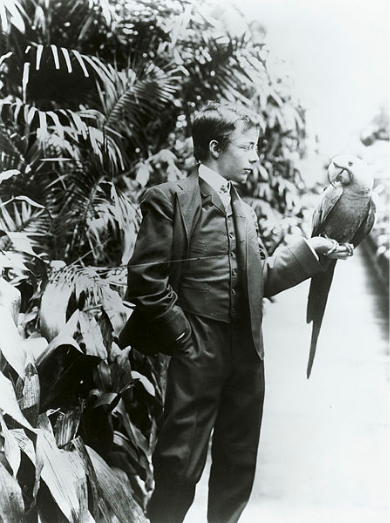
The Roosevelts kept at least two parrots during TR’s lifetime, one of which was a blue macaw called Eli Yale. The bird was friendly and beloved, although sometimes a handful. For example, TR mentions in a 1902 letter to his son Kermit that when carpenters were working on a greenhouse at Sagamore Hill, the Roosevelt family estate on Long Island, the bird went on a terrible rampage! Displeased at his favorite plants being removed, he screamed and screeched and flew about until he was moved to another greenhouse. What did Eli Yale eat that gave him so much energy? According to a 1901 letter by TR to Sarah Schuyler Butler, daughter of Dr. Nicholas Murray Butler, President of Columbia University: bread, potatoes, and coffee beans!
In 1904, President Roosevelt was gifted one of his more exotic pets, a hyena named Bill, by Menelik II, Emperor of Ethiopia. (Menelik also sent a pair of lion cubs, one of which died on the journey, and a fine pair of elephant tusks.) According to an article in The Young Idea, an educational periodical, the hyena was fed ten pounds of meat scraps from the crew’s rations daily during his journey on the steamship Lowther Castle. Given the reputation of hyenas as scavengers, this makes sense. When Bill arrived in the United States, multiple newspapers reported that he was quite a vicious beast, snarling in his cage and kept on a heavy chain when removed from it. Some modern sources claim that Roosevelt actually briefly allowed the hyena in the White House and fed it scraps there as well. Imagine a wild hyena not only being allowed in the White House but doing tricks in exchange for table scraps from the President’s own table! Although a fun story, the evidence to support it is slim. A 1906 article in the New York Times Herald claims the hyena and lion cub were at the White House for a few days, but does not say they were fed scraps or dined at the table. Newspaper reports from 1904 make no mention of them being at the White House at all. Either way, Bill found his way to the National Zoo after arriving in the United States, where he was reported to be quite happy.
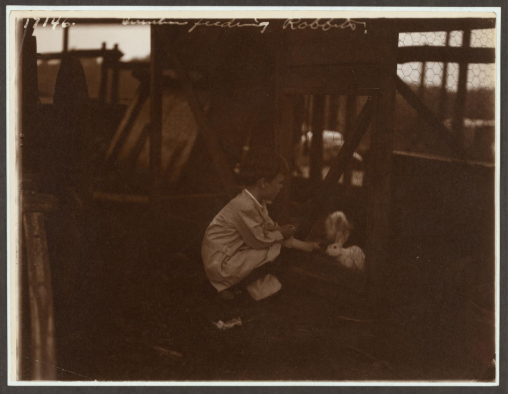
Smaller animals brought amusement to the White House as well. For some time, the family kept kangaroo rats, one of which Kermit liked to carry around in his pocket. Friends such as Jacob Riis fondly remembered that Kermit would even bring a rat to mealtimes! He would let it out of his pocket to run across the table, where President Roosevelt would give it a lump of sugar to nibble on.
Sagamore Hill, and the second home on the estate, Old Orchard, was host to a menagerie of beloved pets. Theodore Roosevelt’s son Ted, who lived at Old Orchard, even dedicated an entire chapter of his 1929 memoir All in the Family to them! Unfortunately, he speaks precious little of what those animals ate – although we know they ate well as several times he refers to animals as being fattened, especially horses. A brief reference tells us that pigs on the grounds ate “elderly apples.” Chickens, naturally, were allowed to forage in the front yard. Much more, however, we get the stories of animals eating things they should not. Jack the terrier devoured shoes and leather-bound books. Later terriers killed chickens. Rabbits would get into garbage. And more than one animal most preferred to chew on people, including the badger Josiah and the parrot Eli Yale.
We are quite lucky to have film of Theodore Roosevelt feeding an animal at Sagamore Hill. In this footage taken on the estate in 1912, Roosevelt joyfully feeds sugar cubes to one of the family’s horses.
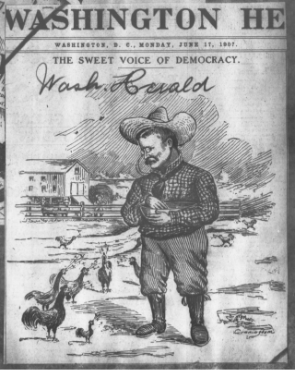
Bird-lover that he was, Roosevelt took great pleasure in feeding birds at Sagamore Hill as well. (Ted actually noted that the Roosevelts preferred to enjoy birds in their natural habitat rather than caged, with few exceptions.) One friend who visited remembered that he put out suet for wild birds in the winter. It was so important to him, in fact, that he went out in temperatures nearing zero to tie pieces of suet up in the trees and bushes. Throughout the rest of his day, Roosevelt would periodically peek out the window to watch the birds, who were for whatever reason not interested in Roosevelt’s kind offerings. “Those little birds are all around, but I don’t think they are eating that suet I put out for them,” he sulked. “Ungrateful things!”
To conclude, I’d like to break the fourth wall for a moment here to tell you, dear readers, how much fun this piece was to write! It was really interesting to gather this hodgepodge of trivia and anecdotes that give us a unique window into the life of Theodore Roosevelt! I really did not expect to find anything, and to me, using these scraps to weave new fabric is a great joy as a historian. So thank you all for giving myself and the rest of the TR Center staff the opportunity to do what we do!
This is very interesting! I don't know if you have done this yet (new reader here), but it would be an interesting topic to learn your process for researching for these sorts of posts!