
Friday Fun
President Roosevelt Bares All

by Ally Hecht
What do John Quincy Adams, Andrew Jackson, and Theodore Roosevelt have in common? “Naked” and “president” aren’t usually words one would like to hear in the same sentence, but, other than being presidents of the United States, each of these men were known to go swimming naked in the Potomac River in Washington D.C.
Naked swimming was not just a pastime of eccentric presidents, but was instead a common way for boys and men to swim (in single-sex settings) through the mid-to-late 20th century. Famous for his dedication to living a “strenuous life,” swimming was a common pastime for young Theodore Roosevelt according to his childhood diaries, and as an adult, Roosevelt even found himself occasionally skinny dipping with members of his Tennis Cabinet and friends in the Potomac River. If planned point-to-point trips with this group of men would end with skinny dipping in the river, they would return to D.C. in the dark, “...so that our appearance might scandalize no one.”1 The effort to remain hidden as he swam naked is understandable due to his political and social position at the time, but it may also have been in an effort to avoid situations like the one he found himself in in 1876, recounted by Corinne Roosevelt Robinson.
In her book, My Brother, Theodore Roosevelt, Corinne writes of an incident in which her brother traveled across Oyster Bay to call upon a young woman, arrived too early, and fell asleep under a dock as he waited for a more appropriate time to call upon her, only to wake up and realize his boat had floated away. Roosevelt undressed and swam naked to retrieve the boat, only to fall asleep–still naked– under the dock once more. To his horror, he awoke to find the girl and her friend on the dock above him, and his boat and clothing missing! Once they left the dock, he snuck away to a more remote area where he found his boat (and hopefully his clothes, although this isn’t confirmed by Corinne), and rowed home immediately without visiting the girl. Of this scenario, Corinne states, “The sequel to this little story throws much light on masculine human nature, for he conceived an aversion to the lady who so unconsciously had put him in this foolish position…”2
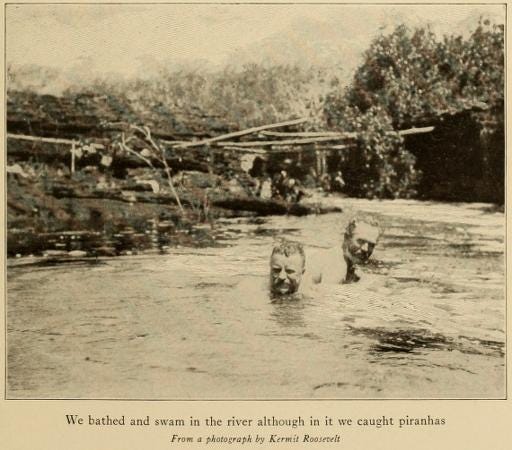
One of the more famous stories of Roosevelt swimming naked in the Potomac River was with French Ambassador, Jules Jusserand, and other members of his cabinet. When the others in the group noticed Jusserand had kept his gloves on, and only his gloves, for the dip in the river, Jusserand defended himself by shouting, “I think I will leave them on; we might meet ladies!”3 In Jusserand’s own autobiography, What Me Befell: The Reminiscences of J. J. Jusserand, he states he had forgotten he had them on, covering his scratched and bleeding hands from their gallivants that day. Jusserand said of the outing, “A passer-by with a camera might have taken a picture worth having: the chief of the state and his friends alined, stark-naked, along the bank.”4
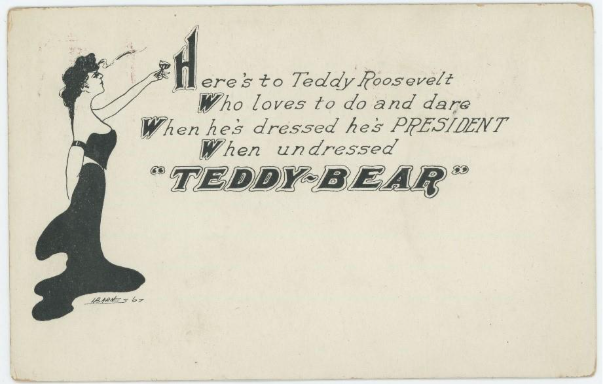
Unfortunately–or fortunately–for us, there is no confirmed photograph of that day, or any others of Roosevelt and his cabinet taking a naked dip. But, there are several postcards I have found in the TRC’s Digital Library from the Fritz R. Gordner Collection that depict or allude to Theodore Roosevelt “baring all.”
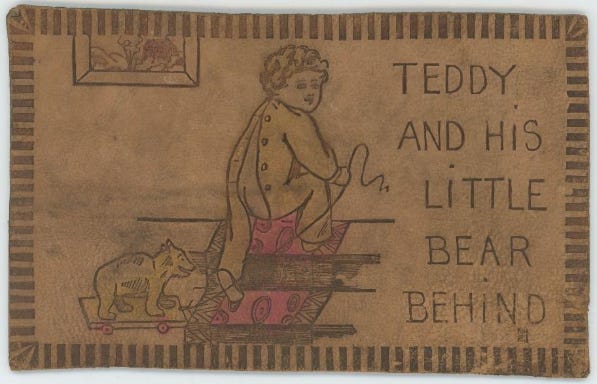
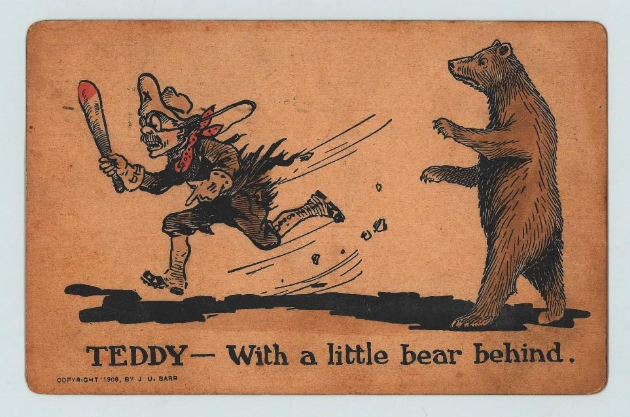
Much like political cartoons, these postcards in our digital library offer amusing examples of word play connecting Theodore Roosevelt and the “teddy bear.” Two such postcards show examples of Teddy’s “bear behind.” Only the first shows any actual skin, but even so, both of these postcards are relying on the bears behind the Teddys to make their points.
My personal favorites, however, are the postcards of Roosevelt naked in the bathtub. Both examples of bathtub postcards in our digital library use different intimate versions of a “Teddy bare” and a “Teddy bear.” Unlike the first two, these do highlight Roosevelt’s nakedness in a funny, yet tasteful way.
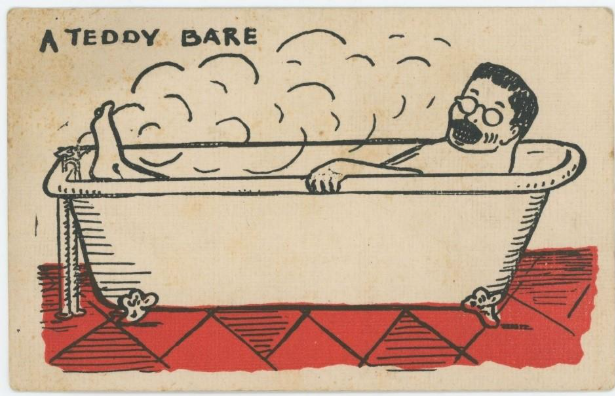
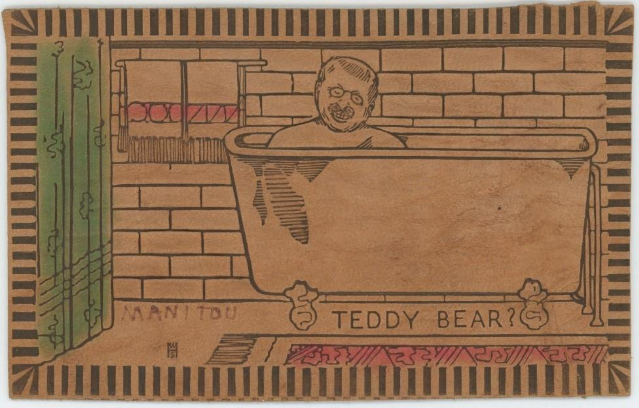
While the makers of these “Teddy Bare” postcards were likely relying on some fun wordplay rather than making direct reference to any actual instance of TR’s skinny dipping, the beauty of the Theodore Roosevelt Center’s work is that it brings these disparate resources and stories together to create a shared context that connects Theodore Roosevelt records together! Do you have a favorite Teddy Bare/Teddy Bear postcard?
This brings it home, for me, and helps me to see Teddy's real, American spirit.
I can relate to him much better, having enjoyed the same type of experience, many times. 😆
Absolutely loved this deep dive into Roosevelt's unapologetic approach to physical fitness. The Oyster Bay anecdote reveals somethign fascinatng about Victorian-era masculinity: the mortification wasn't the nudity itself but the social impropriety of being caught unprepared. My grandfather used to swim in quarries the same way back in the 60s, and it really was just normal back then.