
Friday Fun
Walking in the Bent-over Fashion

(We have a lot of content on our original website blog at theodorerooseveltcenter.org that you may not have seen. Dr. Hansard has adapted the following material from one of his own posts from a few years ago.)
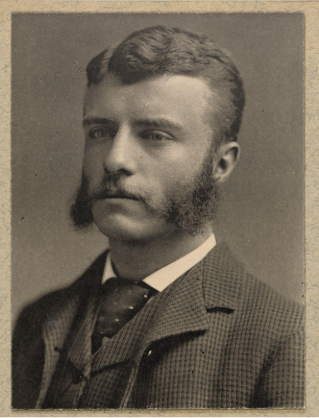
As a politician and public figure, Theodore Roosevelt was something of a showman. He had a way of making his presence known and memorable. And this did not begin with his presidency, but all the way back to his first elected office, as a New York state assemblyman. Many secondary works about Roosevelt include a quote from a fellow assemblyman, who recounted Roosevelt’s theatrical entrance into a preliminary meeting in Albany in 1882 before the assembly was officially in session. Assemblyman John Walsh described Roosevelt's mannerisms as similar to that of a skilled actor:
Suddenly our eyes, and those of everybody on the floor, became glued on a young man who was coming in through the door. His hair was parted in the center, and he had sideburns. He wore a single eye-glass, with a gold chain over his ear. He had on a cutaway coat with one button at the top, and the ends of its tails almost reached the tops of his shoes. He carried a gold-headed cane in one hand, a silk hat in the other, and he walked in the bent-over fashion that was the style with the young men of the day. His trousers were as tight as a tailor could make them, and he had a bellshaped bottom to cover his shoes. ‘Who’s the dude?’ I asked another member, while the same question was being put in a dozen different parts of the hall. ‘That’s Theodore Roosevelt of New York’ he answered.
Now, there is a lot to unpack here, but perhaps most peculiar is the description of Roosevelt’s gait, being in the “bent-over fashion that was the style with the young men of the day.” Why did he walk this way, and what might it have looked like?
Walking was a big deal in the latter half of the nineteenth century. It became an organized competitive sport in the form of Pedestrianism – complete with corporate sponsorships, betting, and huge sums of money earned by the champion pedestrians. Feats of speed and distance were set and topped regularly, and the most successful pedestrians developed their own unique gaits that set them apart and potentially provided them an advantage – as long as those walks followed the “fair heel-to-toe” rule, meaning at least one toe had to remain on the ground until the other heel had touched the ground.
Distinctive styles of walking were far from limited to professional athletes, however. Fashionable walking became a phenomenon as well, especially among women. Highly specific styles of walking began to develop, such as “the Aesthetic,” which required keeping the spinal column at “an angle of about forty-eight degrees” and having one’s “arms to the elbow-points hug her sides like the wings of a duck,” became all the rage in fashionable society. The reasons for this phenomenon of fashionable walking are numerous and contested, but historians have demonstrated that during the nineteenth century, changes in costume led to changes in posture.
Men were of course not immune to the drastic societal changes taking place in the Victorian period, and found themselves swept up in various aesthetic movements that for the sake of simplicity I will lump under an umbrella term of “dandyism.” (Academically, it’s much more complicated, but that’s another blog post!) Dandies expressed their gender identity and class status through their carefully curated appearance, especially their clothing. Cartoonists often poked fun at and parodied the dandies, especially for their perceived effeminacy, as is detailed in this 2013 article in the journal Victorian Periodicals Review. It was in this article that I finally found what I was most looking for when I began this research – what this walk “in the bent-over fashion” might have looked like. Although the cartoon is from an earlier generation – 1869, rather than 1882 – I believe Roosevelt’s entrance might have looked something like this:
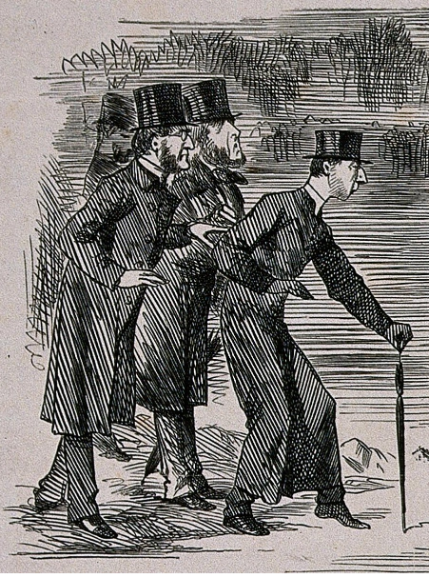
This phenomenon was so widespread that the curved posture and top-hatted costume of these men was instantly recognizable to readers of Punch magazine, just as Roosevelt’s style of walking was instantly recognizable as in fashion to New York state assemblyman John Walsh.
In 1882, Theodore Roosevelt was a rich young man from an influential family who was looking to make his mark in the political arena. Both literally and metaphorically, he burst onto the scene flaunting his money, energy, and style. Paradoxically, by following what was in fashion among a certain group of people, he was able to make his mark among another! This was truly a grand entrance, in every sense of the phrase.
These niche articles are a lot of fun. I love how you are digging into different aspects of his life and times that really round out who he was as a person and what the world was like when he was alive!