
Friday Fun
Moose Hunt

by Rachel Lane
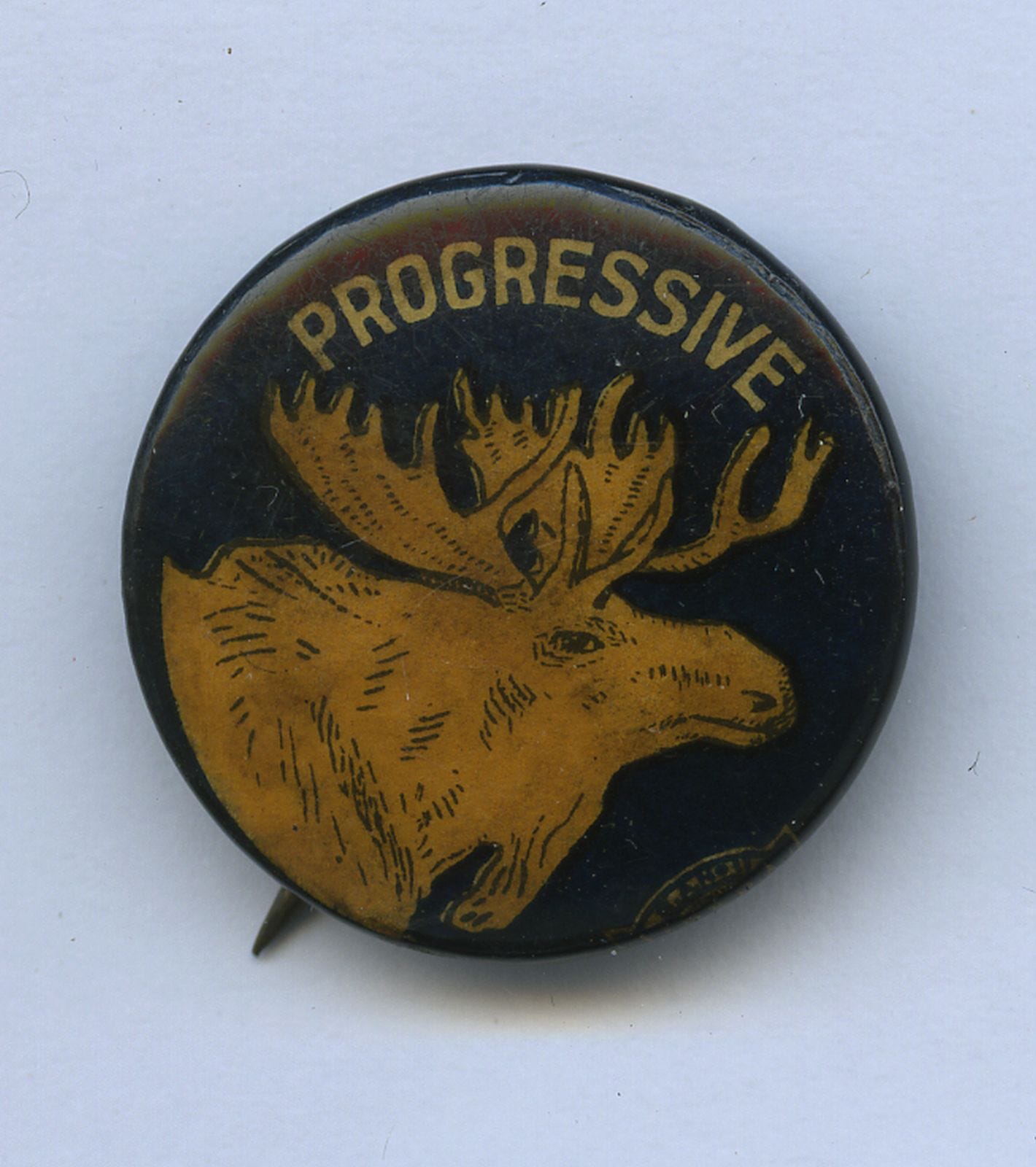
Theodore Roosevelt has long been associated with the moose, specifically the bull moose—the mascot of the Progressive Party. In addition to campaign paraphernalia, moose feature prominently at Sagamore Hill, the family home. There is the large moose head gracing the dining room, and several pieces of art around the house, from an oil painting of a charging moose given to Roosevelt for his 54th birthday hanging above a bookcase in the Library, to a bronze standing moose sculpted by Carl Rungius in 1905 on the mantle in the Dining Room.
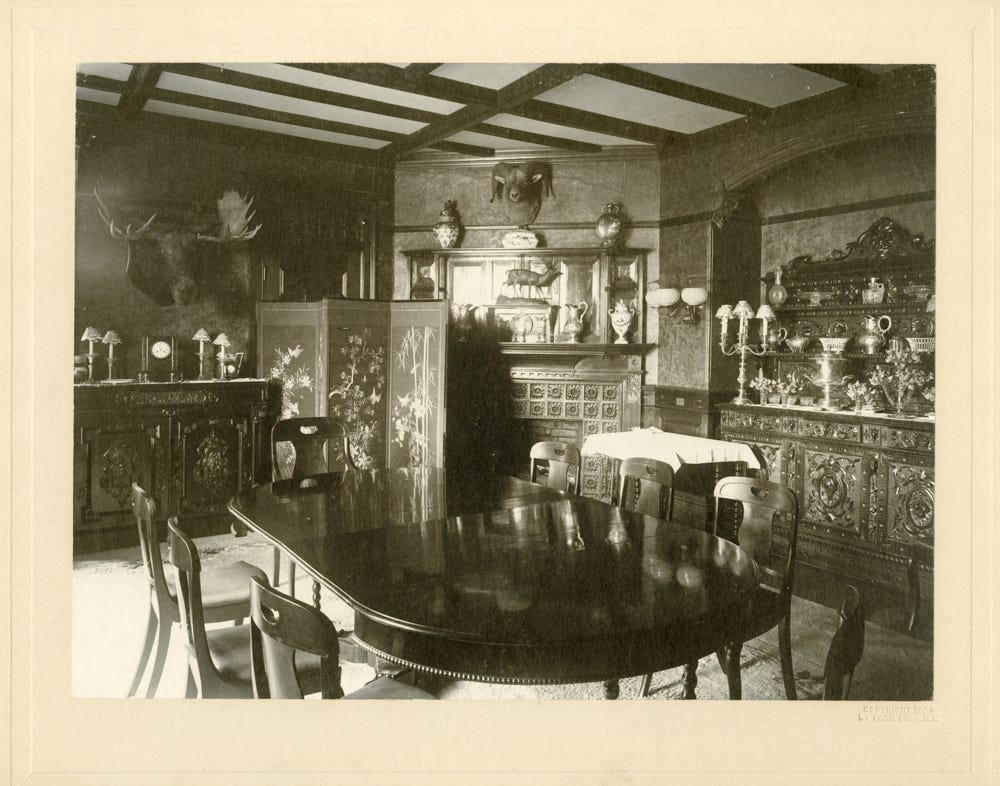
But long before the moose became almost synonymous with Roosevelt, this majestic animal was on Roosevelt’s list of big game to bag. It probably comes as no surprise that the man who epitomized the “Bull Moose” party hunted moose himself, but you might be astonished to learn that his first attempts at moose hunting failed.
In the 1870s after the death of his father Theodore “Thee” Roosevelt, TR visited the backwoods of Maine, hunting with his guides who became friends, William Sewall and Wilmot Dow. As Edwin Emerson wrote in Adventures of Theodore Roosevelt (1928), “There in the Maine backwoods Teddy went on his first moose hunts with Sewall and Dow, but they failed to find any moose.”
It wasn’t until Roosevelt was a civil service commissioner—over twenty years later—that he got his first moose. Much like Roosevelt’s pursuit for a bison in 1883 that took him several weeks, so did his first successful moose hunt in the Bitter Root Mountains in the 1890s.
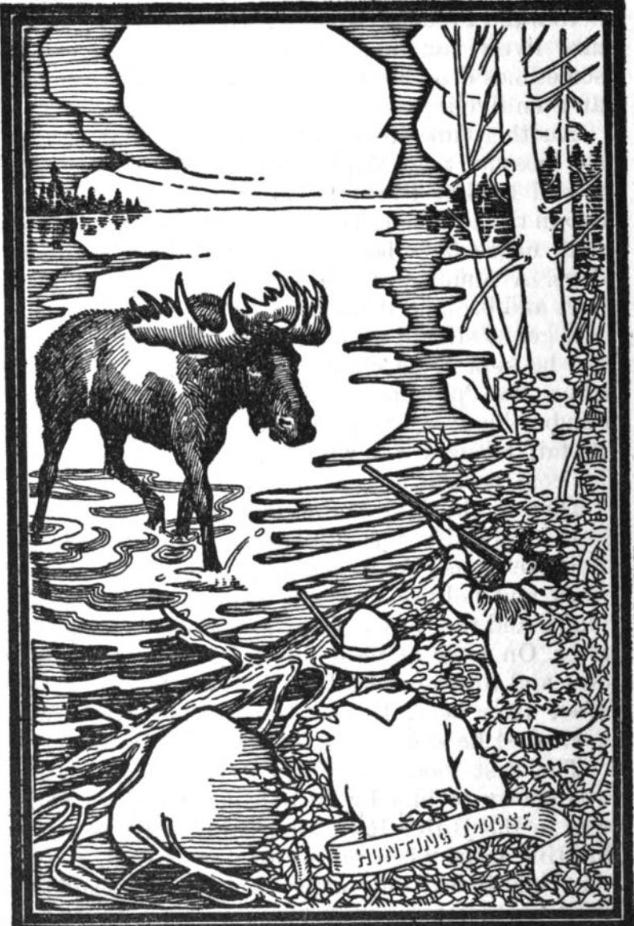
Tracking a moose that started out in some willows surrounding a little lake and moved to a marsh, Roosevelt and his guide—an old-time trapper named Hank Griffin—watched the young bull moose wallow in the muddy water of the marsh. Roosevelt snapped a twig so that the moose would rise and he could take a shot with his 45-90 Winchester, his main hunting weapon from 1886 to 1896.
As he wrote in The Wilderness Hunter (1893), “My veins were thrilling, and my heart beat with that eager, fierce excitement known only to the hunter of big game, and forming one of the keenest and strongest of the many pleasures which with him go to make up ‘the wild joy of living.’”
This experience made quite the impression on Roosevelt, as he devotes an entire chapter to the moose in The Wilderness Hunter, talking not just about his own adventures hunting them but also the encounters others had had with moose and their behavior.
One of my favorite lines from the chapter talks about the taste of moose meat: “The flesh of the moose is very good; though some deem it coarse. Old hunters, who always like rich, greasy food, rank a moose’s nose with a beaver’s tail as the chief of backwood delicacies; personally, I never liked either.”
Although he was invited to go moose hunting several times, I wasn’t able to find any instances of Roosevelt hunting moose during his presidency. In one instance in 1901, Roosevelt’s reason for not hunting was adhering to the unwritten law that the president didn’t leave the United States while in office. (Roosevelt later broke this rule during his visit to Panama in 1906.)
According to a newspaper article, Roosevelt had an amusing quip that he would be “pleased to participate in the hunt if Mr. Eddy [Congressman from Minnesota] could induce the moose to come over on American territory.”
Even though Roosevelt wasn’t able to go moose hunting during his presidency, his eldest son Ted did—and the commander-in-chief exchanged several letters relating to his son’s hunt, likely living vicariously through his son.
Anecdotally, Ted was quite a bit more successful than his father in his first moose hunt. As Roosevelt related in an October 8, 1904 letter to Owen Wister, “Ted has killed a bull moose with fifty-six inch spread of horns - pretty good for a seventeen year old boy’s first try after moose.” (Today fifty to sixty inches is considered a “good spread.”)
In 1911, Roosevelt likewise turned down the opportunity to hunt moose—but finally accepted an offer in 1915. This hunt, which occurred after Roosevelt’s failed presidential bid in 1912, was one of his last big game hunts—and one of the most memorable.
Shortly after breakfast on September 19, 1915, Roosevelt killed a bull moose in the Canadian wilderness of Quebec. (The antler spread was smaller than Ted’s moose at fifty-two inches.) After field dressing the carcass, it was around three in the afternoon when Roosevelt and his guides, Arthur Lirette and Odillon Genest, headed back to their camp—and that’s when the “real adventure,” to use Roosevelt’s words, began.
As they got closer to the edge of the lake, they saw an even larger moose than the first one Roosevelt shot. They attempted to land, but the moose wouldn’t let them. They tried yelling and beating their paddles, but nothing seemed to faze the moose.
After more than an hour of thwarting their landing, the moose disappeared in a river next to the portage trail. Although Roosevelt and his guides attempted the landing, they figured the moose was still around somewhere and knew they needed to be prepared if the moose charged.
And charge he did. As Roosevelt related in a letter to his son Kermit, the moose “came for us like a locomotive.” Lirette shouted to Roosevelt, “Tirez, m’sieu, tirez, vite, vite,” meaning “Shoot, sir, shoot, quickly, quickly.” Roosevelt killed the moose when he was not thirty feet off.
Because he was only allowed to kill one bull moose with his license, Roosevelt had to submit an affidavit to the Canadian Minister of Mines and Fisheries in Quebec—what Roosevelt called the “Secretary of the Interior” in his letter to Kermit—who remitted the fine. (The minister even sent Roosevelt a complimentary license in 1916.)
Roosevelt summarized the trip to Kermit: “It was as extraordinary an experience as I have ever had in the hunting field.” Even so, Roosevelt thought he “shot atrociously” and was so displeased that he determined to “never again make an exhibition of [himself] by going on a hunting trip.” He said, “I’m past it!” (And he was right. The moose hunt of 1915 was Roosevelt’s last big game hunt—fitting for the man known as a “Bull Moose.”)
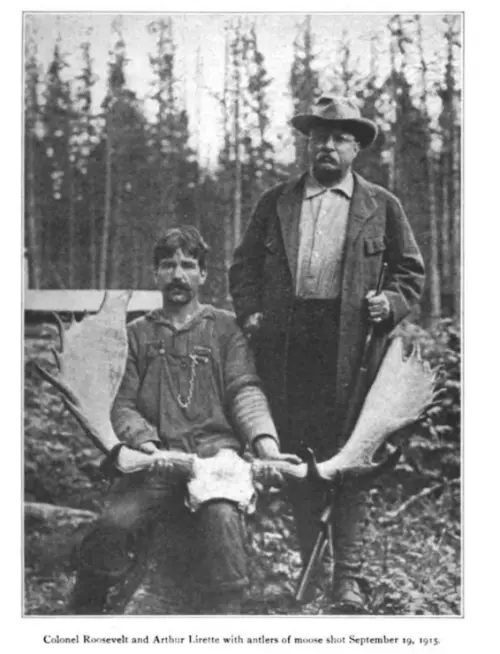
Roosevelt told his story far and wide, writing an article for Scribner’s Magazine in February 1916 entitled “A Curious Experience,” although a better title might have been “The Moose Who Meant Mischief,” a phrase Roosevelt used twice to describe the cantankerous bull moose.
He also regalled friends with the story, writing to W.B. Rogers in late October 1915 that he planned to tell him about the “really extraordinary experience” when they next met. Naturalist George Bird Grinnell similarly wrote to Roosevelt in late November 1915: “I want to hear your moose story, rumors of which have reached me. I should like to get the facts.”
But perhaps most interesting is the fact that Roosevelt felt the need to write to his cousin, Franklin D. Roosevelt, then Assistant Secretary of the Navy, about the adventure—one of the few letters in the digital library from TR to FDR: “I killed two moose, one because it literally held me up. Both had good antlers.”
Check out everything in the digital library related to moose here, including sheet music for the “Bull Moose Romp,” the “Bull Moose March,” and the “Brave Young Moose”!