
Friday Fun
Belle Hagner's Memoirs

Here at the Theodore Roosevelt Center, we try to paint the fullest picture we can of TR and his world, using the widest variety of sources we can, not only from TR himself, but from his colleagues and contemporaries. Today, we want to take a look at the memoirs of Isabella “Belle” Hagner, the first White House Social Secretary.
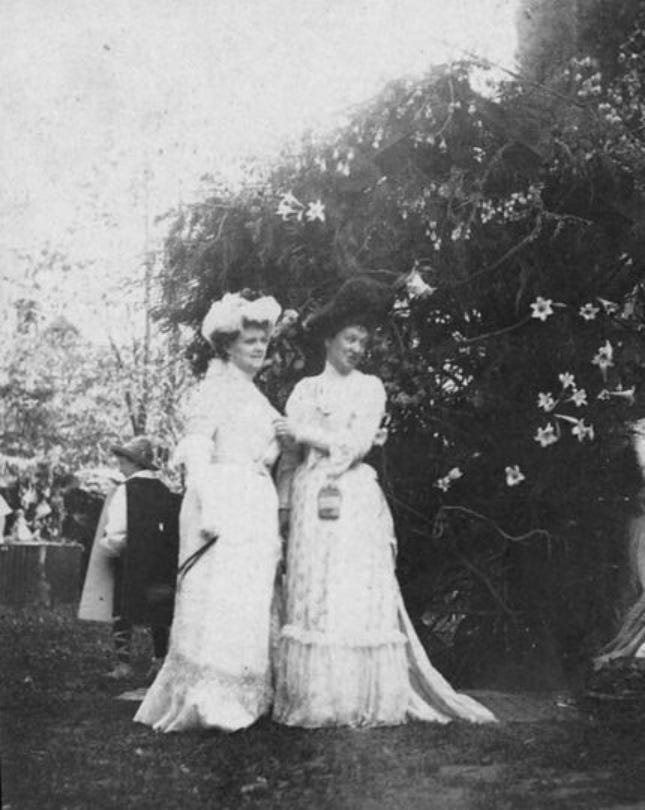
The eldest child of Isabella Wynn Davis and Dr. Charles Evelyn Hagner, Belle was born in 1876 and raised in Washington, D.C. Her family was respected and well-connected.
Belle was sixteen years old in 1892 when both of her parents died. It fell to her to raise her three brothers. Thanks to their large circle of friends, the Hagners endured their sudden poverty. Belle became a social secretary to wealthy Washingtonians, assisting with correspondence and invitations. She also held down clerkships in the War Department and for the Social Register, a published roster of socially prominent families.
Among the women for whom Belle Hagner worked was Anna Roosevelt Cowles, Theodore Roosevelt’s sister. It was at the Cowles’ residence, in March 1901, that Hagner met Edith Roosevelt. They discussed the potential of Hagner helping with the upcoming debutante ball of Alice Lee Roosevelt. After Edith became First Lady in September, she hired Hagner as a full-time social secretary on October 2, 1901.
Edith Roosevelt depended upon Hagner and came to think of her as a daughter. All the Roosevelt children loved Belle. They confided in her and she helped them through scrapes and illnesses. Belle often filled in when entertainments called for an “extra woman,” and she had an excellent sense of the political landscape that was useful to the Roosevelts.
Hagner later served as First Lady Ellen Wilson’s social secretary. In 1915 she married widower Norman James, and became mother to his three children. She died in 1943 and is buried in Loudon Park Cemetery, Baltimore, Maryland.
The White House Historical Association holds Belle Hagner’s papers. In 2009, they published an excerpt of her memoirs, edited by a Roosevelt, covering the first term of Theodore Roosevelt’s presidency. Hagner’s memoirs offer a fascinating inside look into the modernization and streamlining of White House operations, of which she was an integral part.
It is important to note that Belle, a highly sought after clerk and secretary throughout both the public and private sectors, did not seek out her job, as she says early in the piece.
I would like to say that ever since this position was created for me, I have always felt very strongly that the job of secretary to the President’s wife is one which should not be solicited. I am happy to say that both times in my case, I was asked to take the place, without ever raising a finger to get it.
Among Belle’s most important duties was sorting Edith’s correspondence, especially the mountains of letters from those seeking gifts, often to be sold at fairs. Belle mentions sending out gifts from Edith that were requested for charitable purposes.
Mrs. Roosevelt decided it was better to try to send a small memento to many fairs, rather than something elaborate to a few, so as “Handkerchief Showers” were then very popular, she bought dozens of handkerchiefs, and these were dispatched, one by one, accompanied with her visiting card, on which I wrote “Good Wishes” for her. We kept a record book of these donations so that two would not be sent to the same fairs or towns.
The TR Center actually has two of these very handkerchiefs and a visiting card in our physical collections! It is something of a cautionary tale for researchers, however – if one didn’t know better, they might assume that was Edith’s signature on the card.

Belle was not only an employee, but became close to the family as well. She tells a number of amusing, typically Rooseveltian stories about family antics at the White House, especially those involving the children. A particular favorite is a story involving Roosevelt’s friend and Rough Rider comrade, Tabasco sauce magnate John Avery McIlhenny, who arrived to an aging, cramped, haphazardly arranged White House that the Roosevelts would later renovate.
The morning after the arrival of Mr. McIlhenny, the inadequate provision for guests was peculiarly illustrated. One of the bedrooms facing the north portico had been divided by a wooden partition reaching half way to the ceiling, and made into two baths, one of which had to be used by the Roosevelt boys, and the other provided the only accommodation for guests. While Mr. McIlhenny was seated in his tub, he was greeted with a large wet sponge on top of his head!
For her employer and friend, the First Lady, Belle had nothing but kind things to say.
I may as well here as later give my paean of praise of Mrs. Roosevelt. I can say what I like, as she never knowingly reads anything about herself. She is a descendant of Jonathan Edwards, and of French extraction; so her New England conscience, joined with her innate good taste in art, music and literature, make a remarkable combination. Mr. Frederick B. McGuire of the Corcoran Art Gallery (where she spent many happy hours while in Washington) always said she had more instinctive acumen and judgment in regard to things artistic than he had ever known. Her mental processes are more like a man’s, though coupled with the greatest femininity and daintiness. By nature and inclination she should probably have had a life of sheltered seclusion among her family and friends, but owing to The President’s natural tastes and political associations, she was and is constantly in the limelight, and never did a woman carry herself with more gentle dignity and charm. Her really intimate friends to whom she gives her all have been comparatively few, but her friendliness is always there, to high and humble alike. Her wisdom in never offering advice until solicited is an attribute few women, and not many men, possess. Her real Christian spirit in these days of much unbelief is an inspiration to all who know her, as well as her unselfish devotion to family and all who have a claim upon her. Or course, before the family came to the White House their income was small, and demands great, but even now Mrs. Roosevelt hates wastefulness, and believes in proper frugality, in order to be able to lend a hand when right and proper. Her great patriotism and courage were certainly shown to all the country when her four boys went overseas, her “Benjamin” not to return; never a murmur, but an example of fortitude, good sense and foregoing mourning for her boy, so that those who were left would not be saddened. Then too, the Colonel’s and her decision to let “the tree lie where it fell” was another inspiring example of unselfishness.
For more fascinating stories about life and work in the Roosevelt White House – everything from the issues of securing adequate transportation and office space to details about painted portraits and collecting presidential china, be sure to read the published excerpt from Belle’s papers. Perhaps one day the TR Center will obtain the papers for our digital library, and we can share even more with you!
Nice article. I look forward to reading more about Belle!