
Friday Fun
Theodore Roosevelt, 25th president

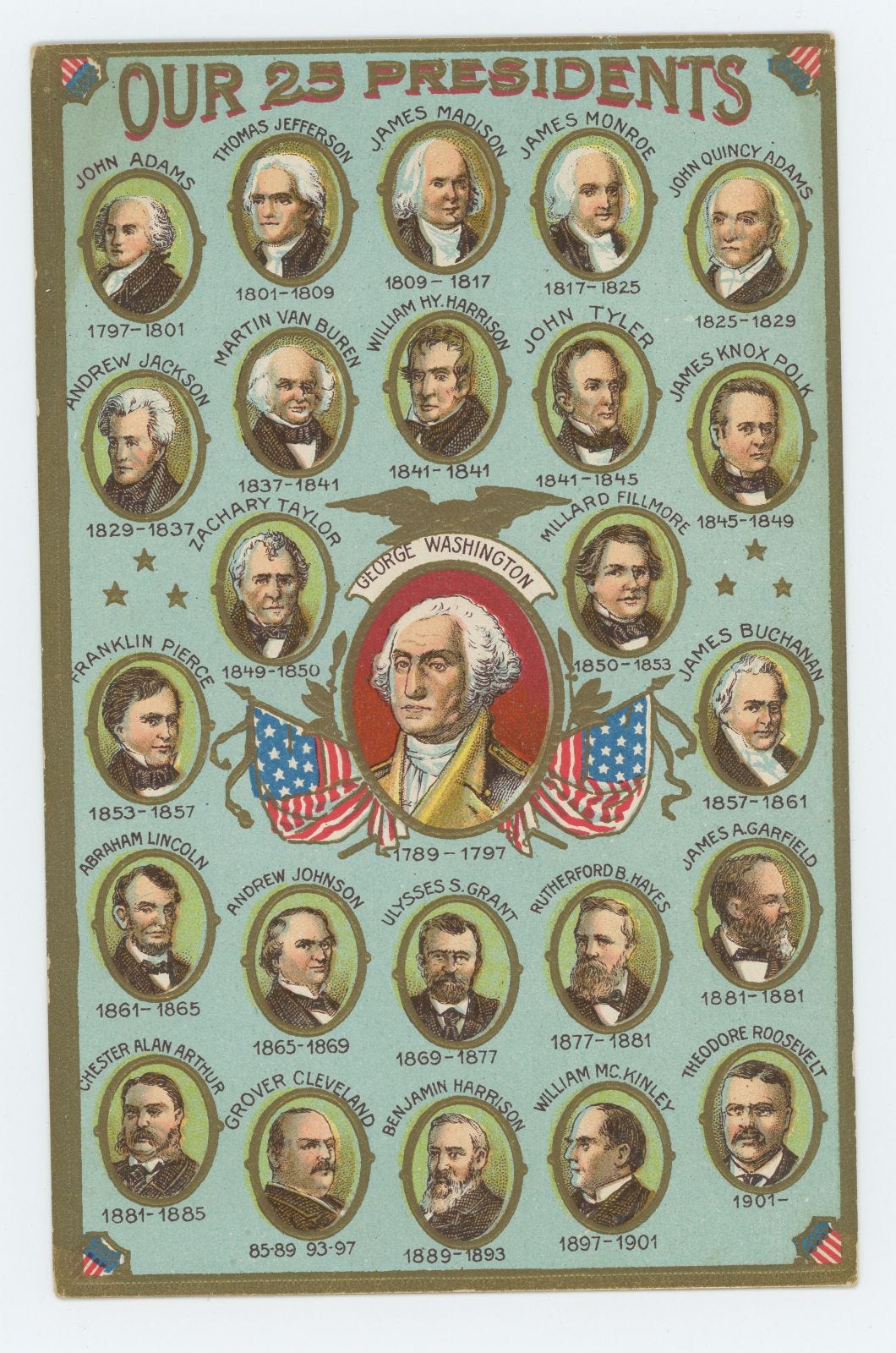
Today we know Theodore Roosevelt as the twenty-sixth president, but he hasn’t always been considered number 26. In fact, Roosevelt considered himself the twenty-fifth president! In this numerical Friday Fun post, we’ll consider the highly subjective concept of numbering the presidents—and how it all relates to Roosevelt.
Although it is now commonplace to call Roosevelt the twenty-sixth president, there was quite the debate during his time in office—and in the years following—as to whether or not he was the twenty-fifth or twenty-sixth president.
Roosevelt’s successor, William McKinley, was the first president after Grover Cleveland served a second non-consecutive term, and people didn’t know how to count him. Was McKinley the twenty-fourth or twenty-fifth president? (Cleveland was the twenty-second person to serve as president, and Benjamin Harrison was the twenty-third.)
No official decision as to McKinley’s number was made, so when Roosevelt became president after McKinley’s assassination in September 1901, the question still lingered. Was Roosevelt the twenty-fifth or the twenty-sixth president? There was not one clear answer. Some papers and books said twenty-fifth, while others said twenty-sixth.
This led to the confusing situation where someone could mean McKinley or Roosevelt when speaking about the twenty-fifth president. In fact, the paintings of both McKinley and Roosevelt at the White House bore the inscription of “Twenty-Fifth President of the United States,” as one female tourist pointed out.
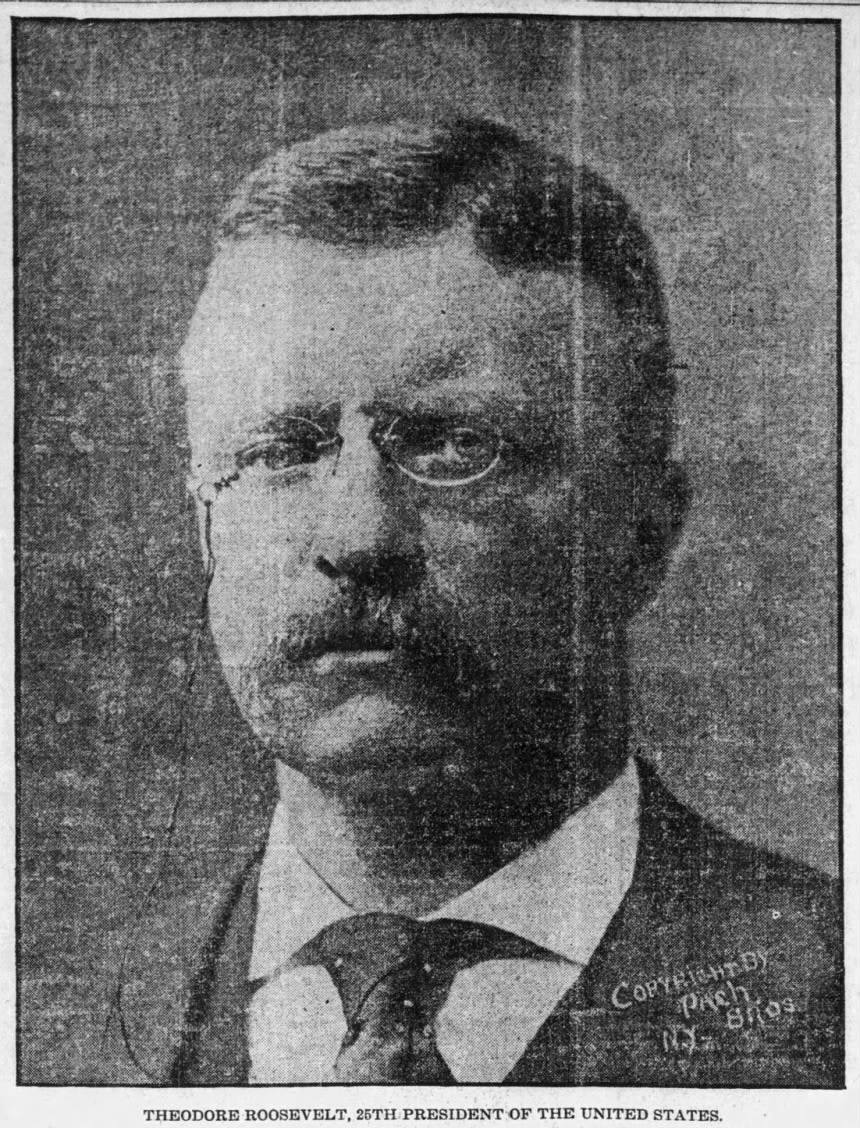
Just before the 1908 election with Roosevelt leaving office less than six months later, one newspaper emphasized the need to solve the problem soon. The newspaper considered counting Cleveland twice an “absurd practice of numbering” and believed it “ought to be possible to correct this numbering before it is too late.”
Unfortunately, the numbering of presidents wasn’t corrected during Taft’s administration nor the four administrations that followed his. It seems that it was during the administration of Roosevelt’s cousin, Franklin Delano Roosevelt, that the standard convention in the United States of referring to Cleveland as the twenty-second and twenty-fourth president—and as a result, Roosevelt as the twenty-sixth president—began.
As one 1938 newspaper noted, “A visitor from a far country, seeking to explain this seeming discrepancy [between the United States having had thirty-two presidents but only thirty-one men who served], might suppose that one President had been a woman. The real explanation, of course, is that usage designates Grover Cleveland the 22d and 24th President . . .”
However, not everyone agreed with the standard convention. Various newspapers across the country regularly received letters to the editor chiding the paper on the numbering—but even the corrections weren’t consistent. Some people contended that Roosevelt was the twenty-fifth president, whereas others pronounced him the twenty-sixth.
Some editors defended their position, but at least in one case, the reply was diplomatic: “If Cleveland is listed as the 22d and 24th Presidents, William McKinley would be listed as the 25th and Theodore Roosevelt, the 26th. If Cleveland is listed only as the 22d President, Theodore Roosevelt would be the 25th.”
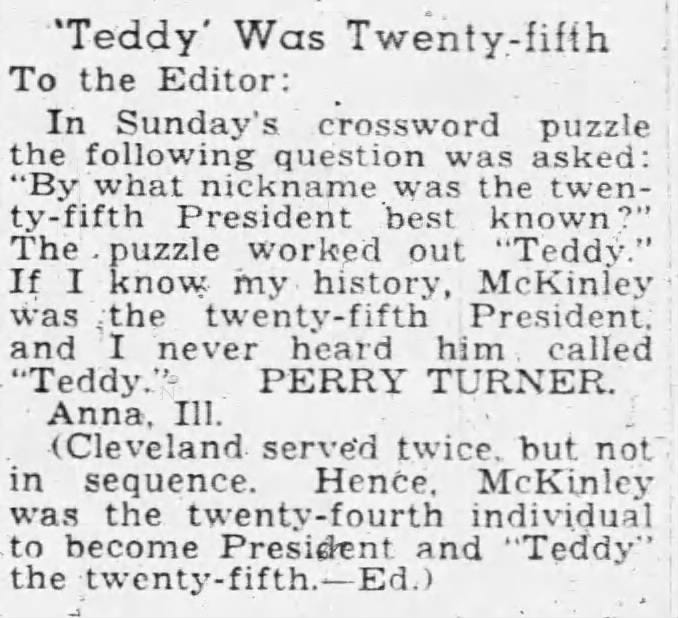
The numbering even affected cruciverbalists trying to complete their Sunday crossword puzzles! As Perry Turner wrote to the editor of the St. Louis Globe-Democrat in 1944, “In Sunday’s crossword puzzle the following question was asked: ‘By what nickname was the twenty-fifth President best known?’ The puzzle worked out ‘Teddy.’ If I know my history, McKinley was the twenty-fifth President and I never heard him called ‘Teddy.’” (The editor gently corrected Turner, explaining why Roosevelt was the twenty-fifth president.)
Perhaps the most vocal opposition of the standard practice of numbering the presidents with Cleveland counted twice came from journalist John Kieran in 1953: “Put the busts of all the Presidents in a row and count them, and you’ll get only 33. . . . There are only 33 Presidents, figure it by any sensible, logical, mathematical method, including the Greek and Scandinavian.”
As is probably no surprise, Roosevelt weighed in on this matter and came to a similar conclusion as Kieran. In a 1904 letter to Charles S. Bromwell, he wrote, “In response to your question as to numbering the Presidents, it is obvious that either all the two-term Presidents or none of the two-term Presidents must have their terms counted in styling them Presidents.”
For Roosevelt, the important part was consistency. Either Cleveland was only the twenty-second president (and not the twenty-fourth also), or two-term presidents were double-counted.
Roosevelt preferred the former, writing: “In accordance with the usual terminology I shall direct for the present that the old custom be adhered to, and that Mr. Cleveland be put down for the 22d President, Mr. McKinley as the 24th, and I as the 25th. . .”
Although Roosevelt had a defined opinion, what might surprise you is Roosevelt’s conclusion: “It is not a very important matter.”
What do you think—is Theodore Roosevelt the 25th or 26th president? Let us know in the comments!
Hello,
Maybe this will clear up the confusion.
Why not label each president with the number of terms they served, consecutive or not?
Teddy would be the 25th-II president (the "II" would be in roman numerals).
I wonder how it was decided to have 26 steps to his grave…