
Friday Fun
TR and Women of the Gilded Age and Progressive Era

For this month’s Voter’s Choice post, we’re dee-lighted to devote a post to examining famous women of the Gilded Age and Progressive Era with whom Roosevelt interacted. We selected five notable women, which we’ve included in alphabetical order.
There were others that we wished we could have included, but Roosevelt didn’t have any known interactions with them. What women would you have added to the list? Let us know in the comments below!
Jane Addams
Well-known for her social reform work, Jane Addams regularly corresponded with Roosevelt. The earliest record in the digital library is a 1906 letter from Roosevelt to Addams in which he praises her work as a reformer, distinguishing her from the “reformers of the hysterical and sensational stamp”: “Will you let me say a word of very sincere thanks to you for the eminent sanity, good-humor and judgment you always display in pushing matters you have at heart?”
Addams even seconded Roosevelt’s nomination as the Progressive Party candidate at the National Convention in 1912, which he thanked her for in a telegram since he had not been able to do so in person. (It’s also one of the longest telegrams we’ve ever seen!) Addams, in turn, thanked Roosevelt for the telegrams he sent to the female delegates at the National Progressive Convention.
Roosevelt’s Progressive Party candidacy was the peak of their collaboration, as they differed greatly in their thoughts about World War I. Roosevelt did not mince words speaking about Addams’s pacificist beliefs, calling her “one of a shrieking sisterhood” and “poor bleeding Jane.”
Despite this rift, Addams wrote a tribute after Roosevelt’s death in January 1919 in honor of his impact on social work, mentioning “his open mind, his quick apprehension of social needs, [and] his will to social righteousness.”
Susan B. Anthony
By the time Roosevelt was president, Susan B. Anthony was an older woman who had spent years as a women’s rights activist and proponent of women’s suffrage. There is only one letter in the digital library related to Anthony from Roosevelt, but it wasn’t written directly to her.
Instead, it was written to Anna Howard Shaw, the president of the National American Woman Suffrage Association, wishing Susan B. Anthony a happy eighty-sixth birthday in 1906.
Anthony wasn’t particularly impressed with the president’s reply, responding in turn, “I wish the men would do something besides extend congratulations. I have asked President Roosevelt to push the matter of a constitutional amendment allowing suffrage to women by a recommendation to Congress. I would rather have him say a word to Congress for the cause than to praise me endlessly.”
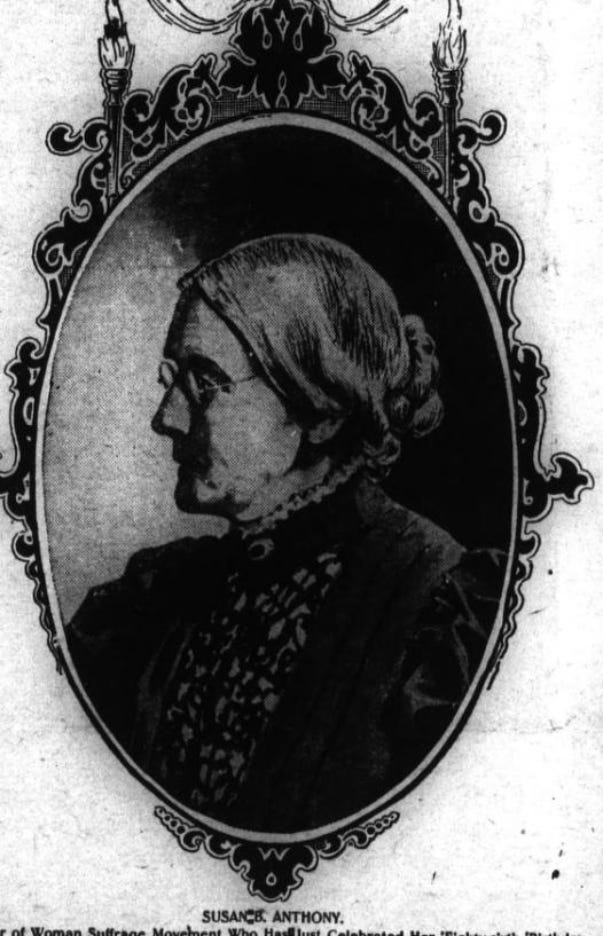
Her biting reply was quickly picked up by newspapers across the country, including in this one in North Carolina, which included the illustration of Anthony below.
Clara Barton
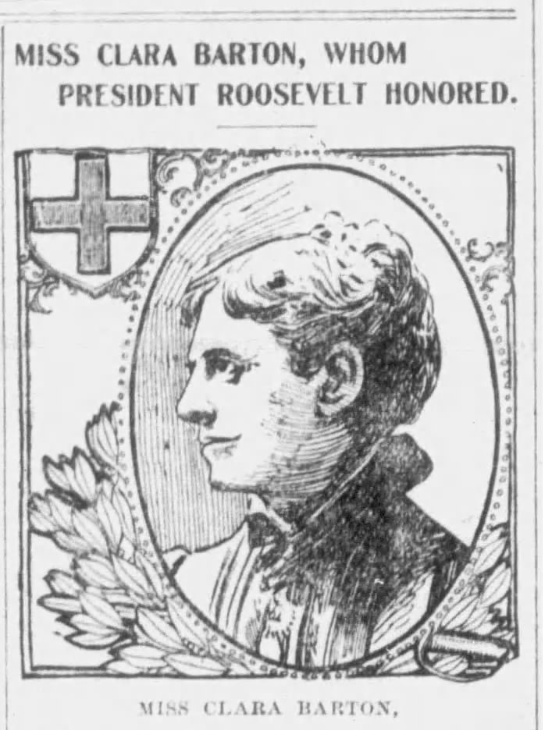
Perhaps one of the most well-known women living during the American Civil War and the Gilded Age and Progressive Era was Clara Barton. But unlike other women of the era, Roosevelt had a less positive view of Barton.
As he wrote in a 1916 letter to Mrs. John A. Logan, “I understand that Miss Barton did great work before I was brought into contact with her; but I was by no means favorably impressed by the type of work she did during the Spanish-American War.”
Roosevelt added that he didn’t intend to say anything against Barton in public and asked Logan to keep his letter confidential, but he could not write the letter Logan desired—presumably something about Barton.
Roosevelt also had strong words to say about Barton while he was president in 1906, writing to Henry L. Einstein of The New York Press, “As regards the Red Cross, you are evidently ignorant of the fact that all the scandals were connected with the regime of poor Miss Clara Barton. But that regime has long been at an end . . .”
Other correspondence in the digital library related to Barton includes a 1902 letter from Secretary of State John Hay to Roosevelt regarding the attendees to the St. Petersburg conference he knew, which included Barton, and a 1905 letter from Roosevelt’s sister Anna “Bye” Cowles regarding Red Cross matters, including mentioning Barton who “hastily resigned.”
Despite his harsh words in private for Barton, we know that Roosevelt attended one major public event that Barton also attended: an event for Spanish-War veterans held in Detroit in September 1902. In addition to escorting Barton to her seat on the stage prior to his address, Roosevelt also sat with Barton at the president’s table at a banquet.
Ida Tarbell
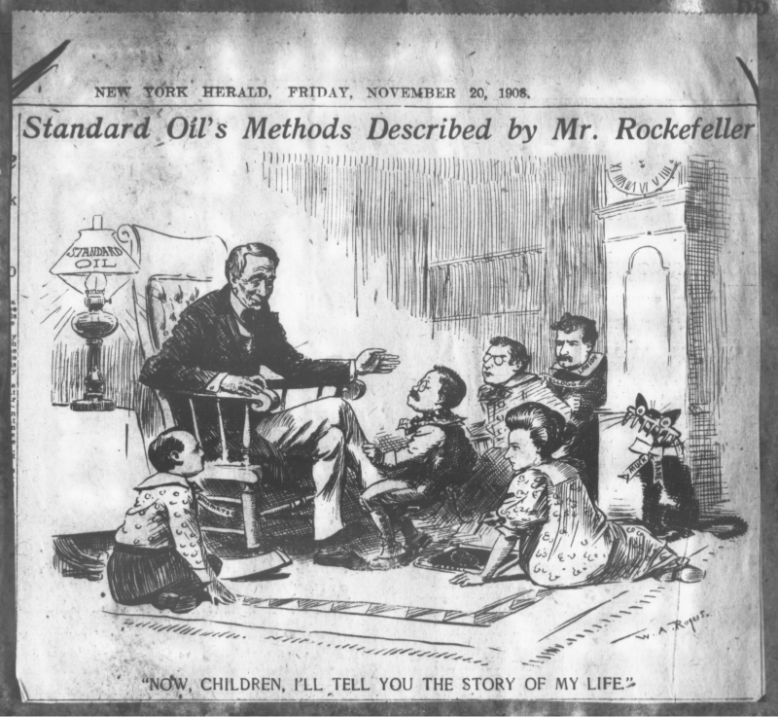
A famous muckraking journalist, Ida Tarbell corresponded with Roosevelt about journalism and plans to meet in person. They didn’t always see eye-to-eye, as is evidenced in a 1911 letter from Roosevelt to Tarbell in which he lambasts her for her assessment of the New York Herald.
Roosevelt could not believe she equated the Herald, known for its sensational journalism, with the Tribune, a paper known for its conservative approach that some called as dull as the grocer’s bill.
But in other correspondence with Tarbell, Roosevelt was much more positive, as in a February 1912 letter in which he expressed his interest in seeing Tarbell the next time she was in New York and noting that her letter “pleased and interested” him.
As for Tarbell, in her autobiography, All in a Day’s Work, she recalled a conversation with Roosevelt in which they disagreed about journalistic methods: “I once argued with Mr. Roosevelt that we on McClure’s were concerned only with facts, not with stirring up revolt. ‘I don’t object to the facts,’ he cried, ‘but you and Baker’—Baker at that time was carrying on an able series of articles on the manipulations of the railroads—‘but you and Baker are not practical.’
Edith Wharton
Edith Wharton was a well-known woman of the Gilded Age and Progressive Era who was good friends with Roosevelt and his wife Edith. She was also in fact a distant relative to the other Edith. Wharton was also the first woman to win the Pulitzer Prize in Fiction in 1921 for her book, The Age of Innocence, two years after Roosevelt’s death.
It is unknown exactly when Roosevelt and Wharton became acquainted, but the earliest archival record of their correspondence is dated May 1897. After that time, Wharton and Roosevelt corresponded occasionally, sometimes talking about literature, planning visits, and later discussing World War I. (See letters from Wharton to Roosevelt here and from Roosevelt to Wharton here.)
In fact, Wharton was one of the first people Roosevelt invited to the White House after he became president in 1901. What Roosevelt and the rest of his family valued about Wharton was her appreciation of literature, which is likely why she was so high on the guest list for the White House.
We know that Roosevelt read some of Wharton’s work, including most notably, her 1911 book, Ethan Frome, which he enjoyed and called “a really great story.” Based on Roosevelt’s correspondence with Wharton and mentioning the family loving her “story of the worthy ladies who hunted culture gregariously,” we believe Roosevelt also read “Xingu,” a short story by Wharton published in Scribner’s Magazine in December 1911.
In addition to reading her work, Roosevelt even wrote the introduction to a collection she edited called The Book of the Homeless in 1916, which he considered “not only a pleasure but a duty” to fulfill Wharton’s request for an introduction.
Wharton had a high regard for the entire Roosevelt family and visited with several of Roosevelt’s children after they became adults, including his youngest son Quentin just two months before he died. (See this photograph of Wharton with several American soldiers in France in 1918, including Roosevelt’s two sons, Archie and Quentin.)
Wharton even considered Roosevelt’s younger daughter Ethel one of the leading Americans of her era, even when she often had disdain for American culture and civilization as compared to that in Europe.
However, when a friend defended American civilization with the example of Ethel Roosevelt Derby, Wharton agreed: “Of course there are green isles in that sea of misery—but they’re so far apart . . . . Alas, there are not enough to go round.”
After Roosevelt’s death in 1919, Wharton wrote a poem in his honor, “With the Tide,” which celebrated Roosevelt’s achievements and life.