
Theodore Roosevelt and Bees

To give our readers a peek behind the curtain, we like to share the inspiration for our posts when it’s something fun, and today’s Friday Fun post is a great example of that. We’ve mentioned political cartoons briefly in previous Substack posts, but today’s post was actually inspired by them!
After coming across several cartoons at different times depicting Theodore Roosevelt and bees, we decided to write a post about it in honor of World Bee Day, which took place two days ago on May 20. Although you wouldn’t expect to find much about Roosevelt and bees, we found more than we expected and we wanted to share!
Bees Symbolizing the Allure of Political Office
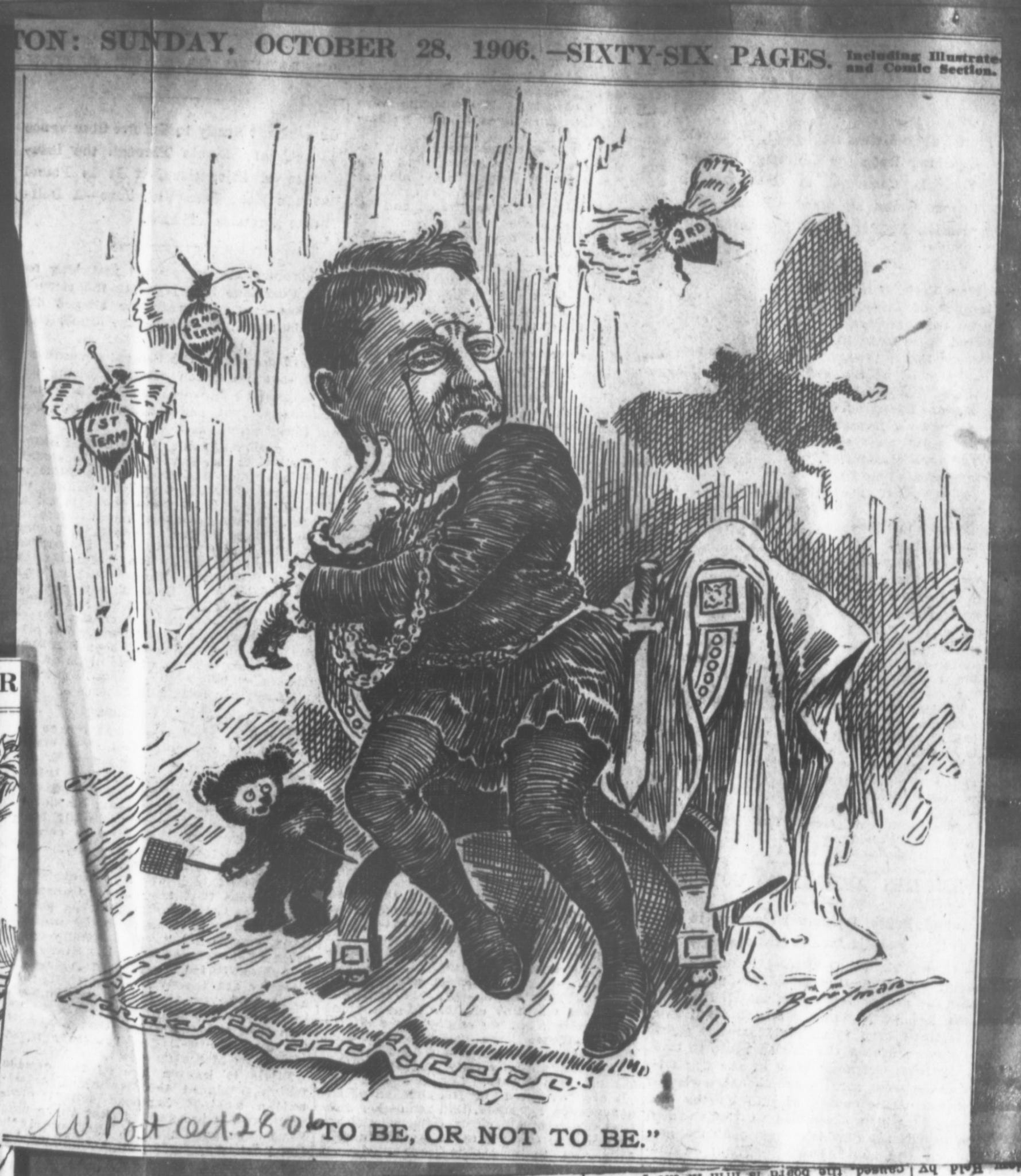
By far our favorite cartoon depicting Roosevelt and bees is Clifford Berryman’s “To be, or not to be,” also sometimes known as “Two Bees or Not Two Bees—That is the Question!”
Berryman is the cartoonist who drew the iconic image that led to the creation of the teddy bear. After creating the teddy bear, Berryman almost always included cute little bears in his cartoons of Roosevelt including the one above with a fly swatter—or should we say bee swatter?
In the “Two Bees” cartoon drawn in 1906, Roosevelt is depicted dressed as Hamlet as he ponders a third term. The cartoon above uses the exact wording from William Shakespeare’s play Hamlet whereas the title of the “Two Bees” version is a play on words. Would Roosevelt be content with two bees—or two terms—or did he want another?
As a digital exhibit on Berryman curated by the National Archives mentioned, the famous cartoonist used bees to symbolize political aspirations as the “‘buzz’ in a potential candidate’s ear.” In Berryman’s cartoon, Roosevelt had two bees buzzing in his ear as a third term bee flying over. Would the bee end up buzzing in his ear or not? Berryman leaves that up to the viewer.
While we prefer Berryman’s depiction of Roosevelt and bees, there’s also another cartoon in the digital library drawn in the same vein. This one, which was drawn by N. Eingen, depicts only the “3rd term bee,” not the first and second term bees as Berryman did.
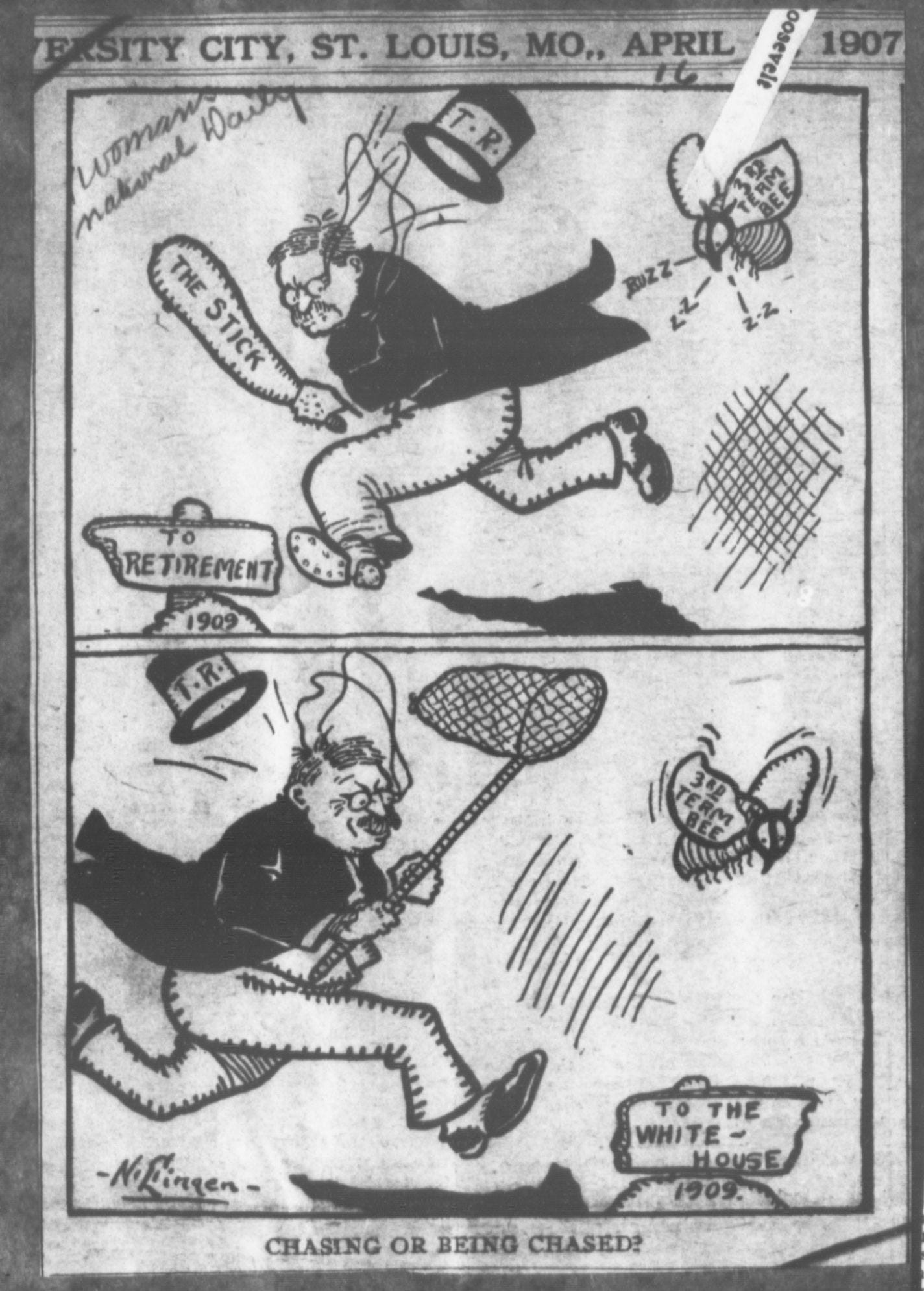
As you’ll notice, the top half of Eingen’s cartoon is very similar to Berryman’s cartoon. He depicts the third term bee flying toward Roosevelt representing the allure of political office. But like Berryman’s Roosevelt, Eingen’s Roosevelt in the top half isn’t sure about a third term. In fact, he is running away.
By contrast, the bottom half is completely different from Berryman’s cartoon as Eingen shows Roosevelt blatantly seeking the third term bee and trying to catch it with a net. Even the title of Eingen’s cartoon—Chasing or Being Chased?—calls into question Roosevelt’s character: is he indecisive or hypocritical?
As one final note, you may have noticed Roosevelt’s big stick in the cartoon labeled simply “the stick.” This is one of the 275+ cartoons in the digital library that feature a big stick, as we mentioned in a previous Substack post.
Bees Symbolizing a Nuisance
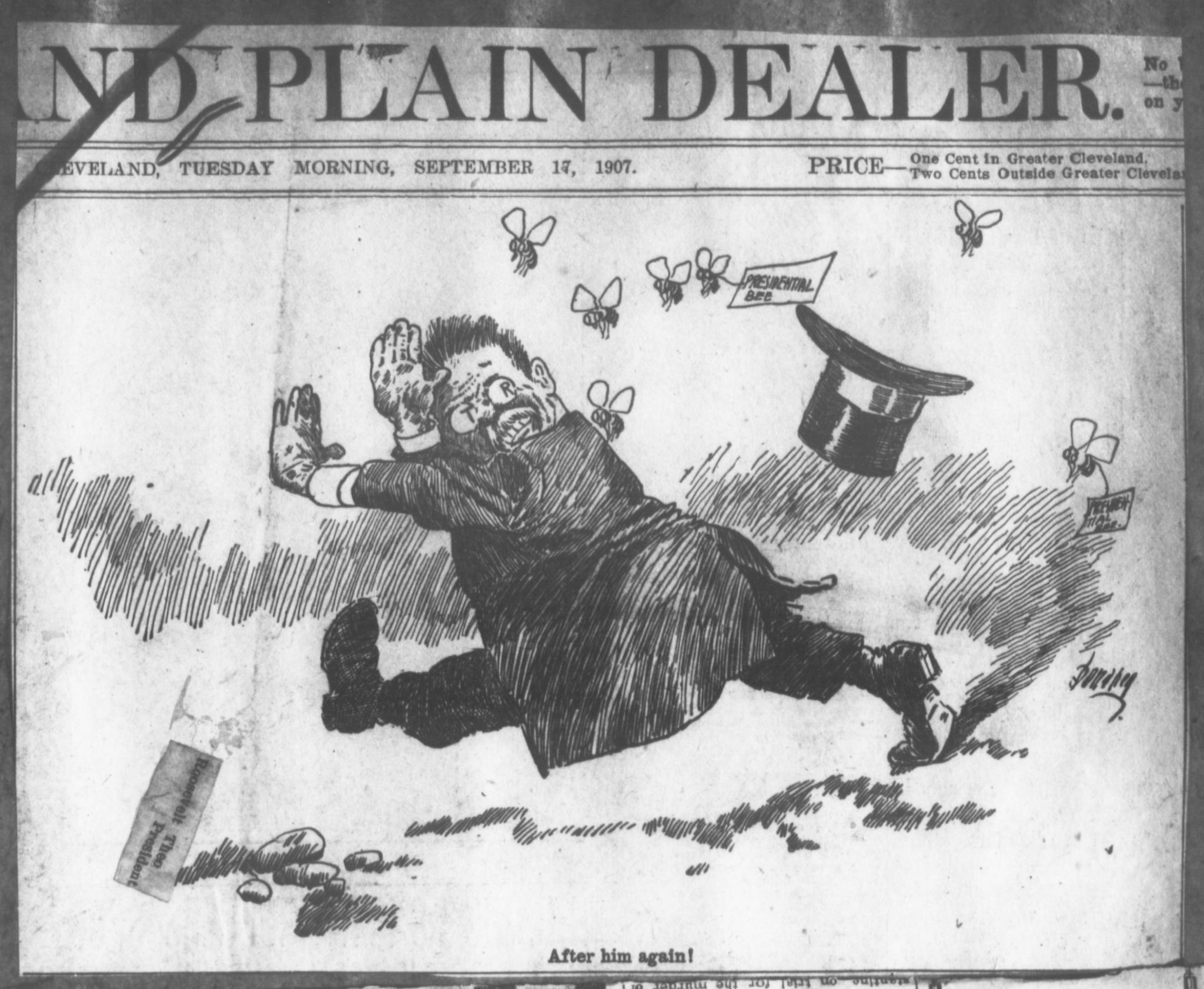
While the other two cartoons depict Roosevelt considering a third term with no more than three bees, J.H. Donahey of the Cleveland Plain Dealer in 1907 drew Roosevelt running away from seven presidential bees.
Typically, cartoonists would draw a singular presidential bee—or a limited number—so Donahey’s decision to depict them as a swarm, and thus a nuisance or even a danger, was intentional. If you look carefully, you can also see that Donahey depicted Roosevelt with his trademark addition of a “T” and an “R” in Roosevelt’s glasses.
But it wasn’t just presidential elections and campaigns that prompted cartoonists to turn to bees in their cartoons. Charles Raymond Macauley’s 1906 cartoon entitled “Stung!” depicts Roosevelt using “the big stick” with a “White House amendment to R.R. [railroad] rates bill” tag to poke a “Senate” beehive. (This is yet another example of cartoons with big sticks in them.)
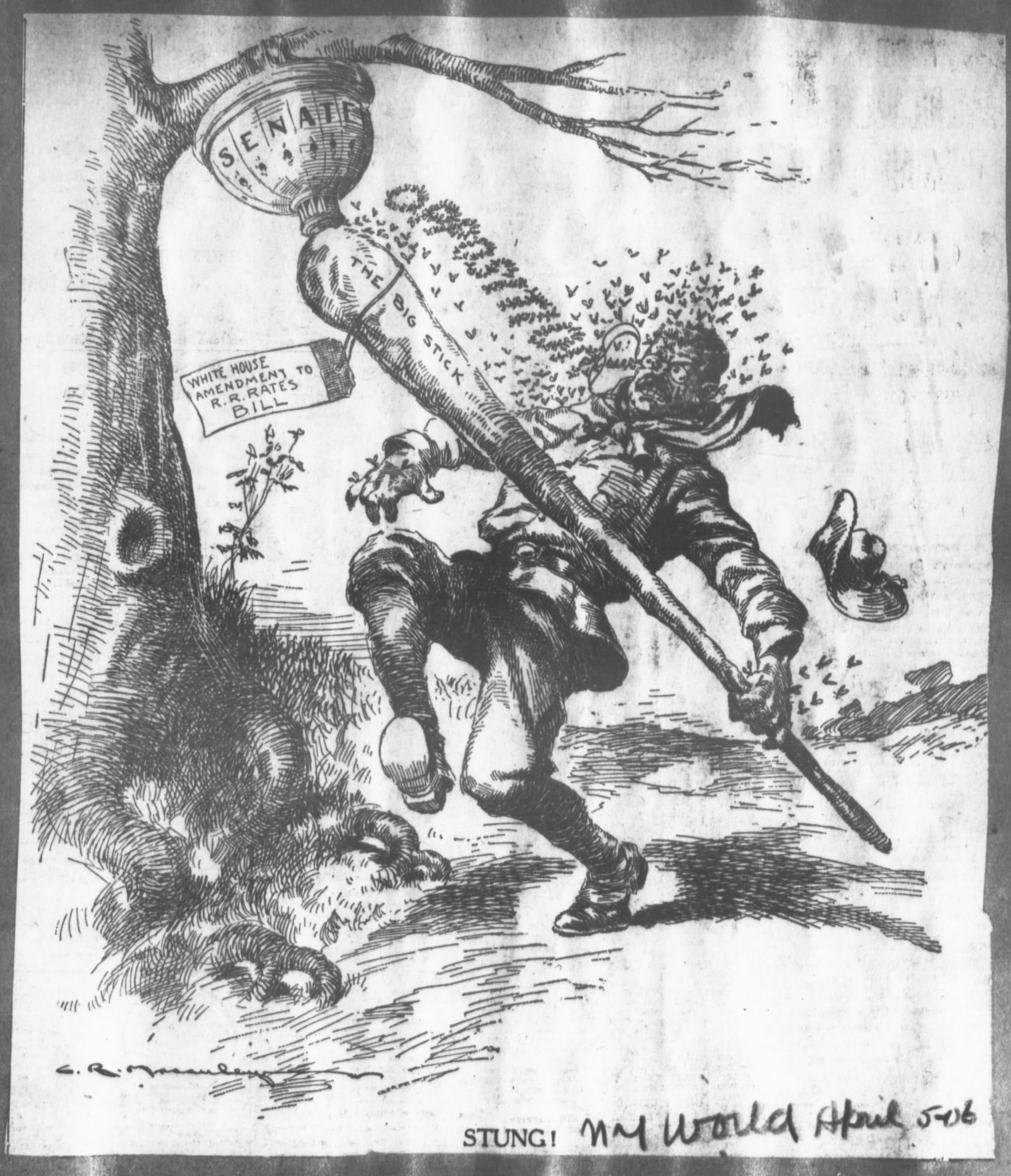
Unlike Donahey’s Roosevelt who appears to narrowly escape the presidential bee swarm, Macaulay’s Roosevelt is not as lucky, as a number of bees labeled “Opposition” swarm out and sting Roosevelt.
Although we like these two creative renditions of Roosevelt and swarming bees, our favorite cartoon featuring an annoying bee is McKee Barclay’s “Talking to Germany” cartoon. In this cartoon, Roosevelt isn’t being chased by bees; instead, he is the bee annoying President Woodrow Wilson.
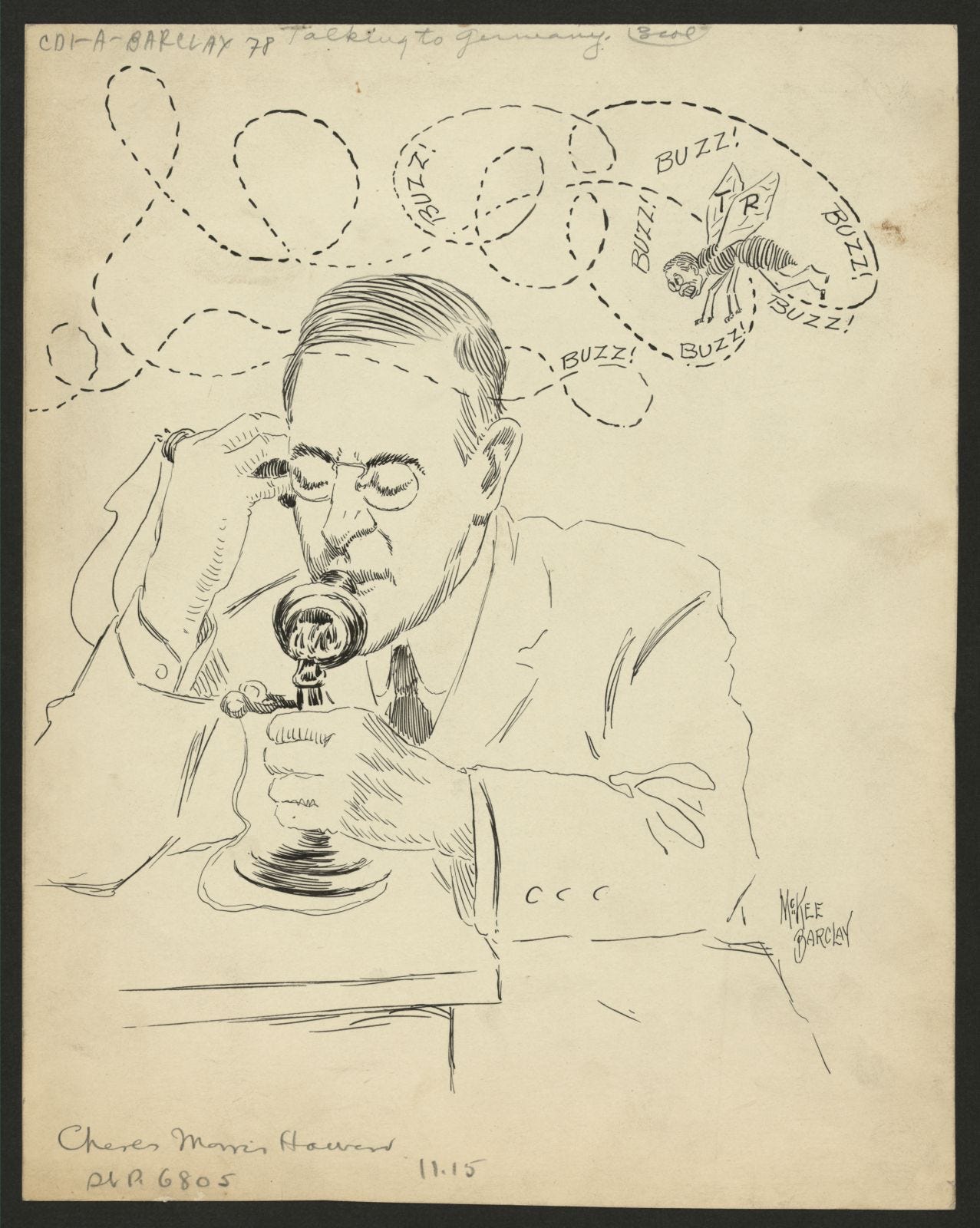
We’ve also included a close-up of Roosevelt the bee below for full effect. In our humble opinion, Barclay did a wonderful job capturing Roosevelt’s face in a bee’s body.
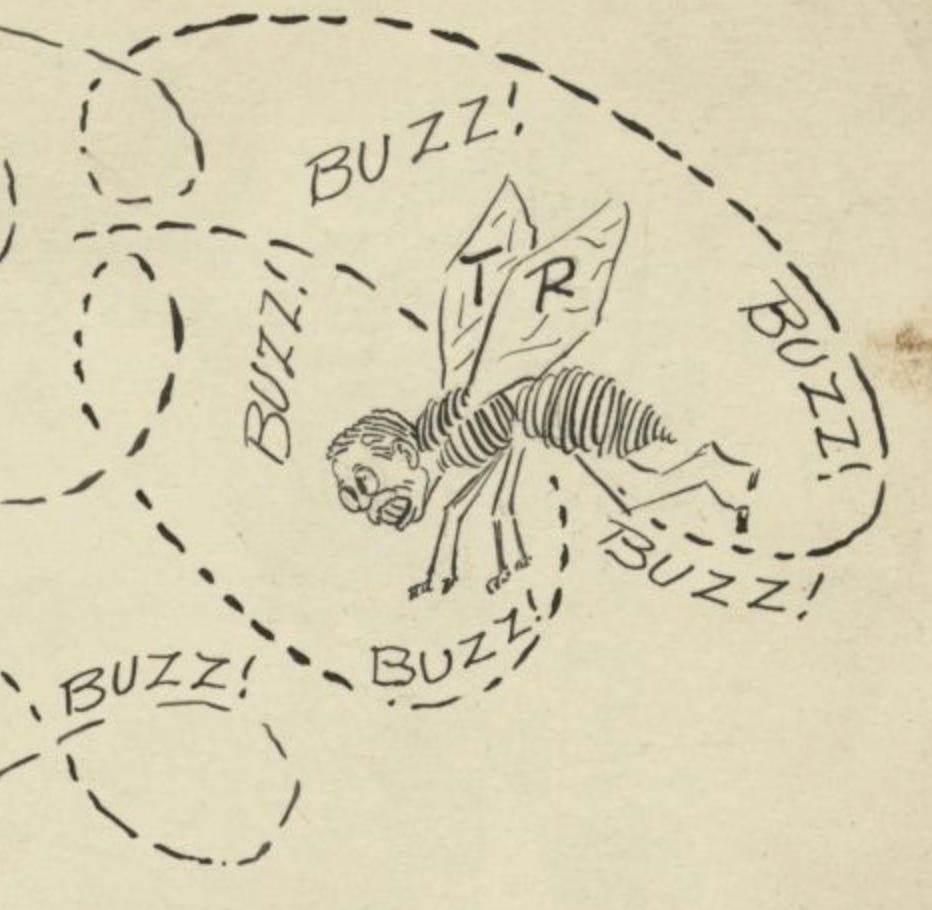
While Barclay’s cartoon focused on Roosevelt’s fierce criticism of Wilson’s handling of Germany during World War I, it also is an accurate depiction of Roosevelt’s overall disapproval of the Wilson administration—both foreign and domestic.
As you may know, Roosevelt didn’t mince words about his feelings toward Wilson. Take, for example, Roosevelt’s 1916 letter to former Rough Rider Charles C. Bull, “[Wilson is] the most wretched creature we have had in the Presidential chair; and we have had some pretty weak sitters there.” The only aspect that might have made Barclay’s cartoon more accurate is if Roosevelt the bee had stung Wilson! (Or maybe not since Roosevelt’s political power of Wilson was somewhat limited.)
Bees Symbolizing a Crowd of Support
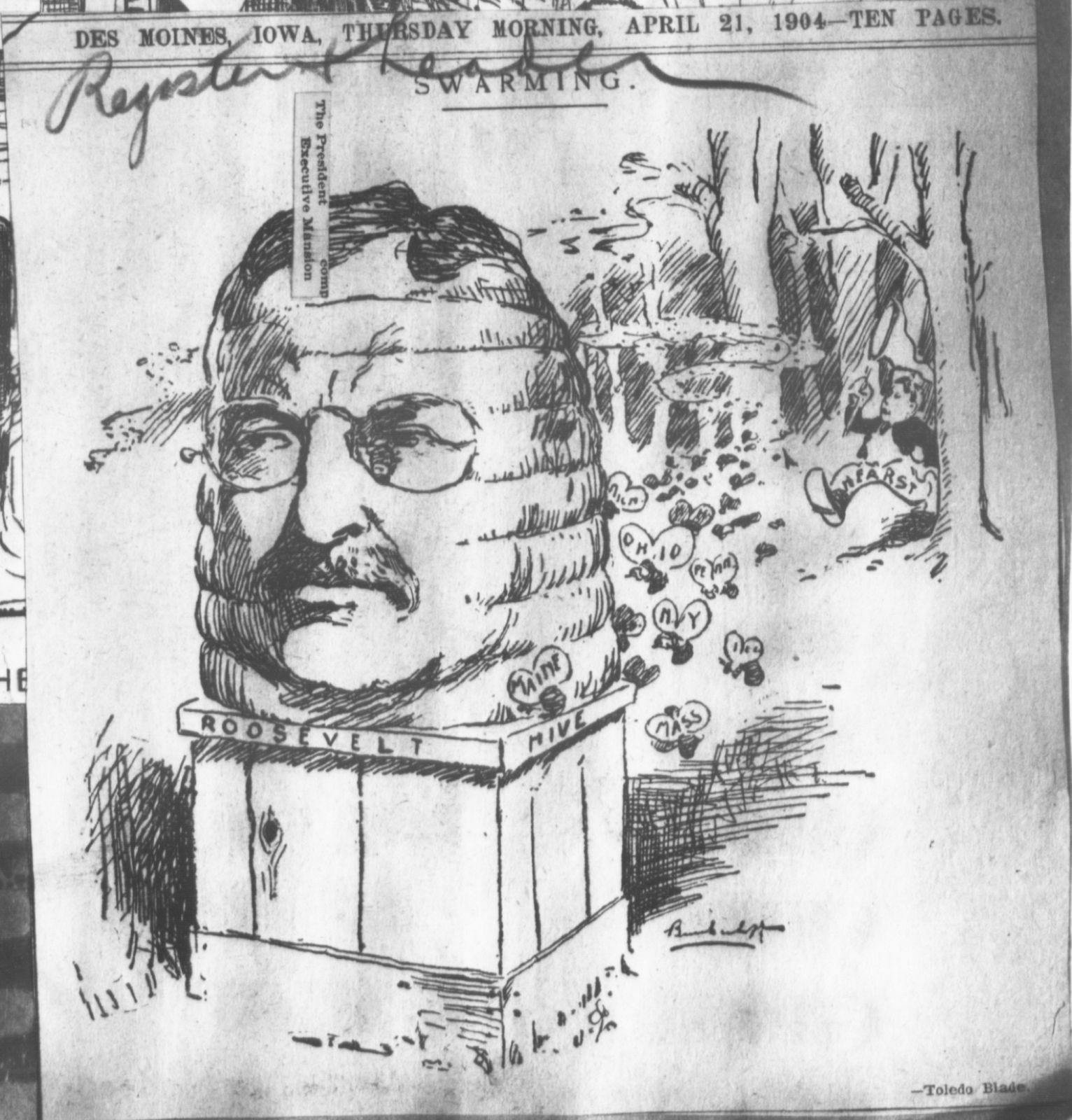
In the final cartoon that features bees connected to Roosevelt in some way, Roosevelt isn’t the bee; rather, he’s the beehive. Drawn by R.M. Brinkerhoff, this cartoon features bees swarming to the hive, symbolizing Roosevelt’s immense popularity in the various states.
In the background, William Randolph Hearst, a newspaper publisher running as a Democratic candidate in the 1904 election, is shown with a net trying to capture bees labeled as different American states. Ultimately, he wasn’t able to capture the imagination of the American public like Roosevelt had.
Moreover, Hearst lost the nomination to a more conservative Democratic candidate, Judge Alton B. Parker. But during the brief time he was a presidential candidate, Hearst ran an energetic campaign against Roosevelt, which Brinkerhoff captured in this cartoon.
Roosevelt’s depiction as a large beehive was an apt one, as he demonstrated his popularity in November 1904 when he defeated Parker soundly. Roosevelt was the first presidential candidate to receive over three hundred electoral votes and won the popular vote by the largest margin in the span of a hundred years between 1820 and 1920.
Other Rooseveltian Apian Anecdotes
As interesting as we found these six cartoons, we were even more entertained by an anecdote about his youngest son Quentin that Roosevelt included in a 1908 letter to his other son Archie. We are including the quotation in its entirety so you can enjoy Roosevelt’s description in his own words.
“[Quentin] has become greatly interested in bees, and the other day started down to get a beehive from somewhere, being accompanied by a mongrel-looking small boy as to whose name I inquired. When repeated by Quentin it was obviously an Italian name. I asked who he was and Quentin responded, ‘Oh! his father keeps a fruit stand’. However, they got their bees all right and Quentin took the hive up to a school exhibit. There some of the bees got out and were left behind (‘poor homeless miserables’, as Quentin remarked of them), and yesterday they at intervals added great zest to life in the class room. The hive now reposes in the garden and Scamp surveys it for hours at a time with absorbed interest. After awhile he will get to investigating it and then he will find out more than he expects to.”
Unfortunately, we weren’t able to find out if anything happened with the bees and Scamp, a black-and-tan dog which Roosevelt called a cross between their dogs, Skip, a rat terrier, and Jack, a Manchester terrier. However, we do wonder if he ever decided to investigate the hive or if Quentin had moved on to other hobbies by that point.
If you’d like to read more of Roosevelt’s reflections on bees, check out this linked section of African Game Trails where he discusses a honey bird leading Kermit and him to bee trees.
The cartoons are so cool!