

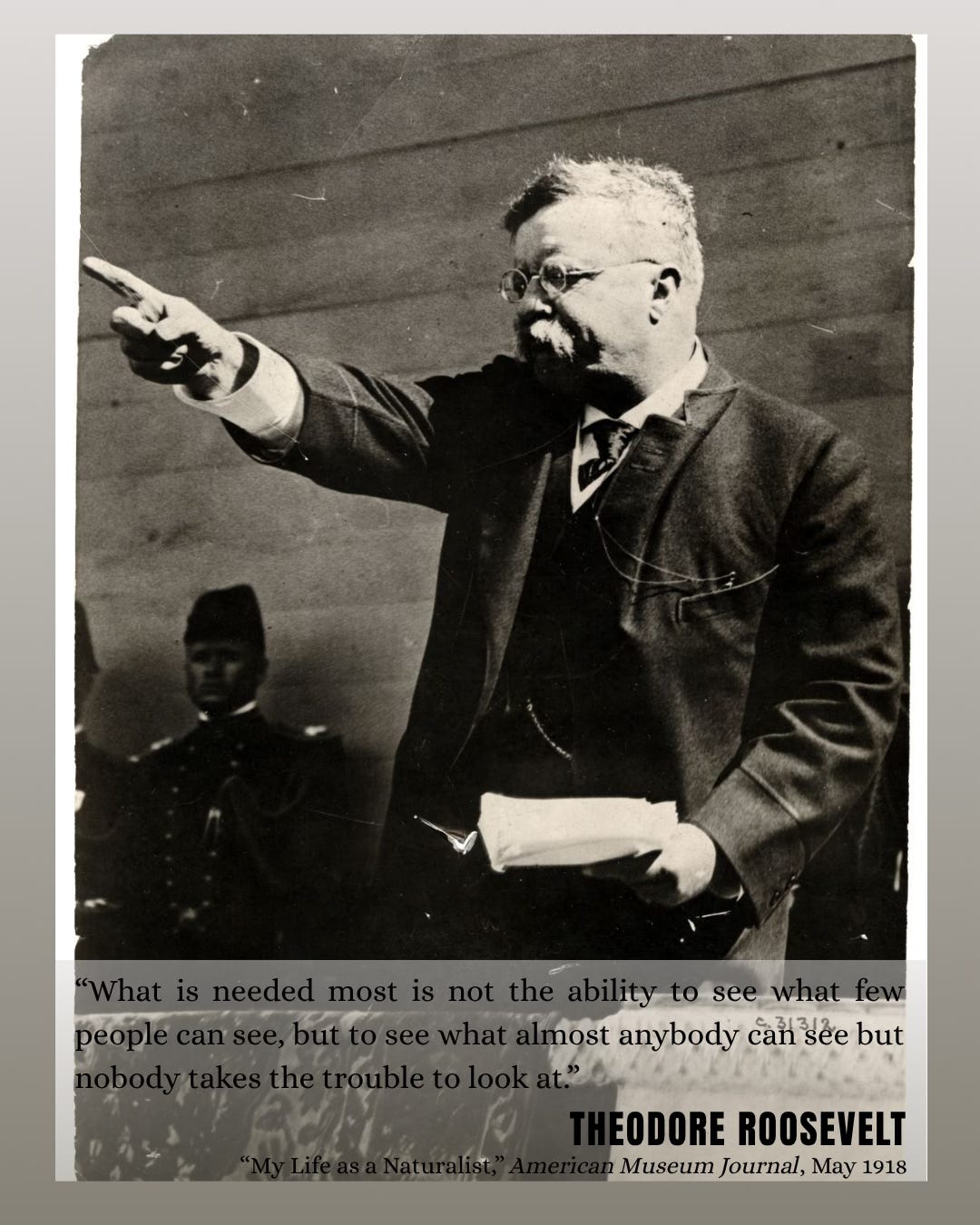
Near the very end of his life, Theodore Roosevelt wrote a piece for the American Museum Journal titled simply, “My Life as a Naturalist.” As we’ve mentioned in a previous Substack post, Roosevelt saw himself as an old-school naturalist his entire life. (He refused to use the modern-day word of biologist.)
Roosevelt’s entire article is worth reading, as it captures his love of nature in his own words. We could have chosen a number of lines from it for today’s #WednesdayWisdom but ultimately selected the following.
“What is needed most is not the ability to see what few people can see, but to see what almost anybody can see but nobody takes the trouble to look at.”
Roosevelt penned this line in the context of talking about how although he never lost his love for natural history, he regretted that he didn’t describe more about the big game he encountered in the Badlands of North Dakota when he had the opportunity to do so. He then followed up with examples of when he did describe animals in his travels.
Even though Roosevelt was a man of action who took the next step rather than theorizing about the 200th step, he also believed in taking the time to pause and observe. While his reflections about observation are certainly true of science, we think it is also more broadly applicable in life.
Roosevelt was able to see things that others didn’t because he paid attention and he cared about the small things. There are countless examples in his letters to his children when he mentioned something minute that he knew would interest them and sometimes even drew pictures of the scene.
For example, as Roosevelt wrote in a January 29, 1901 letter to his nine-year-old daughter Ethel from Keystone Ranch, “You would be much amused with the animals round the ranch. The most thoroughly independent of them is a large white pig which we have christened Maud.”
Although we don’t often call Roosevelt a man of observation, we think it’s a description that should be more associated with him.
Read the entire article here and find other gems like Roosevelt’s last line of the article in which he wrote, “[W]hile my interest in natural history has added very little to my sum of achievement, it has added immeasurably to my sum of enjoyment in life.”
One sees what one knows is a maxim from medical school. I think this may be the origin of that thought: Thomas Carlyle in 1837 referred to an earlier saying: “the eye sees in it what the eye brings means of seeing”.