
Wednesday Wisdom
Worth His Salt

As we’ve mentioned in previous Wednesday Wisdom posts, Theodore Roosevelt had several phrases that he used over and over again in his writing and speeches, such as “eyes on the stars,” “work worth doing,” and “the man that counts.”
And today we’re featuring yet another we’ve discovered: “worth his salt.” Likely the most notable usage of this phrase comes from Roosevelt’s speech, “The Right of the People to Rule,” in 1912, but we’re aware of at least three other instances in prior writing or speeches.
“Courage and honesty – no man is worth his salt as a citizen unless he has both. And both of them together aren’t enough. I don’t care how brave and how honest a man is, if he is a natural born fool you can do little with him.” ~Remarks at Lexington, Kentucky, September 6, 1902 (speech)
“Each one of us that is worth his salt is trying to do his share in working out the problems that are before all of us now at the beginning of the twentieth century.” ~ Address before the Grand Lodge of Pennsylvania, November 5, 1902 (speech)
“[T]he father . . . if he is worth his salt, must in every way back up the mother in helping bring up the children.” ~ Letter from Theodore Roosevelt to Mrs. E. H. Merrell, January 31, 1907 (letter)
“The leader for the time being, whoever he may be, is but an instrument, to be used until broken and then to be cast aside; and if he is worth his salt he will care no more when he is broken than a soldier cares when he is sent where his life is forfeit in order that the victory may be won. In the long fight for righteousness the watchword for all of us is spend and be spent.” ~“The Right of the People to Rule,” 1912 (sound recording)
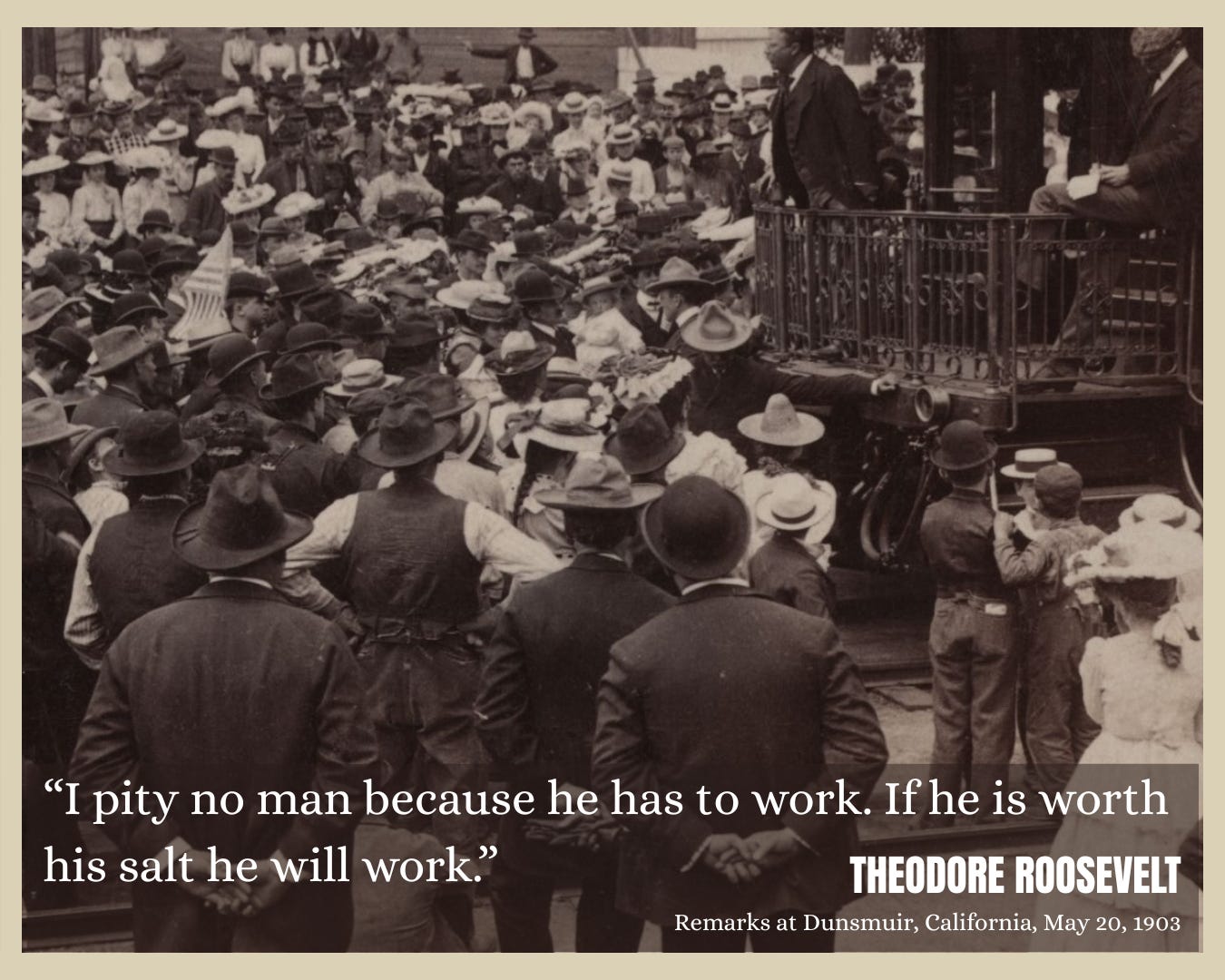
Although we could have chosen any of these, we ultimately selected another example for today’s #WednesdayWisdom: “I pity no man because he has to work. If he is worth his salt he will work.”
This usage of “worth his salt” comes from a brief speech Roosevelt delivered in Dunsmuir, California on May 20, 1903 on his whistle-stop tour across the United States. (The image we selected also was taken during Roosevelt’s stop at Dunsmuir.)
While the quotation sounds like other things Roosevelt said about work throughout his whistle-stop tour, the setting for this particular quotation was unique. Dunsmuir was a mountainous town in northern California near Mount Shasta, a stratovolcano at the southern end of the Cascade Range that is the second-highest peak of the Cascades.
Although the people of Dunsmuir faced unique challenges due to the environment around them, Roosevelt emphasized the commonality they shared with all Americans—the need for courage, honesty, decency, and drive.
In Roosevelt’s short speech of less than ten minutes (he only stopped from 11:40 a.m. to 11:50 a.m. in Dunsmuir), he remarked on the beauty of the area, praised the citizens of California for their work in making the state “what she is,” and encouraged them to continue working hard and acting “squarely.”
Apparently, Roosevelt made enough of an impression that the citizens of Dunsmuir wanted to hear him speak again eight years later in 1911 when they sent a telegram to Roosevelt requesting that he stop and deliver a short address.
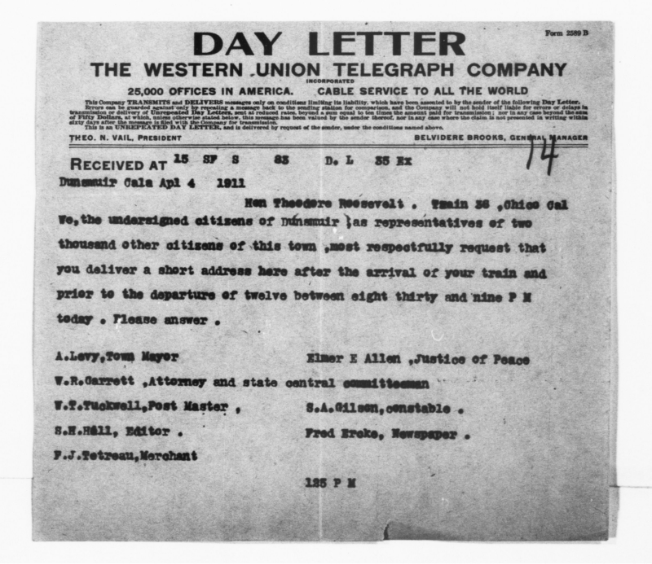
We weren’t able to find a copy of his remarks in 1911, so we think if he did speak, it was a very brief address. Although Roosevelt would return to California two more times during his life in 1912 and 1915, he didn’t go back to Dunsmuir, making his 1903 visit all the more significant to the people of Dunsmuir.
Read Roosevelt’s entire 1903 speech praising the people of California and Dunsmuir and their work here.
Good stuff!