
Wednesday Wisdom
Promoting Direct Democracy

On this day in 1912, Theodore Roosevelt delivered his “Confession of Faith” speech before the National Convention of the Progressive Party in Chicago, Illinois.
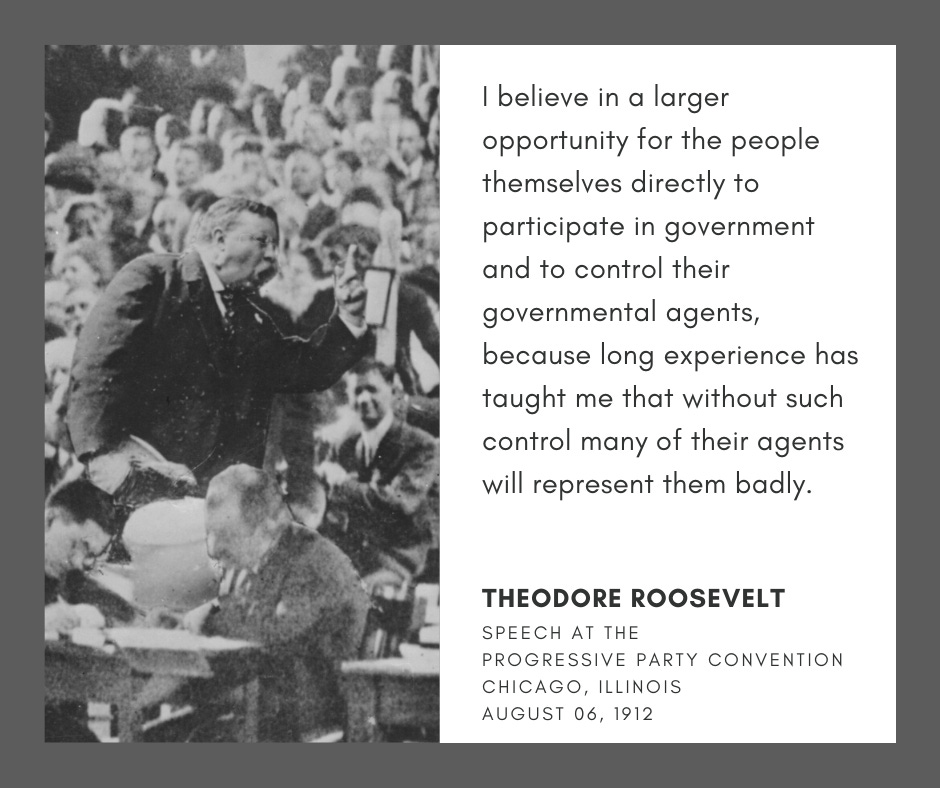
Frustrated with traditional party politics and the obstructions he faced in government, Roosevelt became a more radical advocate of direct democracy in the years following his presidency, including the presidential primary. Republicans held their first primaries in thirteen states in 1912. Roosevelt won nine. As far as he was concerned, this entitled him to the Republican nomination for president.
(One of those he lost, interestingly, was North Dakota! Senator Robert M. “Fighting Bob” La Follette was the winner, and Woodrow Wilson took the state in the general election.)
Still, due to party machinations — of which Roosevelt had previously been the beneficiary — he lost the nomination to the incumbent President Taft. Believing he would have won the nomination under a more widespread primary system, Roosevelt accused the Republican Party of corruption, incompetence, and even of fraud in seating delegates. To some extent, Roosevelt was correct - both malicious methods and general incompetence had caused him to lose votes in primaries, especially in New York. However, it is unclear whether this was enough to change the outcome. Roosevelt and his delegates walked out and subsequently formed the Progressive Party, sometimes better known as the Bull Moose Party, due to Roosevelt’s use of the bull moose as a symbol of his strength.
In his speech at the Progressive Party convention, he denounced the old party system as outdated and dangerous. “It is, from the standpoint of our country, wicked as well as foolish longer to refuse to face the real issues of the day,” he said. “Only by so facing them can we go forward; and to do with we must break up the old party organizations and obliterate the old cleavage lines on the dead issues inherited from fifty years ago. Our fight is a fundamental fight against both of the old corrupt party machines, for both are under the dominion of the plunder league of the professional politicians who are controlled and sustained by the great beneficiaries of privilege and reaction.”
After he systematically addressed the countries’ most pressing issues – labor and industrial reform, conservation, the cost of living, and the tariff, just to name a few – he made clear that he was not simply speaking academically. “Now, friends, this is my confession of faith,” he said. “I have made it rather long because I wish you to know just what my deepest convictions are on the great questions of today, so that if you choose to make me your standard‑bearer in the fight you shall make your choice understanding exactly how I feel—and if, after hearing me, you think you ought to choose someone else, I shall loyally abide by your choice. The convictions to which I have come have not been arrived at as the result of study in the closet or the library, but from the knowledge I have gained through hard experience during the many years in which, under many and varied conditions, I have striven and toiled with men.”
Finally, he made the case that the entirety of democracy was at stake, and that he needed his supporters to join him in defending it. Bellowing angrily as his speech concluded, he said, "We fight in honorable fashion for the good of mankind; fearless of the future; unheeding of our individual fates; with unflinching hearts and undimmed eyes; we stand at Armageddon, and we battle for the Lord."
Read the full speech as it was published in pamphlet form in our digital library: https://www.theodorerooseveltcenter.org/Research/Digital-Library/Record?libID=o291875