
Wednesday Wisdom
Many Deeds to Do

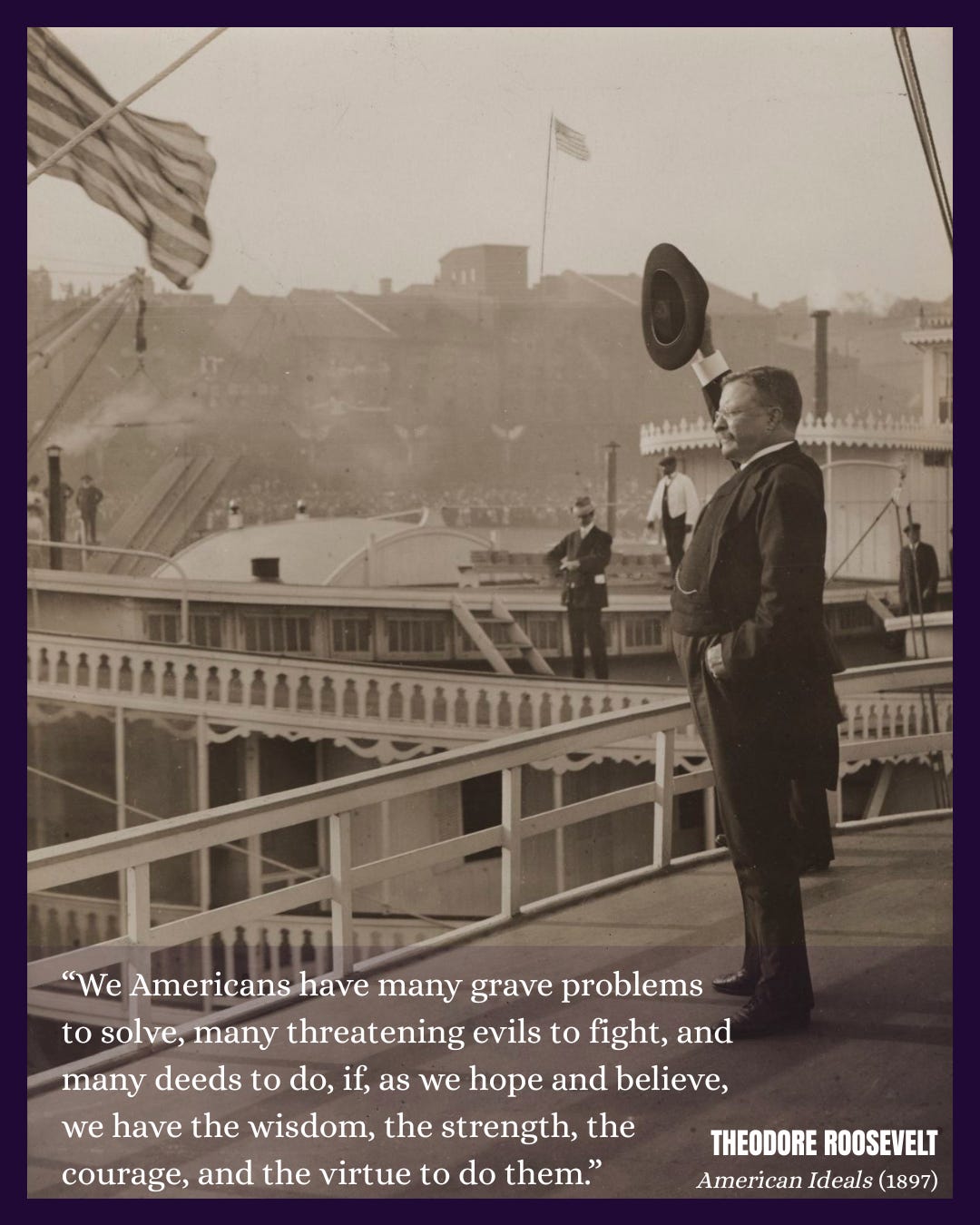
In 1897, G.P. Putnam’s Sons published Theodore Roosevelt’s collection of essays entitled American Ideals—the same year he became assistant secretary of the Navy in April. Although he would become a household name a year later after the charge up Kettle Hill with the Rough Riders, Roosevelt was starting to rise in national prominence in 1897.
American Ideals, a three-hundred-plus-page work contained fifteen essays, one of which was entitled, “True Americanism,” an essay originally published in The Forum in April 1894—the same month and year his son Archie was born. In this essay, Roosevelt defined what Americanism meant to him in the modern world in which he was living
There are many quotable lines from this essay. In fact, we had initially planned to select another as today’s #WednesdayWisdom. But when we read through the entire essay, we decided on this sentence, which is a great example of the literary device, schesis onomaton, or a series of successive, synonymous expressions.
“We Americans have many grave problems to solve, many threatening evils to fight, and many deeds to do, if, as we hope and believe, we have the wisdom, the strength, the courage, and the virtue to do them.”
In Roosevelt’s mind, Americans needed to face the modern world with a proper understanding of Americanism, which he defined in three ways. First, he contrasted nationalism with localism and sectionalism. Of course, Roosevelt strongly supported local communities and was heavily involved in his community of Oyster Bay, New York, regularly serving as the town’s Santa Claus, but not at the expense of prioritizing the village over the nation.
Roosevelt next emphasized his belief that patriotism was a virtue, rather than a vice. He did not support those who preferred cosmopolitanism to love of their country. He believed it was better to be a “first-class American” than a “second-class imitation of a Frenchman or an Englishman.” Roosevelt disagreed with those who went over to Europe for an education, believing it was better for Americans to be “brought up among his fellow Americans.”
Finally, he believed that Americanism meant “newcomers” becoming Americans. Throughout his political career, Theodore Roosevelt campaigned vociferously against what he called “hyphenated Americans.” He did not want people to be “German Americans” or “Irish Americans.” Rather, he thought they should just be called Americans. In Roosevelt’s mind, “To bear the name of American is to bear the most honorable of titles . . .”
Roosevelt concluded the essay as he began it, emphasizing the importance of Americans of all nationalities and creeds banding together to face the problems currently facing the world, standing “shoulder to shoulder” and being “in very truth Americans.”
Read the entire “True Americanism” essay and the other fourteen essays in American Ideals here.