
Wednesday Wisdom
Out of Doors

by Rachel Lane
In addition to being commander-in-chief, Theodore Roosevelt could also be called birder-in-chief. He had a lifelong passion for birding, which was more “bird shooting” than birdwatching when he was young although that changed as he got older.
Roosevelt kept lists of birds he had seen, including in Europe, Syria, and Egypt during an 1872-1873 trip; in and around Oyster Bay, Long Island, printed in 1879; in and around the White House and in Washington, DC published in 1908; and even overseas in England when doing a bird walk with Viscount Edward Grey in 1910.
And of course, Roosevelt’s first published work—even before The Naval War of 1812—was a list of birds he and his friend, H.D. Minot, compiled in 1877 of birds they had seen in the Adirondacks between 1874 and 1877.
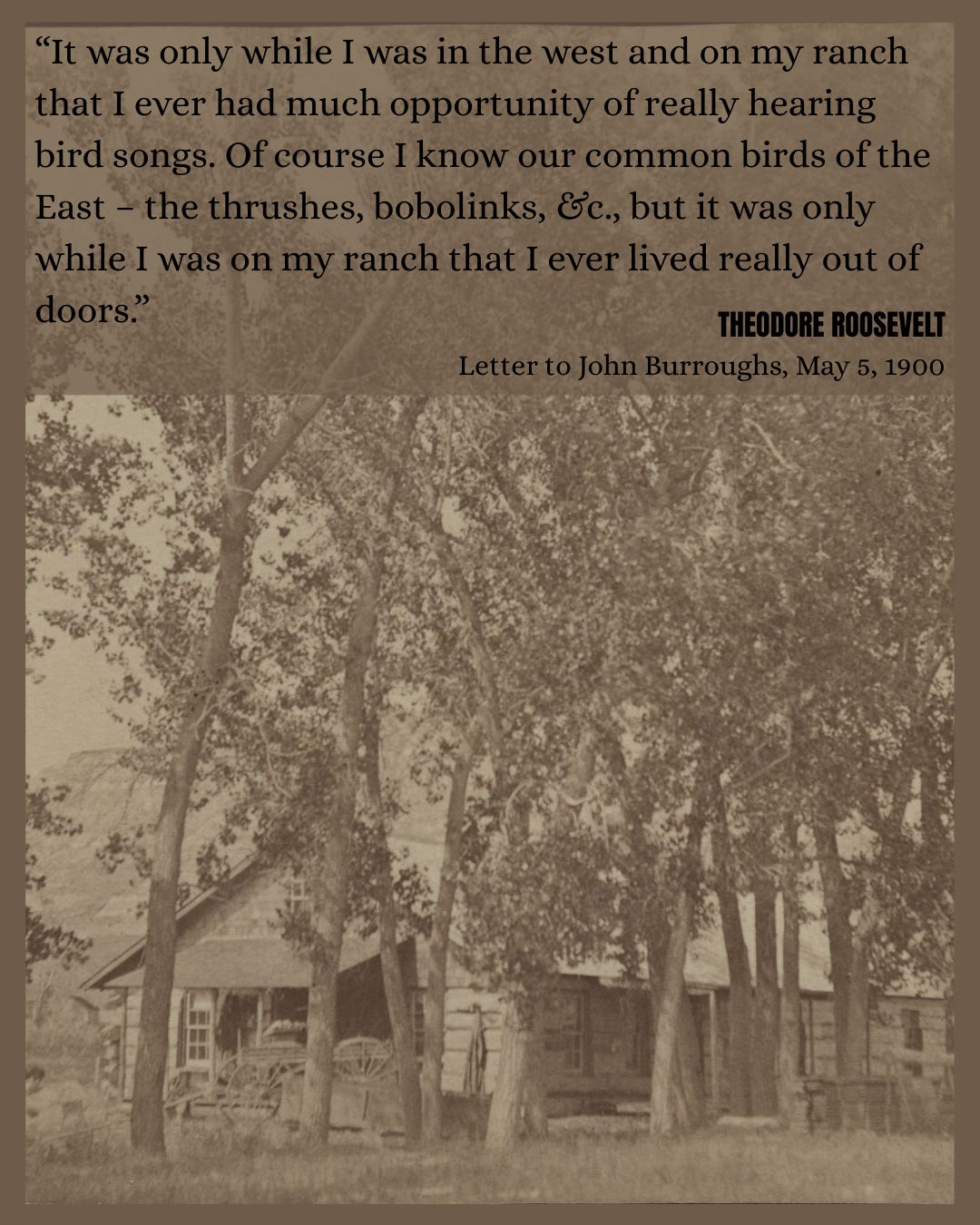
One would think that Roosevelt would have affirmed that he spent much time living outside and hearing bird songs on the East Coast. However, according to today’s Wednesday Wisdom, as Roosevelt wrote in a 1900 letter to his friend, John Burroughs, it was only on his ranch that he “really” heard bird songs and “lived really out of doors.”
Roosevelt memorialized in great detail the birdsong he heard in Dakota Territory in and around his ranch in several books—often emphasizing the Western meadowlark, today the state bird of North Dakota.
In The Wilderness Hunter (1893), Roosevelt wrote that the Western meadowlark and the plains skylark were “among the most attractive singers to which I have ever listened.” He thought the meadowlark ought “to rank with the best,” on the same level of the European skylark and nightingale, which Roosevelt called “birds with literary associations.”
Even while president, Roosevelt didn’t forget the birdsong of the meadowlark, writing in Outdoor Pastimes of an American Hunter (1905), “I love to hear the Eastern meadow lark in the early spring; but I love still more the song of the Western meadow lark.”
These passages reveal Roosevelt’s lifelong love of the West, especially as seen through birds. Perhaps he was reflecting on his encounters with nature when he said during a whistle stop in Medora in September 1900, “[I]n this country of hills and plateaus the romance of my life began.”
Although Roosevelt would visit many other wild places across the country and the world from Yellowstone and Yosemite to Africa and the Amazon (and observe many other birds), the Badlands of North Dakota—and birds in it—would always be near-and-dear to his heart.
If you want to read more about Roosevelt’s birdwatching, you might enjoy this 2010 article in the Theodore Roosevelt Association Journal.
Nice article.