
Wednesday Wisdom
Never Draw Unless You Mean To Shoot

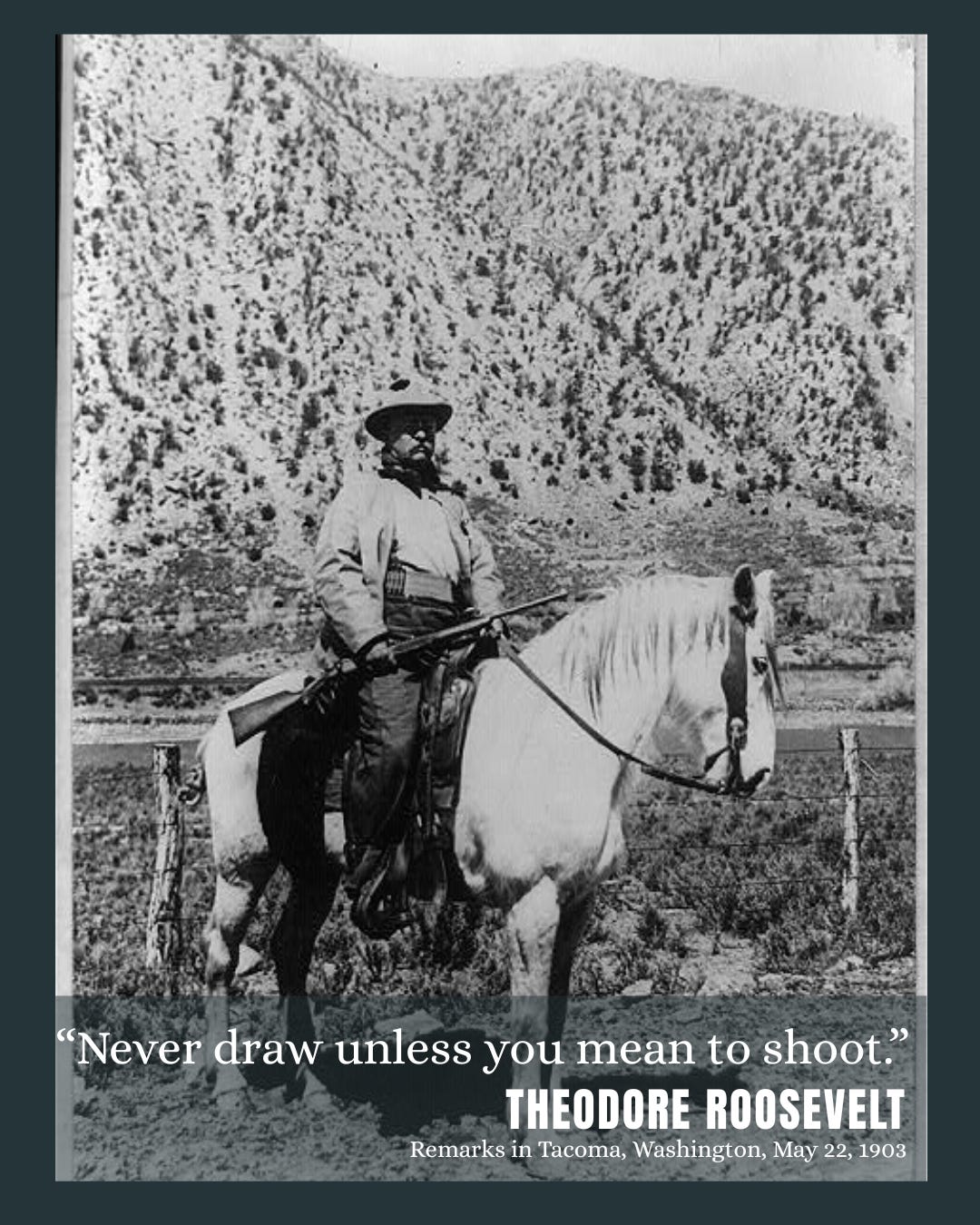
One of the phrases we most associate with Theodore Roosevelt wasn’t one that he created, but rather was a proverb he popularized: “Speak softly, and carry a big stick.” But this wasn’t the only proverb Roosevelt used in his speeches.
Today’s #WednesdayWisdom is another proverb that Roosevelt used occasionally in speeches, including in at least four different speeches in three different states in the span of one week during his tour of the West in 1903.
Just as Roosevelt adapted the African proverb to his political beliefs, so too did he take a frontier proverb and apply it in a different context: “Never draw unless you mean to shoot.”
To give you a sense of how he workshopped this phrase much like a stand-up comedian with jokes, we are including the context of this proverb for all four speeches.
Remarks in Tacoma, Washington (May 22, 1903): “I wish to say just one word this afternoon to you here in this City of Destiny, in this city by the Sound, on our foreign policy, and upon what must ever be the main prop of any good foreign policy—the American Navy. In the old days, when I first came to the Little Missouri, there was a motto on the range, ‘Never draw unless you mean to shoot.’ That is a pretty sound policy for a nation in foreign affairs. Do not threaten; do not bluster; above all, do not insult other people; but when you make up your mind that the situation is such as to require you to take a given position, take it and keep it, and have it definitely understood that what you say you are ready to make good.”
Remarks in Tekoa, Washington (May 26, 1903): “Our foreign policy can be summed up very briefly. We must not wrong the weak and we must not flinch from the strong; we must avoid that sure sign of the weak man or the weak nation — bluster. Do not threaten; do not talk. In the old days when I was in the cow business myself we had a saying: “Never draw unless you mean to shoot.” That is a good policy for the nation too. Do not say anything in the way of threat or abuse of other nations; always speak courteously of them.”
Remarks in Ogden, Utah (May 29, 1903): “No good comes of speaking insultingly of other nations. On the contrary, it is the mark of a weak man to bluster always. I used to live in the cow country myself, and we had a proverb there, which ran: ‘Don’t draw unless you mean to shoot.’ Now, that is pretty good sense for a nation as well as for an individual. Don’t make claims that we are not prepared to back up; don’t talk loosely or loudly as to what we will do to other nations in a way that will cause them to feel that we are acting in an insulting and aggressive way. Treat them with courtesy—with absolute courtesy—and that having been done, make up our minds what the interests and the honor of America require stake it, and make it good when staked.I believe in the Monroe Doctrine with all my heart and soul, and I intend to see that it is made good. I believe that our interests in the Pacific are such that we need always to be ready to protect them in the Atlantic; you can keep this nation in the position she has attained only by going on with the building up of the United States navy.”
Remarks in Cheyenne, Wyoming (May 30, 1903): “This nation in dealing with foreign affairs with other nations should follow just that which we regard as right for a private citizen. In my day there was one kind of man who was not respected in the West It was a man who talked and boasted and threatened, and when the pinch came, didn’t make good. Just so with our nation.
In other words, act in accordance with a proverb I heard in the old days when I myself lived in the cow country. The proverb ran: ‘Don’t draw unless you mean to shoot.’ I ask that you apply that nationally. I believe for instance in the Monroe Doctrine, with all my heart. I believe we should be prepared to back that doctrine up to any extent, if it became necessary, but the only way it can be done is by building an efficient navy; by keeping it up by constantly building and keeping in the best condition, afloat in sea practices, such magnificent battleships as the Wyoming, the ship named after your own state.”
As Roosevelt explained in each of the four speeches, this proverb was one he learned during his time ranching in the North Dakota Badlands—what he called “cow country.” Since we’re based in North Dakota, we’re especially dee-lighted by this week’s Wednesday Wisdom because it demonstrates how pivotal Roosevelt’s time in the North Dakota Badlands was to him.
In each of these four speeches, Roosevelt could have used his tried-and-true aphorism of “Speak softly, and carry a big stick,” when speaking about international diplomacy, the Monroe Doctrine, and the ability of the United States to back up its claims with the Navy, but instead he turned to wisdom from the Badlands, thus demonstrating that even as president, the Badlands were never far from his mind.
But 1903 was hardly the only year Roosevelt used this proverb. Two years later during a visit to Dallas, he included it in his remarks. In 1910, he mentioned it in a letter to his presidential successor, William Howard Taft.
Finally, the last instance we could find of Roosevelt using it was in his book, The Foes of Our Own Household, published in 1917 during World War I, which argued that the greatest foes of the United States were not foreign powers but political corruption and a lack of military preparedness.
If you’re interested in reading more of the speeches, here are all four of his remarks in Tacoma, Washington, Tekoa, Washington, Ogden, Utah, Cheyenne, Wyoming that include some variation of today’s Wednesday Wisdom.