
Wednesday Wisdom
Man of Words and of Action

On this day in 1915, Theodore Roosevelt spoke before the American Historical Congress at the Native Sons’ Hall in San Francisco, California. The American Historical Congress was a weeklong series of meetings of historians, educators, and administrators from around the world, convened by the National Education Association.
Roosevelt was just one among a number of important figures who spoke over the course of the event, which occurred partially in conjunction with the Panama-Pacific Exposition in San Francisco. For example, King Alfonso of Spain sent as an envoy his director-general of elementary education, Professor Rafael Altamira y Crevea. (Crevea spoke about how Spain was endeavoring to invest their money in education rather than in war.) Roosevelt was invited to attend and speak as a guest of his friend, Dr. Benjamin Ide Wheeler, a philologist and the President of the University of California.
The purpose of Roosevelt’s address, primarily, was to explain and justify his actions regarding his role in the construction of the Panama Canal. (Traffic had been flowing through the Canal for not even a year at this time; it opened after a decade of construction in August 1914.) He discussed his desire that the United States have sole dominion over the Canal and negotiations with other countries, particularly Colombia, to acquire the rights and land to build it. Roosevelt viewed the Panama Canal as both his greatest achievement as president (although he left office before it was completed), and the greatest engineering feat in the history of mankind. Therefore, it was imperative to him that the historical record reflect his role in its development.
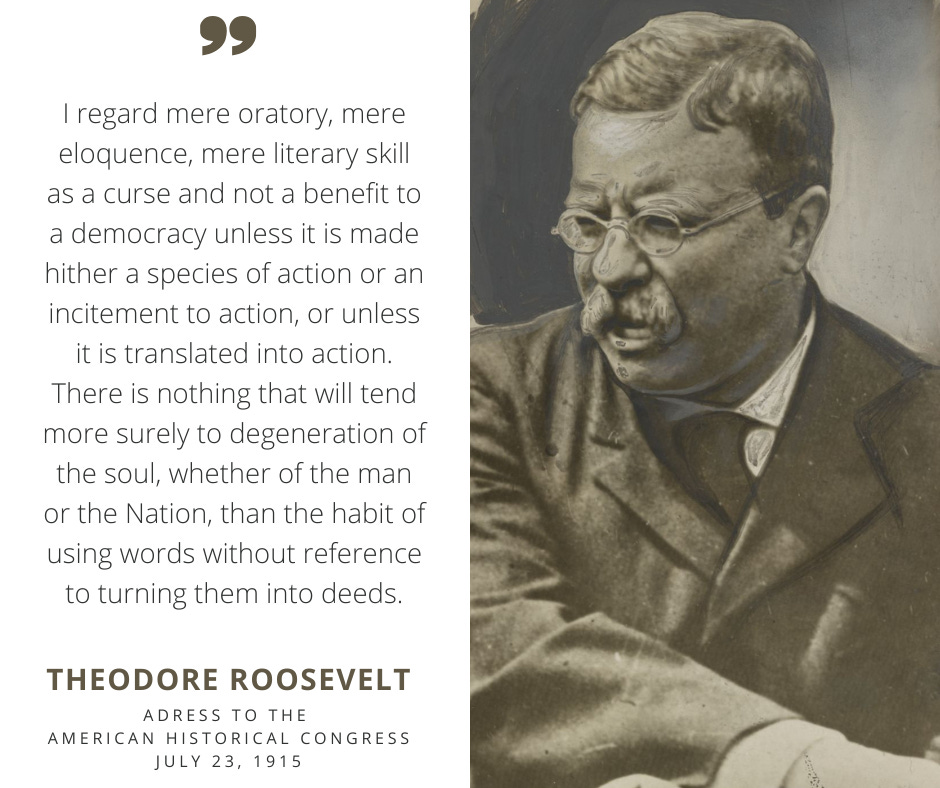
But Roosevelt, being Roosevelt, also used this opportunity to make much bigger arguments about the importance of actions and deeds that back up one's words. Echoing his earlier and more famous address, “Citizenship in a Republic” (better known as “The Man in the Arena due to its most famous passage), Roosevelt argued that words were not only worthless but harmful if they were not supported with decisive action. “And when as President I said anything to my own people or to a foreign people, big or little, I meant it,” he said to applause. “And the other party knew I meant it.”
Read the full address in our digital library: https://www.theodorerooseveltcenter.org/Research/Digital-Library/Record?libID=o288746
Walks up to a bunch of teachers and admins and tells me “your words mean nothing if you don’t act on them.” Such a boss.