
Wednesday Wisdom
Joy in Outdoor Nature and Books

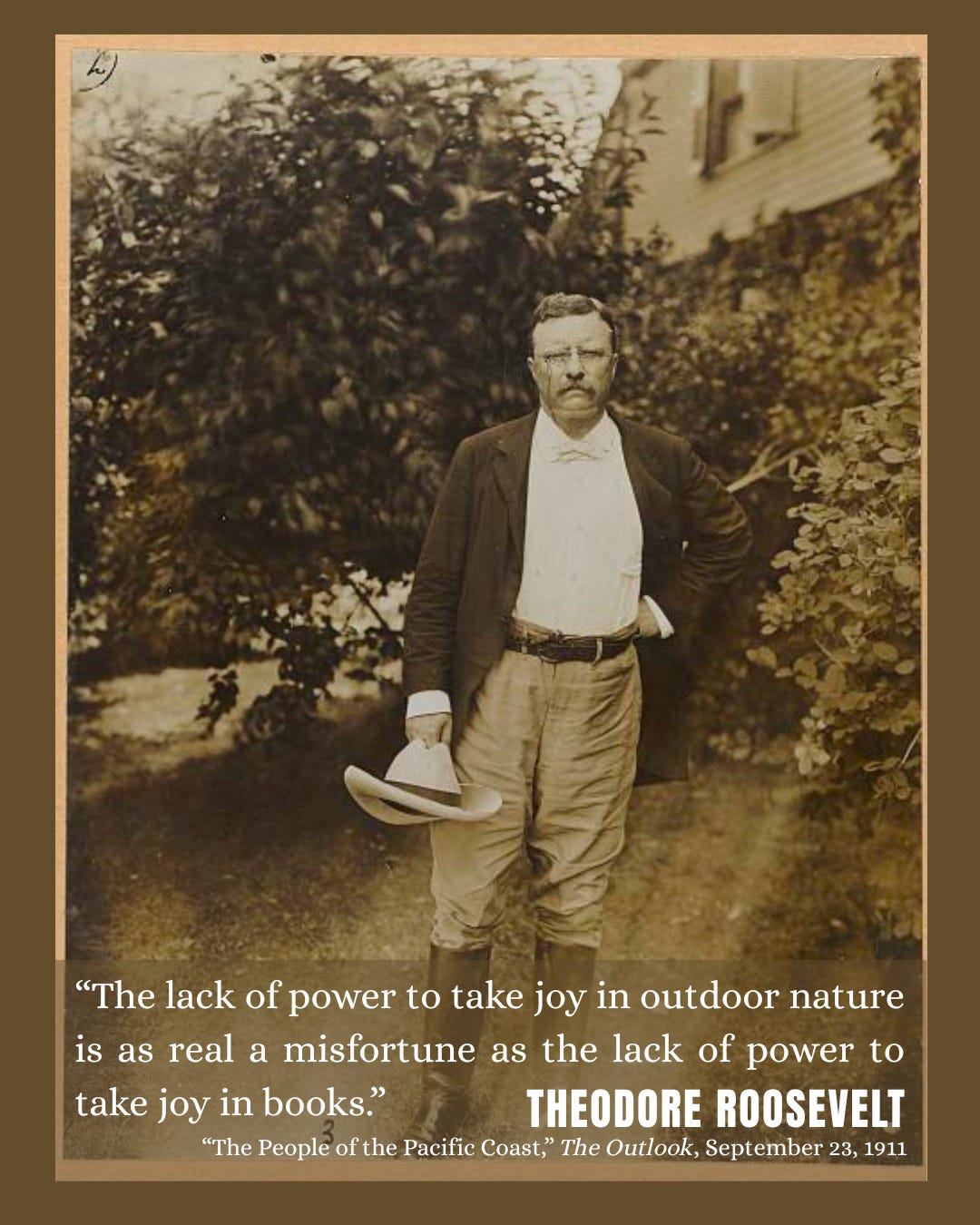
As we mentioned in our April Fools’ Day post this year, there are plenty of quotations attributed to Theodore Roosevelt on the internet, and of course, not all of them are true!
And what we find particularly frustrating is when a quotation is listed with attribution to Roosevelt but with no particular source or location from which the quotation came, which makes it tricky to verify if a quotation was actually said by Roosevelt or not. It can take a good bit of digging to finally track it down—as was the case for today’s #WednesdayWisdom.
Because it took a lot of effort to source today’s quotation, Rachel thought our readers might enjoy learning a little bit more about the research process for our Wednesday Wisdom posts in particular, so we’re sharing some more behind-the-scenes looks at our research and writing process.
Rachel’s sister is a copyeditor, and she noticed an epigraph in a book she was copyediting with a quotation attributed to Roosevelt: “The lack of power to take joy in outdoor nature is as real a misfortune as the lack of power to take joy in books.”
She tried to verify the quotation herself first, but Google kept suggesting that it came from Chapter IX of Roosevelt’s Autobiography. When she searched for the quotation there, she couldn’t find it. So she reached out to Rachel to inquire if Roosevelt actually said it.
Interestingly, even before her sister told her about Google suggesting Chapter IX of the Autobiography, Rachel’s first thought was that the quotation reminded her of a quotation from that chapter.
When her sister shared that the quotation in question was on the National Park Service website for Theodore Roosevelt National Park in North Dakota, Rachel figured it was a real quotation from Roosevelt but didn’t know where it was from.
Since the first two sentences of the NPS site said, “This page contains numerous quotes used currently or in past versions of the park website. Many of the quotes listed here are from Theodore Roosevelt’s popular books Hunting Trips of a Ranchman and The Wilderness Hunter,” Rachel tried searching in those two books but came up with nothing.
Since Google hadn’t worked for her sister, she tried snippets of the quotation in Google Books, and the only hits that came up with more epigraphs attributed to Roosevelt with no source listed. So she decided to try Newspapers.com and stumbled upon an older article that referenced the quotation and noted that it came from an article by Roosevelt published in The Outlook in 1911.
Rachel figured out the title of the article, went to the list of Roosevelt’s writings on our website to find a link to the original source, and finally found the quotation on the last page of Roosevelt’s article, “The People of the Pacific Coast.”
As far as the quotation itself, it is significantly more succinct than the long paragraph in Chapter IX of Roosevelt’s Autobiography, better capturing an ideal that Roosevelt upheld his entire life: that books and nature went hand-in-hand.
What’s unique about how Roosevelt communicated this ideal in today’s Wednesday Wisdom is the context in which it was written. “The People of the Pacific Coast” was a short editorial about Roosevelt’s travels to California, Oregon, and Washington State earlier in the year in 1911 in which Roosevelt expressed admiration for those who lived in these states.
Near the end of the editorial, Roosevelt gave two examples of cultural life in Oregon and mentioned how impressed he was by Governor Oswald West of Oregon (who happened to be a Democrat).
As Roosevelt wrote, “In Governor West, of Oregon, I found a man more intelligently alive to the beauty of nature and of harmless wild life, more eagerly desirous to avoid the wanton and brutal defacement and destruction of wild nature, and more keenly appreciative of how much this natural beauty should mean to civilized mankind, than almost any other man I have ever met holding high political position.”
After remarking on his appreciation for nature, the paragraph concluded with today’s Wednesday Wisdom, emphasizing how much Roosevelt valued those who took joy in nature just as he did—whether they lived on the East Coast or the West Coast.
You can read Roosevelt’s entire article here to discover more of his thoughts on the Pacific Slope as well as encounters with nature in the Pacific Northwest.