
Friday Fun
"A Taste for Ghost Stories"

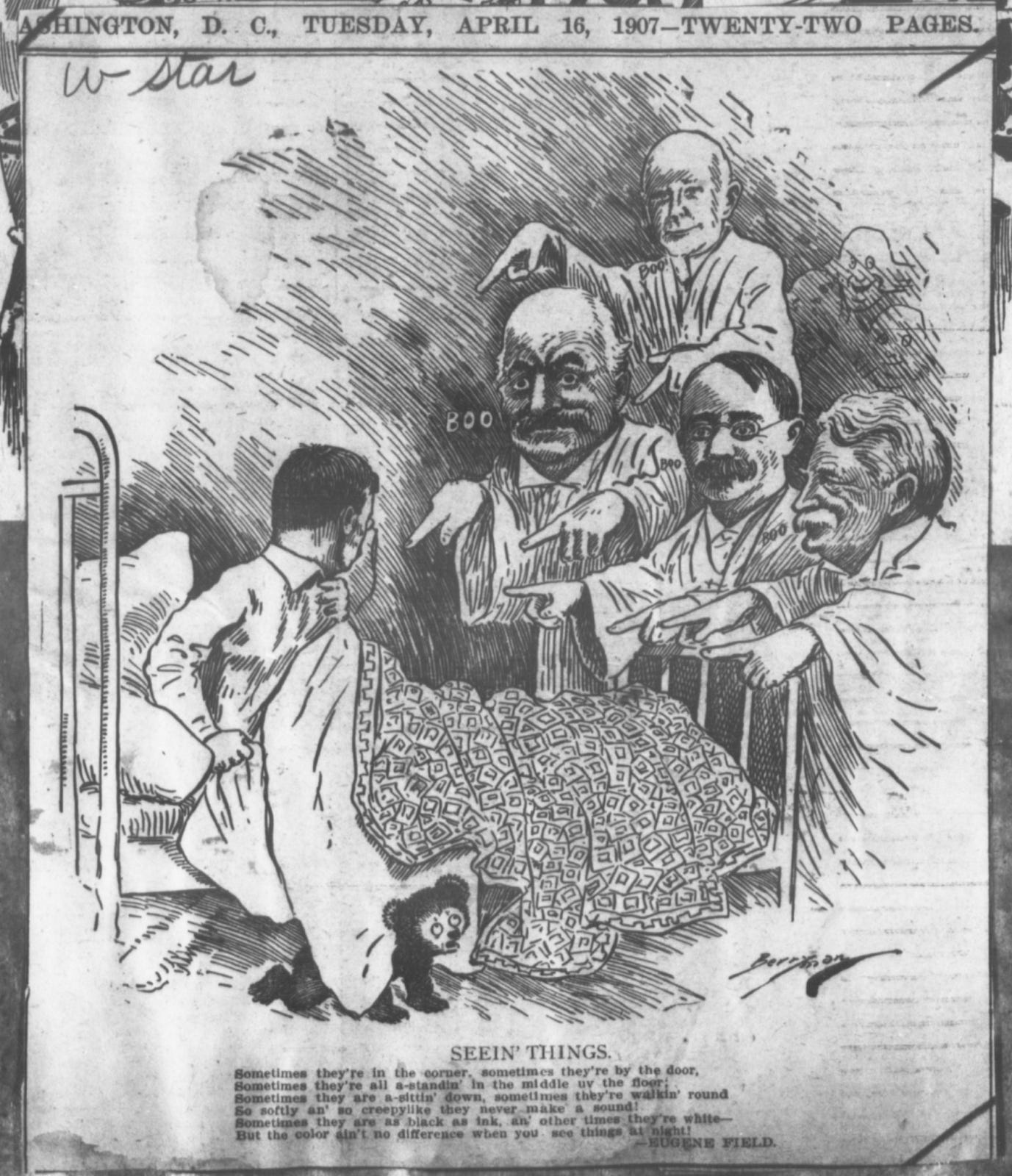
For a special spooky Friday Fun on Friday the 13th and in honor of National Reading Month, we’re dee-lighted to look at Theodore Roosevelt’s guilty pleasure: reading ghost stories.
We at the Theodore Roosevelt Center have long called Roosevelt the “readingest” and “writingest” president. He was known for reading a book a day, sometimes even up to three books a day, as his great-grandson, Tweed Roosevelt, notes.
And Roosevelt didn’t just stick to one genre. He enjoyed history and political science books about Lincoln and other statesmen of the past like Pericles, classic children’s literature like Alice’s Adventures in Wonderland and The Wind in the Willows, and family favorites, The Semi-Attached Couple by Emily Eden and A Pilgrim’s Progress by John Bunyan.
None of those books probably surprise any Tedhead, but the fact that Roosevelt liked what he called “ghost stories” might—as it did for me. As Roosevelt’s aide, Archibald Butt, remembered, “[Roosevelt] is fondest, he says, of history and biography, and when he goes to light literature he wants ghost or detective stories.”
I personally stumbled across Roosevelt’s love of ghost stories while researching for the post about Roosevelt’s visits to other countries. In a lengthy letter to David Gray, there was the following offhand sentence about Roosevelt’s visit to the University of Cambridge in 1910: “Moreover, as I have a taste for ghost stories, I enjoyed meeting the head of one of the colleges - King - whose ‘Ghost Stories of an Antiquary’ make, I think, the best volume of ghost stories I have ever read.”
Since I’m not a ghost-story lover myself, I didn’t immediately know the collection Roosevelt referred to and had to look it up. The author to which Roosevelt refers was Montague Rhodes James, a noted medieval scholar, provost of King’s College since 1905, and a ghost-story writer. Many today consider him “the principal modern exponent of the English ghost story.”
In 1893, James began his tradition of writing ghost stories for Christmas and reading them to friends. Christmas ghost stories were common during Victorian England, inspired in part by Charles Dickens’s A Christmas Carol.
Sometimes James would be rushing to finish that year’s ghost story in time for the 11 p.m. reading, and ink would still be wet on the page as he began to read to his friends, surrounded by complete darkness excepting one solitary light.
As James’s stories became more popular, they were compiled into a collection of eight ghost stories published in 1904—the book that Roosevelt referenced in his letter. The collection included two particularly well-known works of James, “Oh, Whistle, and I’ll Come to You, My Lad,” and “Count Magnus.”
In the brief introduction to Ghost Stories of an Antiquary, James makes a nod to his Christmas tradition noting that most of the stories “were read to friends at Christmas-time at King’s College, Cambridge.”
Although I couldn’t find a letter explaining why Roosevelt loved James’s ghost stories so much, I did discover that he recommended them to family and friends. As Dr. Kathleen Dalton, author of Theodore Roosevelt: A Strenuous Life, mentioned in a 2003 article in the Theodore Roosevelt Association Journal, “[Roosevelt] read across several fields, and along with his love of Irish legends, Greek epic poems, French tales of chivalry, he liked ghost stories and often recommended to friends Montague Rhodes James’ Ghost Stories of an Antiquary.”
Even though we couldn’t find any letters of Roosevelt reflecting on James’s ghost stories, he did reveal his opinions about other ghost stories in different letters to family and friends.
For example, in a 1906 letter to George Cabot Lodge, the son of his friend Massachusetts Senator Henry Cabot Lodge, Roosevelt thanked the younger Lodge for passing along The Turn of the Screw by Henry James. (A hearty thanks to Dr. Hansard for directing me to this letter!)
As Roosevelt wrote to Lodge, “It certainly is one of the most striking ghost stories I have ever read - so striking that I think its memory will always stay with me. Perhaps its quality can best be shown by the fact that it is just as gruesome to think of by daylight as by night.”
But according to Roosevelt’s aide, Archibald Butt, Roosevelt expressed disgust for “the Henry James kind of ghosts” two years later. As Butt wrote in a 1908 letter to his mother, Pamela Butt, Roosevelt said, “I want ghosts who do things. . . . I want real sepulchral ghosts, the kind that knock you over and eat fire; ghosts which are ghosts and none of your weak, shallow apparitions.”
In 1908, the example Roosevelt gave of a good ghost story was Francis Marion Crawford’s The Upper Berth, a famous 1885 story that today is considered a classic example of Victorian horror. While The Turn of the Screw is a more psychological ghost story, The Upper Berth features a visceral, physical ghost.
Since Roosevelt particularly enjoyed Crawford’s ghost story in 1908, it is not too surprising that he called Ghost Stories of an Antiquary “the best volume of ghost stories” he had ever read since Crawford and Montague Rhodes James had similar types of ghosts in their works.
In fact, Montague Rhodes James took inspiration from The Upper Berth, considering it “high among ghost stories in general,” as he wrote in a 1927 essay, “Some Remarks on Ghost Stories.”
Beyond reading ghost stories, Roosevelt also liked to tell them while camping out with his children. After a dinner of beef steak and potatoes, they would “sit around the fire, wrapped in blankets, and tell bear-stories and ghost-stories, while the children steal furtive glances at the shadows closing in upon the circle of flickering light,” as Roosevelt’s friend Jacob Riis remembered.
And Roosevelt’s children passed along this tradition of campfire ghost stories to their children. As Roosevelt’s grandson, Archibald Roosevelt, Jr., remembered, “My father inherited [Grandfather’s] talent, building up suspense by the tone of his voice, which grew lower and more ominous as the story reached its climax, until we all shivered in excitement and not a little fear.”
In fact, the younger Archibald Roosevelt called his grandfather the “ghost of Sagamore Hill.” But according to Roosevelt’s grandson, his grandfather wasn’t like the ghosts he wanted in his ghost stories. Rather, Roosevelt’s ghost was “merry, vital, and energetic.”
However, Sagamore Hill isn’t the only place you can find Roosevelt’s ghost, as it appears across the country, as Dr. Cullinane explores in Theodore Roosevelt’s Ghost, including in North Dakota’s Badlands. We think that’s a fitting legacy for the man who loved ghost stories.
I love this! And of course he loved ghost stories-- "tell me you're a Scorpio without telling me you're a Scorpio..."