
Roosevelt's Global Arena
Countries Theodore Roosevelt Visited

by Rachel Lane
Theodore Roosevelt was a world traveler who visited five continents (he didn’t go to Antarctica or Australia) and numerous countries. Just like it’s quite the task to compile all the books and articles Roosevelt wrote, it can be hard to keep track of all the places he visited.
This is our attempt to track down and list every foreign country Roosevelt traveled to during his life. Based on our calculations, excluding the United States, Roosevelt visited twenty-eight foreign countries. If you know of one we’re missing, let us know!
Obviously, this article would be excessively long if we attempted to detail Roosevelt’s adventures in all twenty-eight countries. So, while we will list every country that Roosevelt visited, we will only discuss visits to some of the countries in detail.
We’re also going to especially highlight visits you might not know as much about, rather than focusing on well-known trips like the Smithsonian-Roosevelt Expedition or the Roosevelt-Rondon Scientific Expedition. If there’s one location you’d like to learn more about for a future article, let us know.
One final note. Political boundaries and names of countries have changed over time. For consistency and clarity, we have used the modern names for the countries Roosevelt visited in the headings with the terminology he would have used in the paragraphs that follow.
North America (Canada, Panama)
The North American continent includes three major subregions: Northern America, Central America, and the Caribbean. Roosevelt visited all three of these regions with trips to Canada for Northern America, to Panama for Central America, and to Puerto Rico for the Caribbean.
Roosevelt’s visit to the Panama Canal in 1906 was perhaps the most significant of these visits as he was the first president to travel abroad while in office, signaling a new era of presidential diplomacy. He also visited Puerto Rico during the seventeen-day trip, but since Puerto Rico is officially a territory of the United States, we opted not to count it as a country.
Since we recently discussed Roosevelt’s last big game hunt pursuing moose in Canada in 1915, we will take a closer look at his visit to Toronto, Ontario, Canada in November 1917.
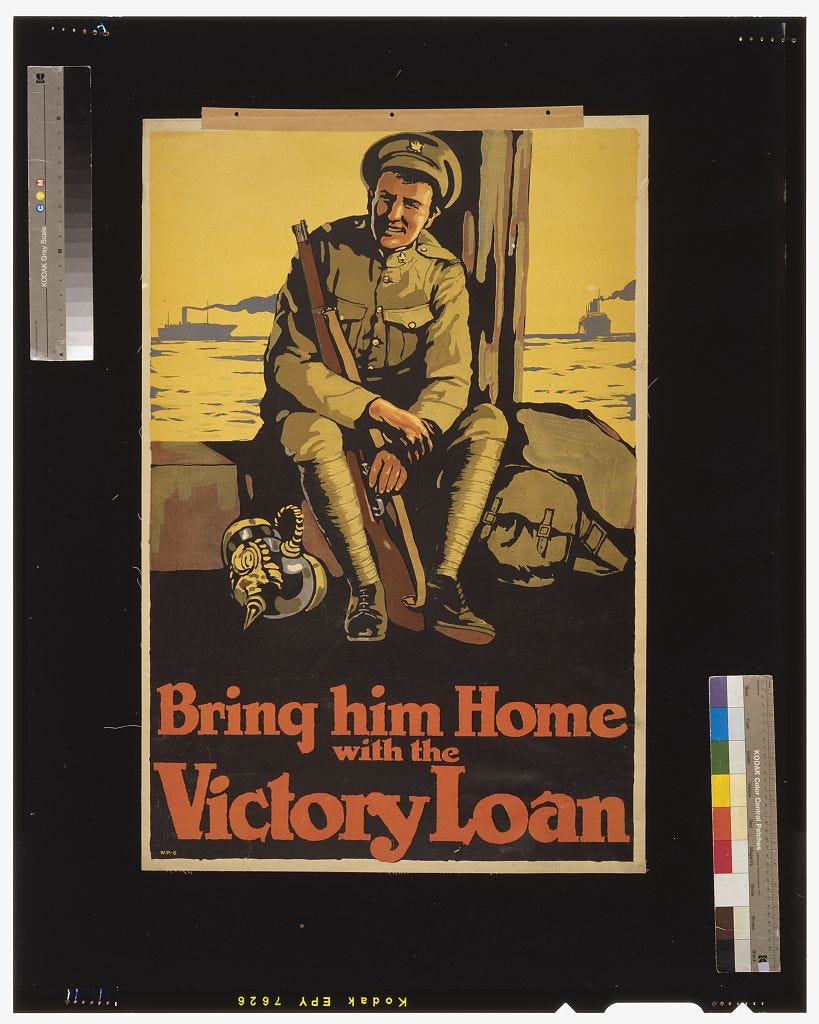
“Bring him home with the Victory loan” was a common slogan in Canadian propaganda, used in this 1915 poster.
On November 26, 1917, Roosevelt “invaded”—to use the wording of one Canadian newspaper—Toronto to launch the final drive for the Canadian Victory Loan with a speech that praised the Canadians for their willingness to send men overseas to the European war as well as raise money through war bonds. He said, “Whatever loans of money, whatever levies of men are needed, you will see that the need is met.”
As Roosevelt mentioned in the speech, this was the first invitation he accepted to speak to Canadians because he felt he could not speak in a formal capacity before the United States had officially entered the war.
Roosevelt also confided to his son Quentin that he decided to accept the invitation this time because “it seemed as if I might really be helping instead of merely doing what I loathe, that is speak as part of an ‘entertainment,’ which is about equivalent to serving as end man in an amateur minstrel show.”
Whether or not his speech was part of an amateur minstrel show or not, Roosevelt was received enthusiastically by the Canadians. One particularly interesting item in the Theodore Roosevelt Digital Library is sheet music for “Sussex By the Sea,” a military march sung “with tremendous success by Frank Oldfield at the Roosevelt Victory Loan Meeting at Toronto Armories before an enthusiastic audience of 20,000 people.”
The trip was also significant for another reason. Edith, Ethel, and Quentin’s fiancée, Flora Payne Whitney—Quentin had formally proposed in September 1917—had joined Roosevelt on the two-day trip to Toronto.
Although not formally a part of the family since Flora and Quentin were not married, the Roosevelts had welcomed Flora with open arms. Flora’s inclusion in this visit to Canada demonstrated that the family considered her a Roosevelt even if she did not have that last name.
South America (Argentina, Brazil, Chile, Paraguay, Uruguay)
Prior to his descent down Brazil’s River of Doubt, Roosevelt went on a speaking tour in South America, stopping in Montevideo, Uruguay; Buenos Aires, Argentina; Santiago, Chile; and Asunción, Paraguay; along with numerous other small towns. The digital library has a variety of resources related to this speaking tour detailed below.
Argentina: speech welcoming Roosevelt, article by Roosevelt, program schedule
Chile: article by Roosevelt, train schedule, speech by Roosevelt
Paraguay: dinner menu
Uruguay: dinner program, article about Roosevelt, article by Roosevelt
We’ve decided to focus our deep dive on Argentina because the invitation to speak at the Museo Social Argentino was the impetus for the entire trip. But instead of looking at the speech entitled “Democratic Ideals,” we’re going to look at a distinctly Roosevelt excursion: spending time in the great outdoors in Patagonia.
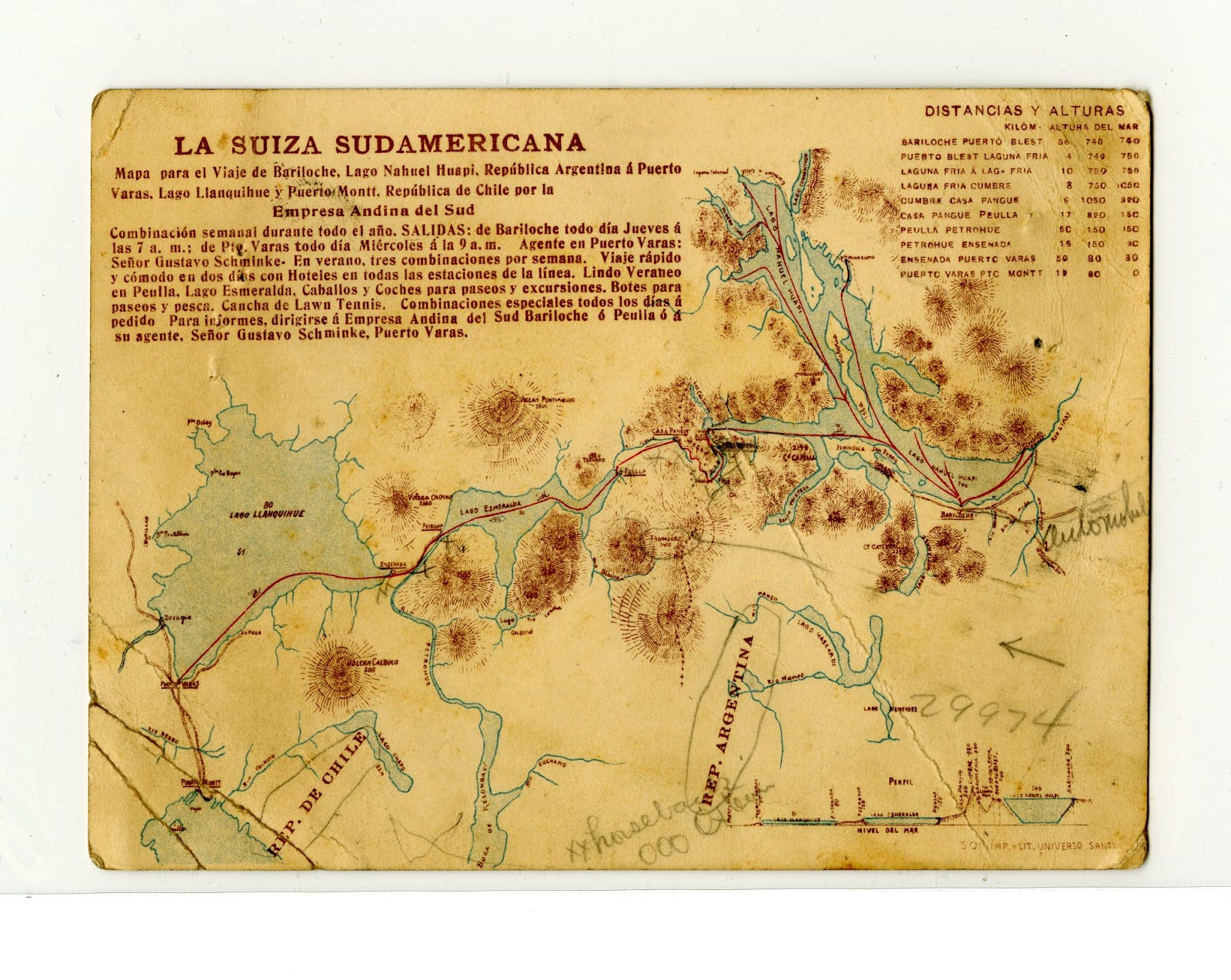
In the digital library, there is a map labeled “La Suiza SudAmerica,” translated “The Swiss South America” of the Lake Nahuel Huapi region with numerous lakes and mountains—a place Roosevelt visited in late December 1913.
There are pencil notations on the map that read “automobile,” “horseback,” and “ox team.” Based on newspaper reports regarding Roosevelt’s modes of transportation—horseback to reach Lake Nahuel Huapi and automobile to leave it—we believe these notations refer to his transportation while there.
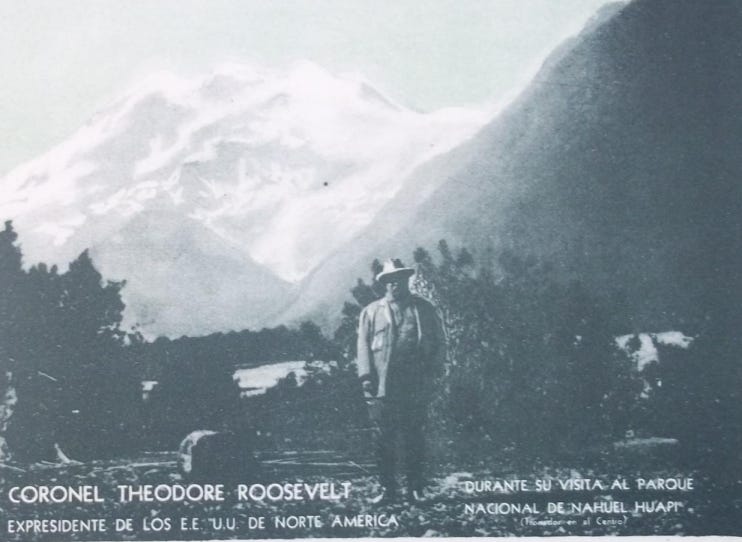
Declared a national park by scientist Francisco “Perito” Moreno in 1903, Lake Nahuel Huapi and the surrounding region officially became Argentina’s first national park—Nahuel Huapi National Park—in 1922.
Although Roosevelt’s visit to the Lake Nahuel Huapi region is often overshadowed by his descent down the River of Doubt, it deserves more recognition. (President Bill Clinton did mention Roosevelt’s stop in a 1997 speech when he visited Nahuel Huapi National Park.)
Roosevelt was delighted by the region, writing in A Book-Lover’s Holidays in the Open (1916), “Then we took horses and rode for a dozen miles to another lake, called Esmeralda or Los Santos. Surely there can be no more beautiful lake anywhere than this!”
Later in the chapter he wrote, “We had been through a stretch of scenery as lovely as can be found anywhere in the world—a stretch that in parts suggested the Swiss lakes and mountains and in other parts Yellowstone Park or the Yosemite or the mountains near Puget Sound.” For a man who was staunchly American, this is true praise indeed!
After Roosevelt’s visit to the region, the automobile trip from Bariloche (outside Lake Nahuel Huapi) to Neuquén, the terminus of the Great Southern Railway—a trip today that takes over five hours by car—was truly Rooseveltian in scope.
It was the first time an automobile had traversed that part of the Andes Mountains and for good reason. As one newspaper reported, the road was “little more than an Andean trail” made by mule trains and ox carts.
Roosevelt’s trip was hardly a passive car ride. Every time the party crossed a stream, they had to lay narrow rock tracks for the wheels of the cars to pass without sinking in the sand. According to a newspaper, “Mr. Roosevelt was the hardest worker in the party, and carried more and larger stones than anyone else.”
Despite their best attempts, the automobiles still got stuck in river beds three times. In one instance, Argentine cowboys, or gauchos, lassoed the cars out with lariats! After reaching the railway in Neuquén, Roosevelt headed out to Cáceres where the real adventure would begin as he met up with the expedition party destined for the River of Doubt.
Europe (Austria, Belgium, Czechia, England, France, Germany, Hungary, Italy, the Netherlands, Norway, Sweden, Switzerland)
Europe was the continent that Roosevelt visited most frequently. He spent time in Dresden, Germany; Tyrol, Austria; Hungary; and modern-day Czechia —known then as Bohemia—during the family’s 1872-1873 trip abroad.
As we discussed in some detail in a previous post, Roosevelt’s first forays into mountaineering were overseas when he ascended Mount Vesuvius on New Year’s Eve in 1869 and the Jungfrau and the Matterhorn in July and August 1881 during a yearlong honeymoon overseas with his first wife, Alice Hathaway Lee.
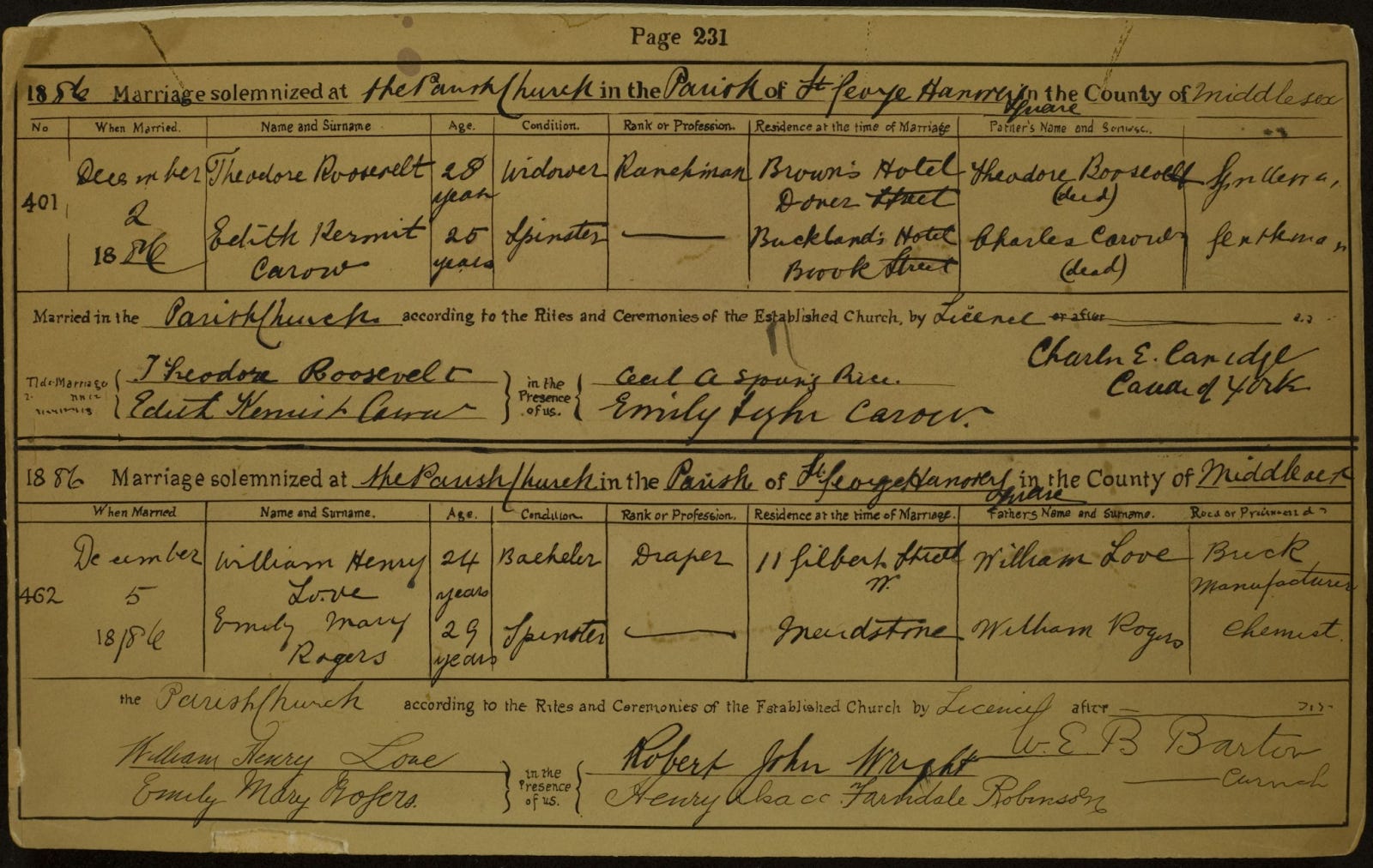
He visited England specifically a number of times, including for his marriage to his second wife, Edith Kermit Carow. They were married at St. George’s parish church in Hanover Square in London on December 2, 1886. (Notice Roosevelt’s occupation on the marriage record above—“ranchman”!)
There are so many visits we could discuss in greater detail that it was hard to choose. Ultimately, we decided to select what Roosevelt himself enjoyed the most. During his 1910 tour of Europe after the Smithsonian-Roosevelt expedition, he made stops in a number of countries, including Sweden, Austria where he reviewed a military brigade in Vienna, and Hungary.
Roosevelt even received and accepted an invitation to ride in a zeppelin by Count Ferdinand von Zeppelin but ultimately wasn’t able to because the zeppelin got caught in some trees and crashed. Roosevelt did end up going to Germany—just not in a zeppelin—and delivered a speech at Berlin University as well as saw the German Army in review.
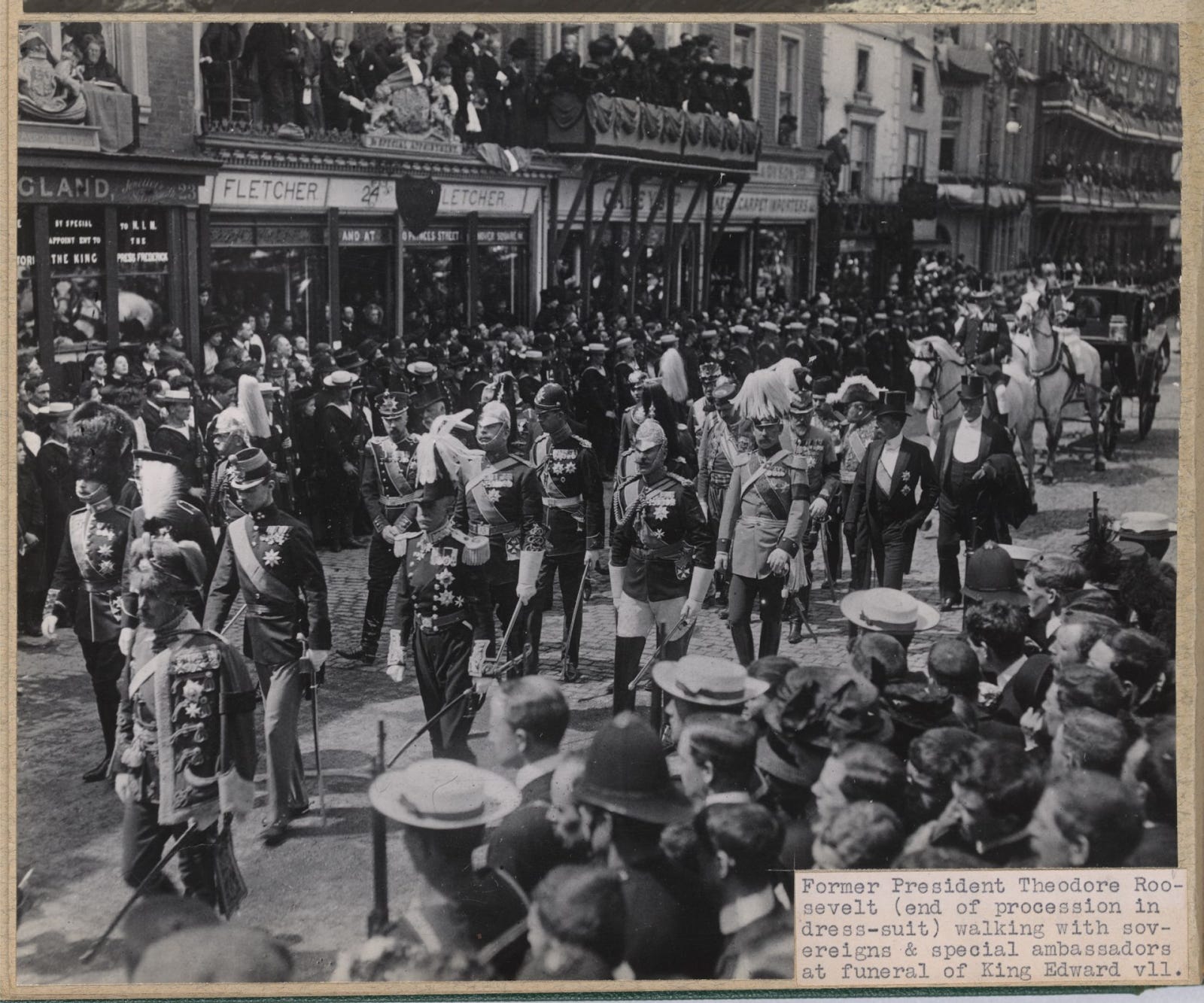
Roosevelt even served as the American special ambassador to the funeral of King Edward VII at the request of President William Howard Taft. Roosevelt attended the dinner held afterward at the State Dining Room in Buckingham Palace. There were sixty guests, twenty-two of which were reigning monarchs. Two were “commoners,” including Roosevelt, according to his personal secretary Frank Harper’s recollections.
Even though most people would likely consider these experiences the highlight of a European vacation, they weren’t Roosevelt’s favorite. As he wrote in a letter to David Gray, he greatly enjoyed his visits to Oxford University where he delivered the Romanes lecture and Cambridge University.
He noted that the students at Cambridge greeted him with a “Teddy Bear seated on the pavement with outstretched paw” and when he received the honorary degree, they attempted to let down “a very large Teddy Bear” upon Roosevelt. (According to Roosevelt, students tried to let down a monkey on Charles Darwin.) He also enjoyed Cambridge because he met Montague Rhodes James, a noted medieval scholar and provost of King’s College, who wrote Ghost Stories of an Antiquary, “the best volume of ghost stories” Roosevelt had ever read.
However, as Roosevelt wrote to Gray, “the twenty four [sic] hours I really most enjoyed not only in England but in all Europe, were those I spent with Edward Grey the last twenty-four hours I was in England.” (If you missed it, read more about Roosevelt’s bird walk with Sir Edward Grey and other birding adventures in our previous post here.)
Africa (Egypt, Kenya, Sudan, Uganda)
Roosevelt’s expedition to Africa in what is modern-day Kenya, Sudan, and Uganda from 1909 to 1910 has been covered extensively in other places, so we will not address it here. After the expedition concluded in Khartoum in modern-day Sudan, Roosevelt spent time in Egypt before heading to Europe.
The 1909-1910 expedition was not Roosevelt’s first trip to Africa. As a teenager, he had spent time in Egypt with his family, including collecting many natural history specimens—mostly birds—which he detailed in his 1872-1873 zoological record.
Fourteen-year-old Roosevelt was effusive in his praise of Egypt, writing in his diary on November 28, 1872: “At eight oclock [sic] we arrived in sight of Alexandria. How I gazed on it! It was Egypt, the land of my dreams; Egypt the most ancient of all countries. A land that was old when Rome was bright, was old when Babylon was in its glory, was old when Troy was taken! It was a sight to awaken a thousand thoughts, and it did.”
Although Roosevelt took in much of the sights and smells in Africa as a teenager, there was one experience that he didn’t have until his return from the expedition as an adult. Although he mentioned seeing camels in his diary as a teenager, it does not appear that he ever rode one until March 1910—an experience he was less than enthralled with.
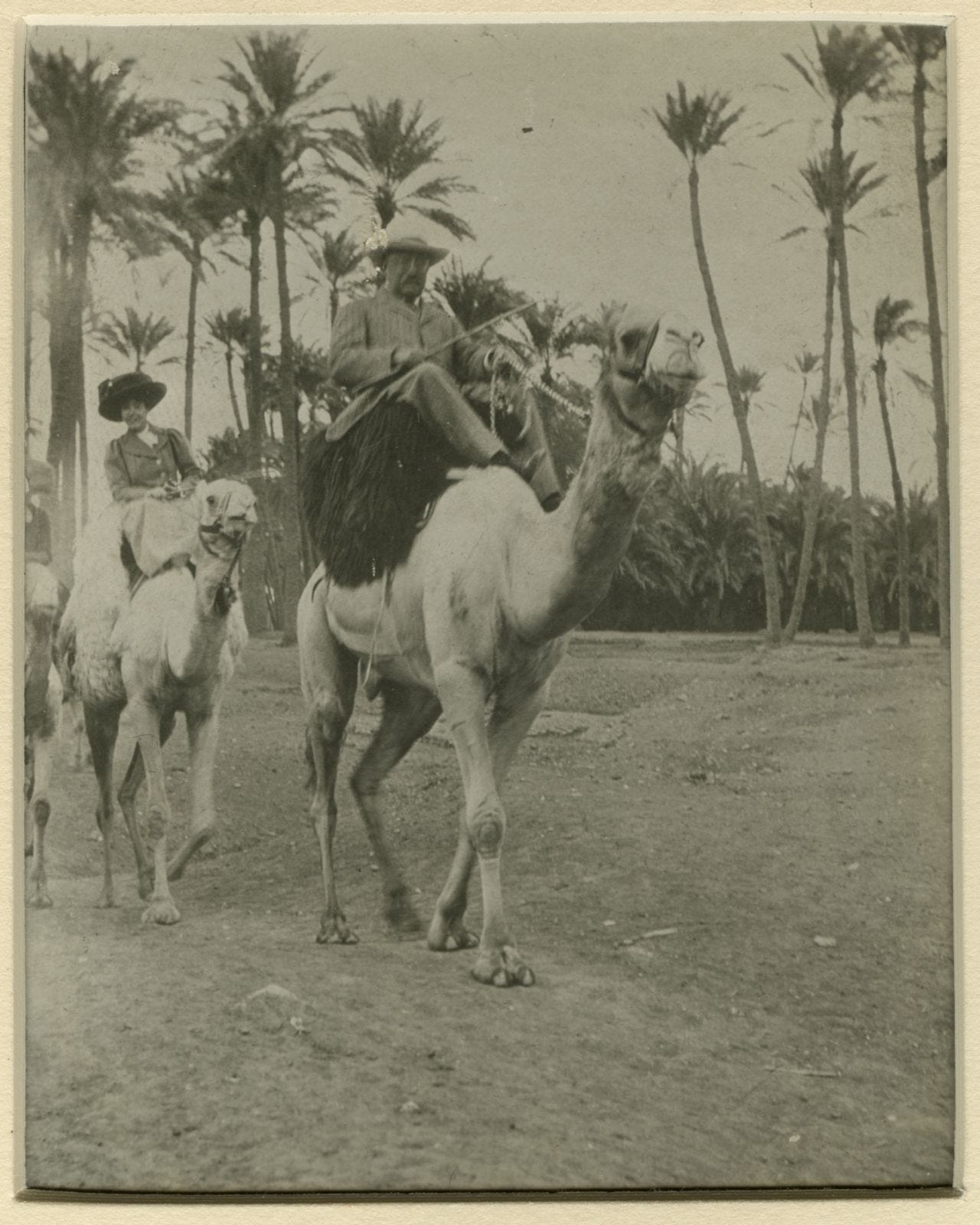
The digital library features several photographs of Roosevelt riding on a camel, shortly after he was reunited with Edith and Ethel in Khartoum. The Smithsonian-Roosevelt expedition had officially ended on March 14, 1910, and by the next day, Roosevelt, Kermit, and the two ladies were on the backs of the “camel corps” visiting the battlefield of Omdurman—also known as the Battle of Karary where the British defeated Mahdist forces to establish an Anglo-Egyptian Sudan.
According to a correspondent, Roosevelt was unsure about riding a camel. When the camel reached its full height, Roosevelt apparently said, “I think I’d rather try a rhino.” Apparently, Edith and Ethel were less dramatic, ascending to their seats with “suppressed ‘Oh’s!’ and sighs.”
In our humble opinion, based on the photograph above, Ethel looks positively delighted to be riding a camel, whereas Roosevelt appears much less sure. Roosevelt’s uncertainty about the camel makes us wonder if perhaps he intentionally did not ride one as a teenager. Apparently, the strenuous life did not extend to riding camels!
Asia (Cyprus, Israel, Lebanon, Syria, Palestine)
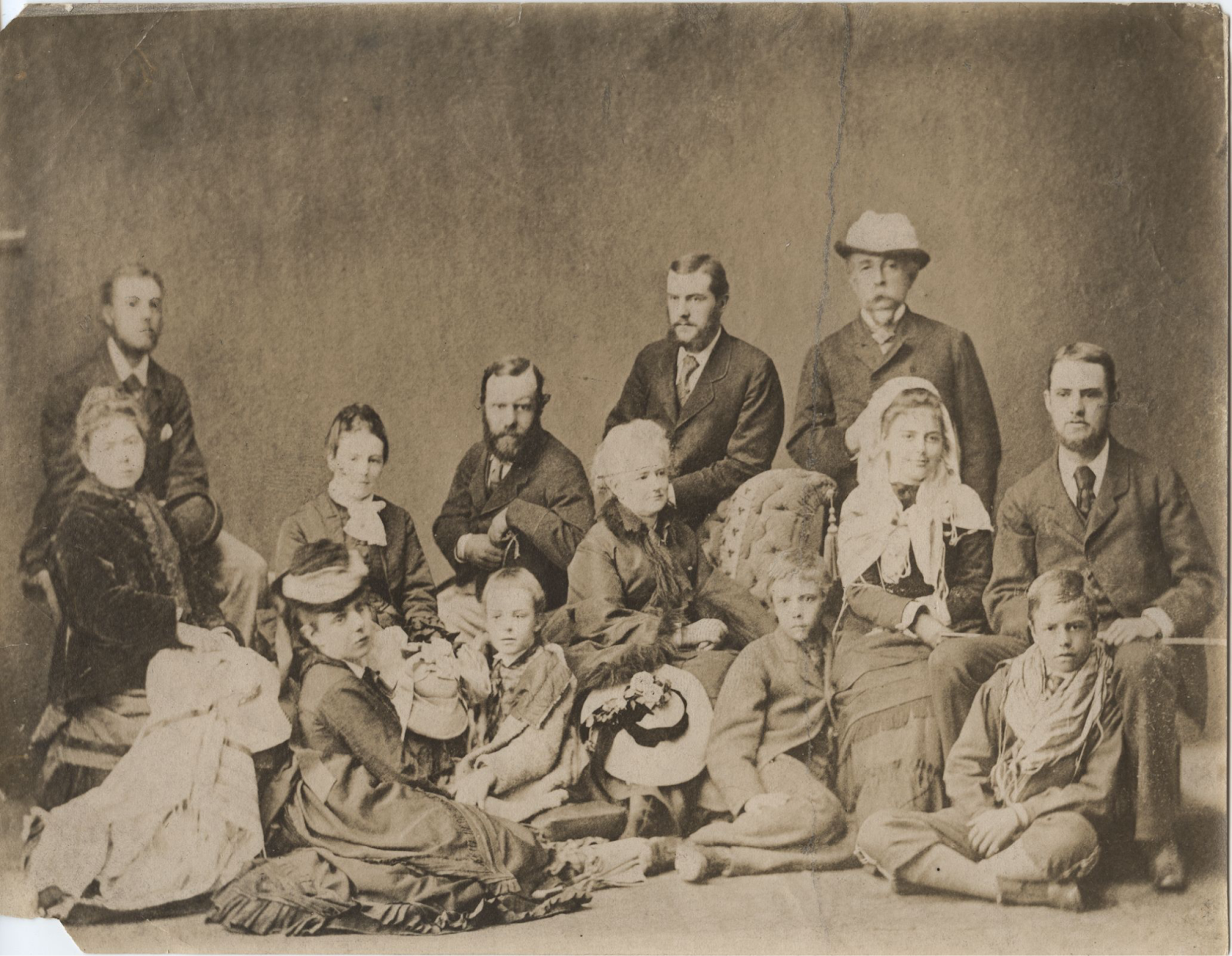
Roosevelt visited several countries in western Asia during the family’s 1872-1873 trip overseas, including Syria; Beirut in today’s Lebanon (which Roosevelt spelled “Beyrout”); Jericho in today’s Palestine; and Cyprus, which is geographically part of Asia although culturally more like Europe.
Roosevelt also records visiting the “mouth of the Jordan,” in his zoological record of the trip, but we are unclear exactly what he meant. He could have meant the Dead Sea, the Sea of Galilee, or the headwaters of the Jordan near the base of Mount Hermon. Depending on what he meant, there is a good chance that Roosevelt stepped foot in what is Israel today as Mount Hermon is Israel’s highest mountain and the Sea of Galilee is located in Israel.
In addition to Roosevelt’s detailed observations of birds in Syria, he also recorded his thoughts of visiting the Holy Land to his friend and later wife Edith: “I think that I enjoyed Egypt most of any place I have yet been to, and after that I had most fun while camping out in Syria.”
What Roosevelt particularly enjoyed about camping out was getting to ride on horseback for “several hours of the day” on the Syrian horses, which he considered “very good.” His family was less enthusiastic about Roosevelt the horseman as he related to Edith: “While riding I bothered the family somewhat by always carrying the gun over my shoulder.” (Apparently, his gun came in handy for hunting a couple of jackals on horseback “for two or three miles as fast as the horse could go.”)
Final Thoughts
We’ll close our deep dive on the countries Roosevelt visited with a brief note. While today many Americans have been overseas to at least one country, traveling overseas at the turn of the century was something only the wealthy did.
During Roosevelt’s life, he was part of the 0.15 percent to 0.25 percent of the American population that traveled overseas in the late 1800s and early 1900s (see figure 6A here). His status as not only a man of wealth but also an important political figure greatly impacted the number of countries he was able to visit.
Thanks for joining us on this deep dive into Roosevelt’s international travels! Let us know if we should cover more visits in greater detail.
Always a pleasure to receive and reconnect to TR