

In honor of Tell a Joke Day on this upcoming Monday, August 16, we couldn’t resist the opportunity to write a fun and lighthearted post about Theodore Roosevelt as the butt of the joke. We first had the idea for this post several months ago when we came across the following photograph.
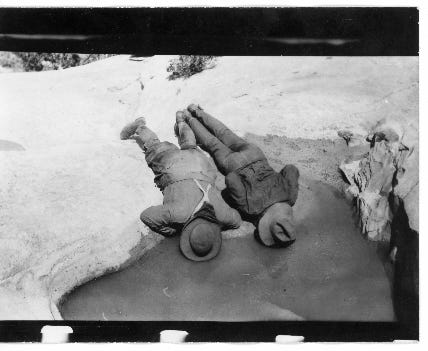
We were not prepared for a photograph of Roosevelt’s and Quentin’s derrieres based on the title of “Theodore Roosevelt and Quentin Roosevelt,” so it made us laugh—and we thought it would make a fun post as Roosevelt, the butt of the joke. So without further ado, let’s begin!
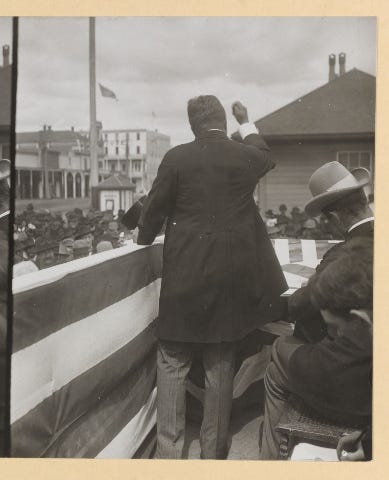
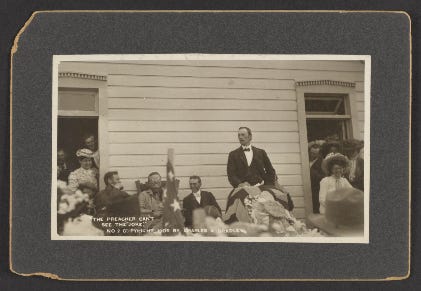
If you’re wondering, this isn’t the only picture of Roosevelt with his back to the camera. We also discovered other photographs below, but we were more prepared this time since the title gave one a hint of what was coming. The photograph immediately below is titled, “Theodore Roosevelt on flag-draped platform, with his back to the camera, speaking to the crowd.”
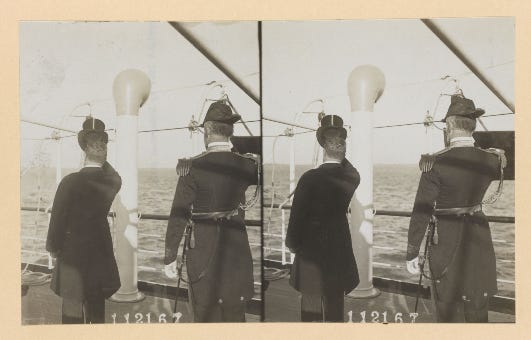
Similarly, there’s the photograph below of Roosevelt and an unidentified naval officer with their backs to the camera. This one also didn’t surprise us since the title gave us a heads-up.
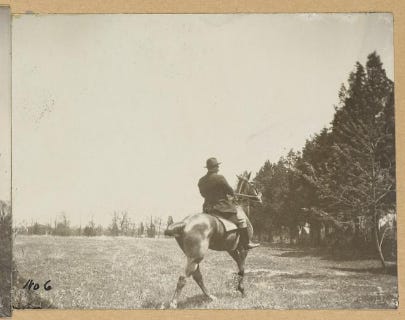
But by far, our favorite “butt of the joke” photograph almost seemed to lean into the hilarity of the image in the title: “Theodore Roosevelt, on horseback, rear view.” Of course, it also helps that it has a horse since we love horses here at the Center.
As far as joking in general, Roosevelt had a great sense of humor. Often he was the person joking around, and there are plenty of examples in the digital library finding something entertaining, including one 1912 letter where he admitted to chuckling!
Other examples include an October 1911 letter Roosevelt wrote to his sister Bye, “I enclose the autograph. The unfortunate creature who asked for it evidently knew nothing of my handwriting!” (We actually don’t think Roosevelt’s handwriting is that bad. Bye’s on the other hand . . .)
Roosevelt even occasionally cracked jokes in speeches, including one speech delivered at Lookout Mountain, Tennessee, where almost the entire speech was humorous.
“Ladies and Gentlemen: If I had known whom I was to meet here I should have come prepared to take the bath I so urgently need. As it is I shall thank you greatly for giving me this chance of greeting you. I have enjoyed to the full all of today. I became lured into taking a ride with the cavalry regiment, which accounts for part of my appearance. I did not expect to have the chance of meeting such a gathering, and I shall simply thank you and say how pleased I am to have seen you. I wish you could see me under circumstances more favorable.”
But other times, Roosevelt was the butt of the joke—sometimes intentionally, sometimes unintentionally. As we mentioned in the Washington section of our previous TR in every state series, mammalogist C. Hart Merriam introduced a new variety of elk in December 1897 and named it after Roosevelt.
We also noted that Roosevelt was a “lumper” who preferred broad categories of animals whereas Merriam was a “splitter” who was very willing to add new species.
It was in this context that Roosevelt told Frederick Courteney Selous about how Merriam had joked with him: “When he sent me this pamphlet [about the Roosevelt elk] he accompanied it with a good-humored note, chaffing me about my controversy with him last year, and telling me that if I thought it only a sub-species he would immediately change the name.”
Roosevelt was even able to see the humor in a serious matter when he had unwittingly been the butt of the joke as can be seen from a series of letters in early 1911. In January 1911, Roosevelt wrote to then Secretary of the Navy George von Lengerke Meyer about his opinions of a lesser punishment for desertion during peacetime.
On January 24, 1911, Meyer replied, “I find that during your term, in October, 1908, (probably unknown to you in the press of business), you changed the punishment for desertion from one year to two and one-half years.”
In turn, Roosevelt wrote back, “I think it is an awful joke on me, my having unwittingly increased the punishment for desertion while I was President.”
We’ll conclude this sillier than usual post with a short poem from Secretary of State Elihu Root in 1908 joking about Roosevelt’s activities that concludes with the line: “Can’t you stop for ten minutes?”
And speaking of Roosevelt always being on the move, check out a short video we recently made inspired by the “sit down for a documentary” trend that tells the story of our work at the TRC in a fun and lighthearted way that pokes fun at Roosevelt just a little bit!