
Friday Fun
National Pet Day

All of us here at the Theodore Roosevelt Center love pets—just like Theodore Roosevelt and his family. We’re guessing many of our readers know about the more iconic Roosevelt pets like Jonathan Edwards the bear, Algonquin the elevator-riding pony, and Alice’s pet snake, Emily Spinach—and of course the guinea pigs, which we discussed in great detail in a previous post. (We’ve also written about feeding pets!)
We could have written about any of their pets in honor of National Pet Day tomorrow but ultimately decided on birds because we felt like the Roosevelts’ avian friends have largely been ignored—with the exception of one blue macaw—and we wanted to change that!
Dogs, horses, and guinea pigs were the family’s favorite types of pets, but they also had other types of animals like birds. As Roosevelt’s oldest son Ted remembers in his book, All in the Family, “Birds were rare among our pets. We loved them out of doors in the trees, but not in cages.”
According to Ted, the only types of birds they really cared for were parrots—more correctly called macaws—but Roosevelt’s own correspondence suggests that chickens also were an important part of the family menagerie.
In a book written in memory of Bellamy Storer, Maria Storer included an April 17, 1901 letter from then vice president Roosevelt in which he discusses the names of the family’s chickens. Baron Speckle was a name we had seen before, but the other ten names were new to us—and we’re thinking they probably are for others as well.
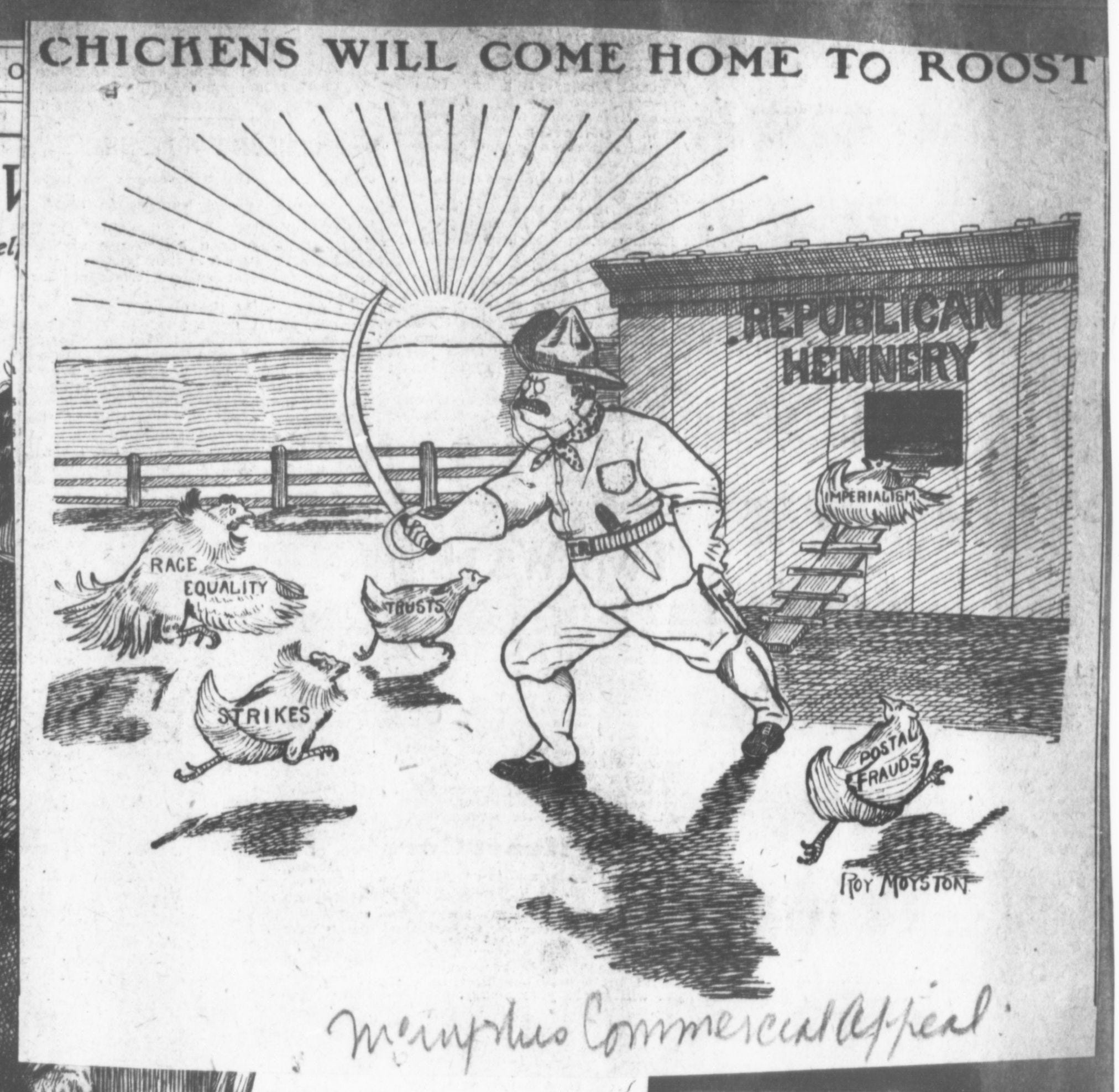
“Edith has been reading to [the children] the Waverley novels [a collection of historical novels by Sir Walter Scott], and I “The Tales of a Wayside Inn,” [a collection of poems by Henry Wadsworth Longfellow] and they have read Ernest Seton Thompson [Canadian wildlife author] on their own account together with some of my Border Stories [Roosevelt’s own stories of his time out west]. Accordingly one brown cock and hen are named Lobo and Blanca; a white cock and four hens appear as Erix [sic] Bloodaxe (Kermit explained that this was because he conquered another cock), Astrid, Thora, Thyri, and Sigrid the Haughty. Among the other hens are Rob Roy, Simon Girty, Isabella de Croye, and finally Baron Speckle, a hen whose name is a compromise, which is held at once to indicate its color and also to show a due remembrance of the little Baron who spent two Christmases with us.”
As is obvious, Roosevelt and his children had a deep knowledge of literature, and they brought that to their pet ownership. It took us some effort to match the chicken names to characters in stories, which surprised us because we love reading here at the Theodore Roosevelt Center. But we did ultimately track down the names, which we’ve included below!
Lobo and Blanca come from Ernest Seton Thompson’s Lobo, the King of Currumpaw, a story about a wolf leader, Lobo, and his mate, Blanca, a white wolf.
Eric Bloodaxe, Astrid, Thora, Thyri, and Sigrid the Haughty come from Henry Wadsworth Longfellow’s “Tales of a Wayside Inn.” Eric Bloodaxe, also known as Eric the Norseman, was a Norse king and well-known Viking leader. Sigrid the Haughty is a Scandinavian queen mentioned in Norse sagas. Astrid, Thora, and Thyri are all female characters in Longfellow’s tales, and Thora and Sigrid both have full sections devoted to them.
Rob Roy is a Scottish folk hero whose adventures were popularized worldwide by one of Scott’s Waverley novels, in which he discusses the adventures of Frank Osbaldistone and his encounters with the outlaw, Robert Roy MacGregor.
Simon Girty and Isabella de Croye refer to historical characters. Simon Girty was a frontiersman and interpreter who lived in the colonial era while Isabella de Croye was part of a European noble family and married into the Hapsburgs.
Baron Speckle is not a literary or historical name, but rather likely a reference to German diplomat Baron Hermann Speck von Sternburg, one of Roosevelt’s closest political advisors and personal friends, whom he affectionately called “Speck” or “Specky.”
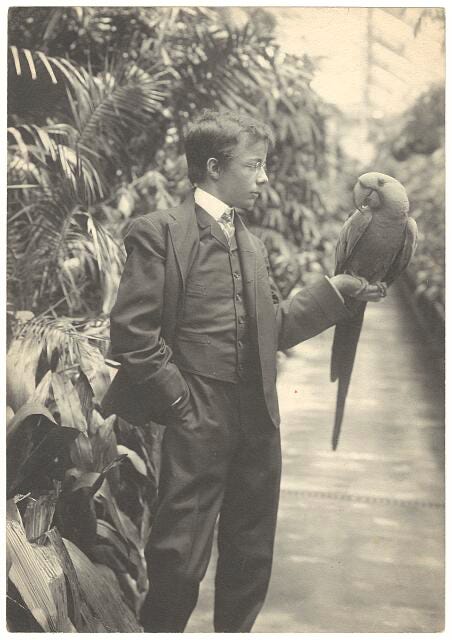
As for macaws—what Ted called the birds the family really cared about—Roosevelt mentioned them more prominently in correspondence. I’m sure many of us have heard of Eli Yale the blue macaw, named for Yale’s signature blue color as Alice Roosevelt Longworth remembered years later, but did you know that the Roosevelts also had two other macaws—one red and one green?
As Roosevelt mentioned in a 1903 letter to Kermit, the other two macaws were waiting for Ted and Kermit in the zoo until Edith’s greenhouse could be built. Given that Roosevelt’s letter is dated in early March 1903, we believe they may be two of the macaws mentioned as donated to the National Zoological Park in Washington, DC, on February 23, 1903. If this is true, then the green macaw did not have any tail feathers. (There is also mention of a yellow macaw, but we haven’t encountered a mention of that bird in any of Roosevelt’s letters.)
If you’re wondering why the macaws went to the zoo, we’re guessing the Roosevelts learned from the experience with Eli the macaw in the summer of 1902 when he was upset by the carpenters working at the White House and “went on a rampage.” They ultimately had to put him “in a green house which has not been touched,” as Roosevelt wrote Kermit on June 22, 1902. Perhaps the Roosevelts wanted to skip the rampage step for these green, red, and yellow macaws and sent them straight to the zoo!
Unfortunately, we weren’t able to find many more details about the other macaws, but we did discover more about Eli Yale that we think may be new information for many of our readers. As Herman Henry Kohlsaat, an American businessman and newspaper publisher, relayed in a 1922 Saturday Evening Post article, Eli Yale had quite a powerful beak that scared many—including Roosevelt himself.
According to Kohlsaat, Roosevelt told him, “Archie calls me a coward. [He] says, ‘You call yourself the hero of San Juan Hill, and yet you are afraid of a bird! You’re a coward!’”
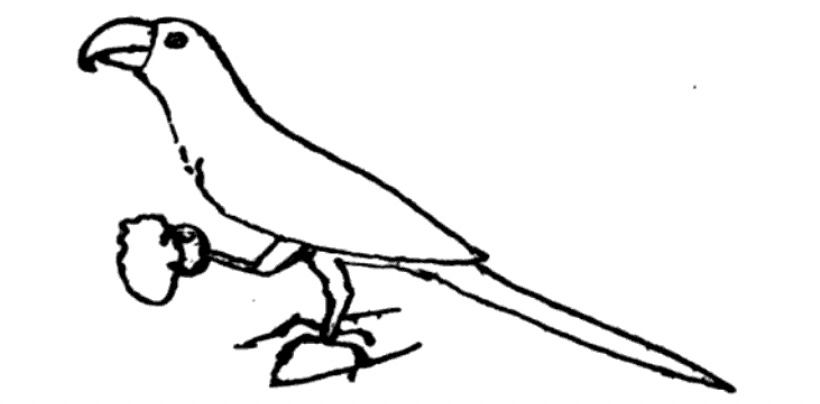
Even if Roosevelt was too scared to hold Eli, that didn’t stop him from drawing Eli. He included a drawing of the bird in a November 1901 letter to Sarah Schuyler Butler, daughter of Nicholas Murray Butler, president of Columbia University. (From our perspective, the beak does seem fairly prominent!)
In addition to the chickens and the macaws, we discovered a new pet bird we had never read about before, a parrot named Loretta. We’re wondering if Loretta may have been one of the green, red, or yellow macaws mentioned above, but we don’t know for sure.
As Roosevelt detailed in a 1904 letter to Kermit, he found Archie in bed with a headache with his nurse Mame and Loretta in her cage nearby. According to Roosevelt, “[Loretta] was having a most lovely time, with the feathers on her head and neck ruffled up, chuckling and talking away in low tones, and alternately shaking hands with first one and then the other of her companions. She was evidently as pleased as she could be, and upon my word, of the three I felt as if at the moment she was intellectually taking the lead herself.”
As this post illustrates, we’re continuing to discover additional Roosevelt pets through our research, and we know there are many more we haven’t yet come across. If there is a particular type of pet you think we should write about in the future, let us know in the comments!