
Friday Fun
Theodore Roosevelt and Alligators

We’ve had a blast with our Friday Fun posts, covering unexpected and entertaining stories about Theodore Roosevelt. Animals, in particular, have a special place in our hearts, and some of our favorite Friday Fun posts have been about Roosevelt and animals, including guinea pigs, snakes, and most recently, bees.
Although you might not know it, today is a holiday celebrating a uniquely American animal: the American alligator. Thus, we decided it would particularly be fitting today to dedicate today’s Friday Fun post to Roosevelt and gators on National Alligator Day.
A brief note before we dive into the swamp. Since Roosevelt fashioned himself an old-school naturalist, we decided to focus only on the family Alligatoridae, which includes both alligators and caimans (or caymans), and not on crocodiles, which are part of the family Crocodylidae.
Alligators in the Digital Library
Alligators appear in various types of records in the digital library, including in at least three political cartoons. Our favorite “gator cartoon” was drawn by William Allen Rogers of the New York Herald and features a muckrake alligator.
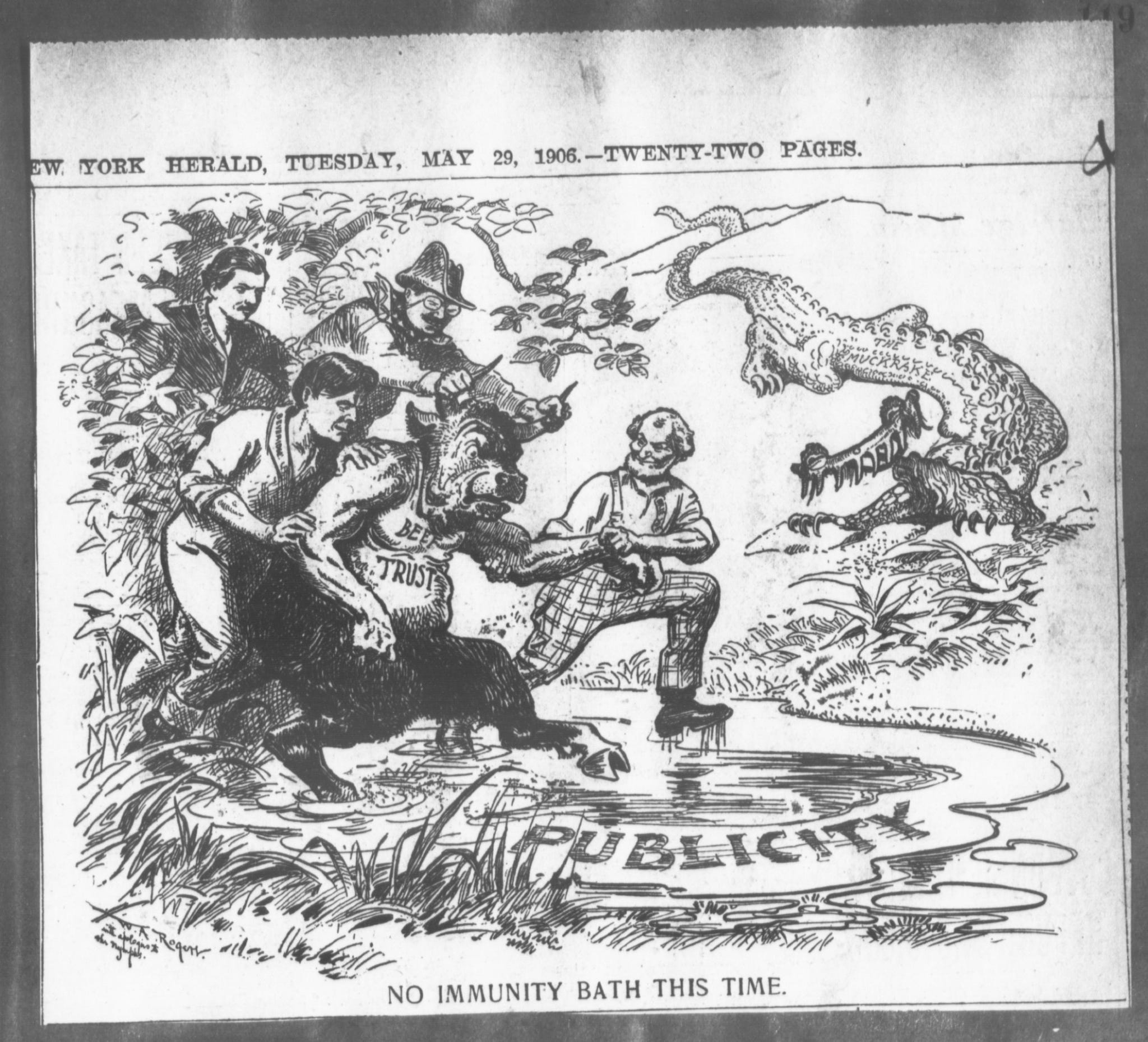
Rogers drew this cartoon shortly before the passage of the Pure Food and Drug Act and the Meat Inspection Act on June 30, 1906 and depicted how Roosevelt, other political leaders, and muckraking journalists like Upton Sinclair had exposed the abuses of the beef trust industry, which had been covered up for so long.
Although the “publicity” pool is the center of the attention in the cartoon, we love the alligator depicted with a muckrake jaw on the side. If publicity wasn’t enough to take on the beef trusts, the muckraking alligator journalists were on the side of the pond ready to chomp down.
Although we enjoyed this cartoon, we actually found two other records about alligators more entertaining. One was a letter from Roosevelt to Dr. A.L. Couch thanking him for the two watch charms of an alligator’s tooth and a bear’s tooth. Unfortunately, we don’t know if Roosevelt ever used them or not.
The even more interesting record is an exchange in the digital library when Roosevelt served helped facilitate the transportation of an alligator across the country. Based on Roosevelt’s reply, John B. Sewell, a physician in Baldwin, Louisiana, asked Roosevelt to see if the New York Zoological Park (today the Bronx Zoo) needed any more alligators.
Roosevelt promised to pass along the letter to Raymond Lee Ditmars, Curator of Reptiles, but he wasn’t sure if the zoo would need any more. As Roosevelt told Sewell, “They have a great many alligators, and so I do not know whether they will be able to take advantage of your kindness or not.”
In his subsequent letter to Ditmars, Roosevelt expressed his uncertainty about the zoo needing more alligators: “I do not suppose you want another alligator, but I send this letter to you on the offchance [sic] that you might.” Ditmars replied to Roosevelt and let him know he had written to Sewell and told him, “[W]e shall be very glad to have the Alligator.”
Thanks to the zoo’s 1912 annual report, we know that Sewell’s alligator was indeed added to the collection, bringing the total of crocodilians to thirty-seven at the zoo.
Roosevelt’s Interactions with Alligators and Caimans
As far as we know, Roosevelt never went hunting for alligators although he wanted to! When writing about the big game he had hunted, Roosevelt wrote about experiences he wanted to have, musing, “Once in a while it must be good sport to shoot alligators by torchlight in the everglades of Florida or the bayous of Louisiana.”
But he did encounter them several times—at least what he called “alligators.” Once was when Roosevelt was in Panama in November 1906 during the first trip a sitting president made outside of the United States.
As he wrote in a letter to his son Kermit, “There are alligators in the rivers. One of the trained nurses from a hospital went to bathe in a pool last August and an alligator grabbed him by the legs and was making off with him, but was fortunately scared away, leaving the man badly injured.” Since true alligators don’t live in Panama, Roosevelt must have meant an American crocodile or a caiman.
Several years later, Roosevelt had several encounters with what he called “small alligators” when he was in South America for his Amazon expedition in 1913-1914. But unlike his mention of alligators in the letter to Kermit, Roosevelt properly identified these smaller alligators: jacaré-tinga in Portuguese or spectacled caiman.
As he wrote in Through the Brazilian Wilderness, “The pools in the marsh were drying . . . in the pools that were not dry small alligators, the jacaré-tinga, were feasting also.” Roosevelt even included an image of jacaré-tinga in his article for The American Museum Journal entitled “Animals of Central Brazil” (see below).
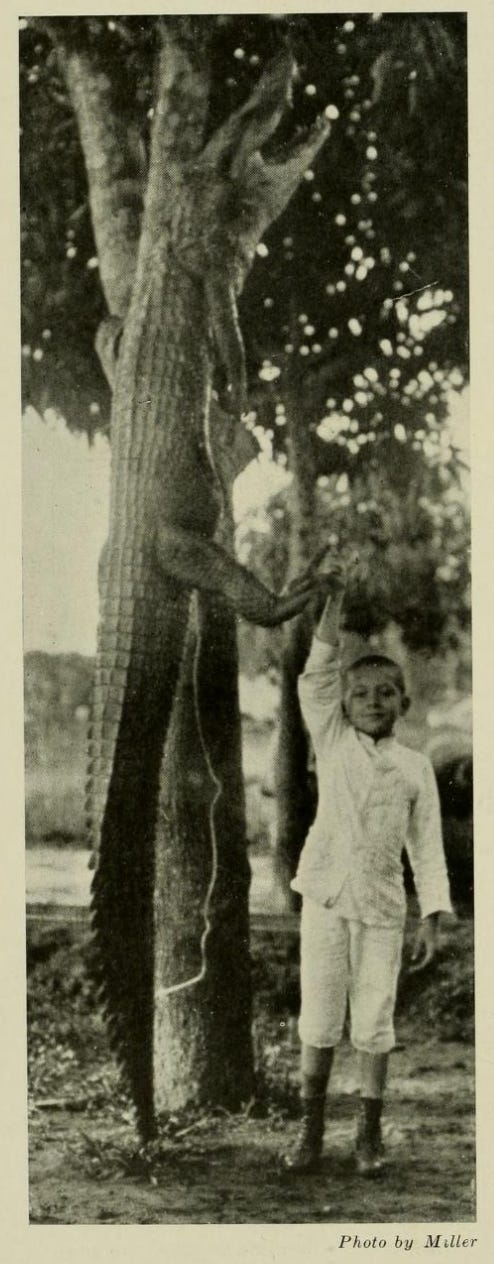
The caption of the jacaré-tinga and the small boy reads: “The caymans, or jacarés, of the Paraguay region are not ordinarily dangerous to man, although they sometimes become man-eaters.”
Although the caption could have been added by an editor, we actually think it might have been Roosevelt himself as the wording is very similar to a sentence from Through the Brazilian Wilderness: “The Paraguayan caymans are not ordinarily dangerous to man; but they do sometimes become man-eaters and should be destroyed whenever the opportunity offers.”
Finally, Roosevelt experienced one particularly interesting encounter with a caiman when he was hunting jaguars in Paraguay before descending the River of Doubt. We will include Roosevelt’s description of the entire event so that you can “hear” it in his words.
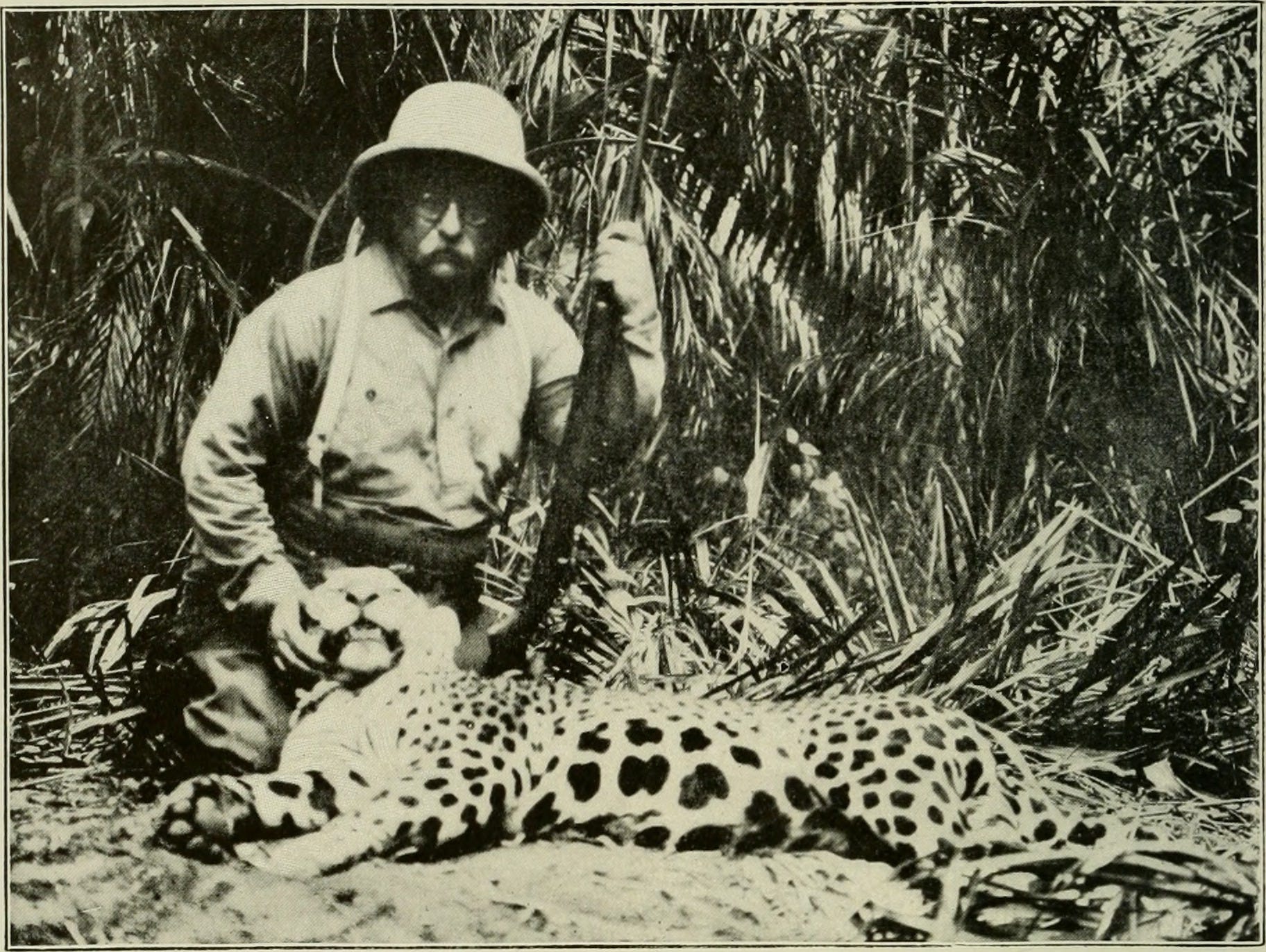
“An interesting incident occurred on the day we killed our first jaguar. We took our lunch beside a small but deep and obviously permanent pond. I went to the edge to dip up some water, and something growled or bellowed at me only a few feet away. It was a jacaré-tinga or small cayman about five feet long. I paid no heed to at the moment. But shortly afterward when our horses went down to drink it threatened them and them; and then Colonel Rondon and Kermit me called to watch it. It lay on the surface of the water only a few feet distant from us and threatened us; we threw cakes of mud at it, whereupon it clashed its jaws and made short rushes at us, and when we threw sticks it seized them and crunched them. We could not drive it away. Why it should have shown such truculence and heedlessness I cannot imagine, unless perhaps it was female, with eggs near by. In another little pond a jacaré-tinga showed no less anger when another of my companions approached. It bellowed, opened its jaws, and lashed its tail. Yet these pond jacarés never actually molested even our dogs in the ponds, far less us on our horses.”
Fortunately, Roosevelt and his party were not injured by the jacaré-tinga, but for the life of us, we can’t figure out why they threw cakes of mud at it. That seems to us like a good way to incite its ire—the last thing they wanted to do!
Alligators in the White House
Our post about Roosevelt and alligators wouldn’t be complete without a stop in the White House. Although John Quincy Adams has long been identified as having a pet alligator while in the White House, that story is probably false. But we do know that Roosevelt—or at least one of his children—did!
On May 11, 1907, Roosevelt wrote to his eldest son Ted in a handwritten postscript about some of Archie’s newest reptile and amphibian friends: “Yesterday evening I met Archie going in to his bath, and he cordially invited me in to see the livestock; there were tadpoles in a jar, four wee turtles in the bathtub, and a small alligator in the basin. Mademoiselle told me that he regarded the turtles as ‘avec beaucoup de tendresse’; but found the alligator ‘antipathique’—I hope my spelling is right.”
For those who don’t speak French, Archie regarded the turtles with great tenderness but found the alligator disagreeable. That must have been why the gator was in the bathroom sink! We don’t know how long the alligator stayed at the White House, but no matter how long it was a guest, happily for the Roosevelts, it didn’t seem to be much of a threat since it was so small and fit in the sink.
There’s so much more we could say about Roosevelt and alligators. If you’re interested in learning more about Roosevelt’s experiences with caimans, alligators, and crocodiles, check out the Theodore Roosevelt Association Journal article by Don Arp entitled “Hunting the Dragons.”