
Friday Fun
The Elephant in the Room

We recently explored what a potential day at the circus could have looked like for the Roosevelts. Today, TR Center employee Gemma (who works remotely from Utah) explores another possible circus connection to Theodore Roosevelt.
You never know where something TR-related will pop up. Recently, the Utah Historical Society posted a reel on its social media featuring items from its collections. Appearing briefly was a photograph of an elephant captioned “Princess Alice.” To anyone else, the name might not mean much. However, for one familiar with TR, it rings alarm bells as being a highly specific reference to Roosevelt’s daughter, Alice Roosevelt, who, as the celebrity first daughter, was known as Princess Alice. Curious if there was a connection, I found the photograph in the digital collection and was at first disappointed to find it was dated 1940—the related photos I initially found likewise dated to the 1940s and 1950s.
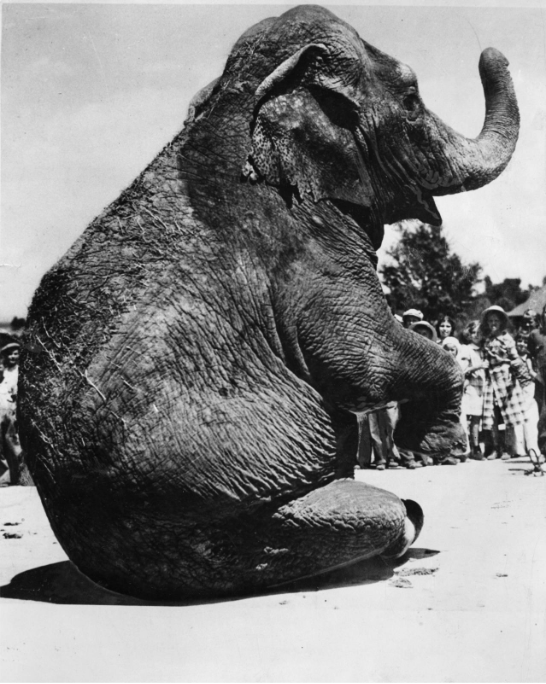
I came across a note saying that Alice was the first elephant in Utah. Curious, I continued researching her and discovered that she was bought from a circus by schoolchildren in 1916 (given elephants’ long lives, it was not surprising to find her 24 years previously). That put her within TR’s lifetime, reopening the possibility that she was named after Alice Roosevelt. This is when I would say that I developed a well-thought-out research plan, but honestly, much of the research I (and my colleagues) conduct consists of “rabbit holes,” both random and serendipitous. In this case, various Google searches, revisiting the Utah Historical Society collections, scouring digital newspapers, along with some help from Dr. William Hansard, whose graduate research focused on the circus. He found her mentioned in one of the circus’s route books, which, coincidentally, was a page he catalogued during an internship.
Princess Alice, the Asian elephant, was born in the wild in approximately 1884. It is unknown when she was captured, but in 1904, she and twenty-one other elephants were brought to the United States as an attraction for Luna Park on Coney Island, New York. In 1906, she was purchased by the Sells-Floto Circus, where she participated in parades and performed in shows across the country. In 1912, she gave birth to a calf (many sources claim she was the first elephant in America to do so, but that honor went to Hebe or “Babe” in 1880). According to the route book, she tried to kill the calf, named Baby Hutch, who subsequently died from starvation due to lack of maternal care. Her two subsequent calves also died, Prince Tambon from improper feeding by caretakers, and Little Miracle, from exposure.
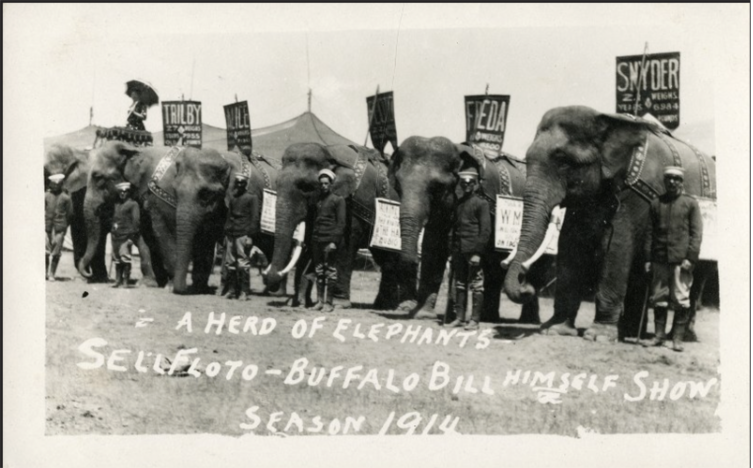
In 1916, the small but increasingly popular zoo in Liberty Park in Salt Lake City, Utah, was looking for new inhabitants. A Telegram reporter suggested an elephant would make a great addition. H. H. Tammen, owner of the Sells-Floto Circus, agreed to sell Princess Alice for slightly less than the $4,000 she was worth. Through a Dollar Club drive and various other fundraisers, Salt Lake City schoolchildren raised the majority of the $3,250 used to purchase Princess Alice. Additional help came from several larger donations, with businessman P. J. Moran contributing the final needed funds. Following her final performance with Sells-Floto on August 27, 1916, Princess Alice walked across the city to her new home in Liberty Park. Joining was Emil M. Bauer “Dutch” Shider, her caretaker from the circus, who continued caring for her until 1932.
At the time of her purchase, Alice was pregnant with her fourth calf. Scientists speculated whether it would escape the fate of its siblings, and plans were made to ensure its survival. The calf was born on April 29, 1918, and named Prince Utah. Despite thriving under his caretakers, he died almost a year later due to cardiovascular issues and was taxidermied (his story doesn’t end there).
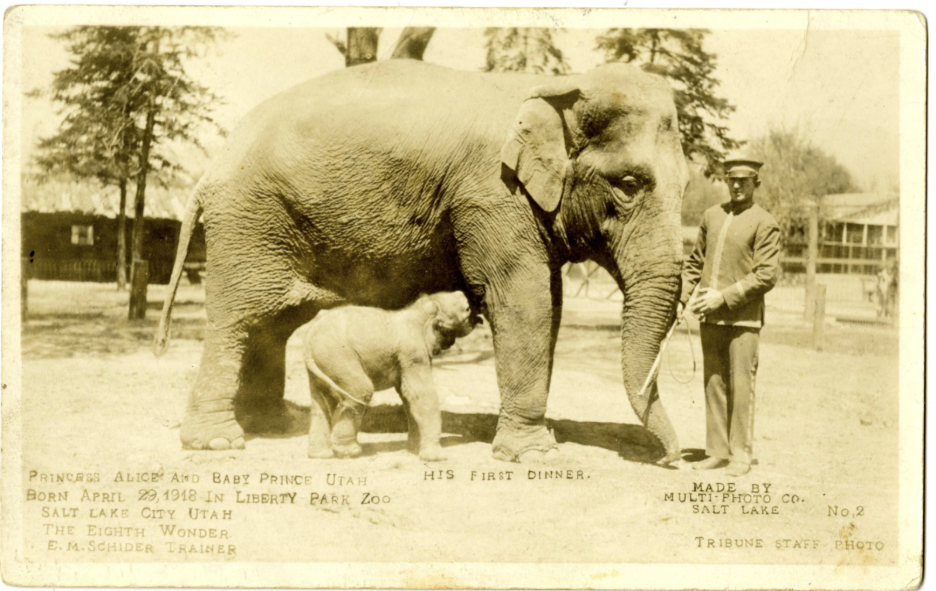
Like her (possible) namesake, Princess Alice’s celebrity status drew attention, but she, too, didn’t shy away from the strenuous life. She hauled heavy items, plowed the park for planting, pulled up trees, and dragged a road grader. Alice the elephant could likewise compete with Alice Roosevelt for headlines, serving as a media staple not just in Utah but across the country throughout her long life. Additionally, one might say the two Alices shared a spirited “attitude,” the four-legged one had a penchant for frequently escaping her enclosure and rampaging the streets of Salt Lake City. (In reality, her behavior is indicative of frustration due to confinement and a lack of species-appropriate enrichment outlets, which now form the cornerstone of today’s zoo animal care plans.)
To (hopefully) stop these escapades, in 1931, Alice was moved to a new zoo outside of the city, the current Hogle Zoo. Alice was a mainstay of the zoo, giving trick performances and occasional rides. A sculpted likeness of her even adorns a post in the elephant enclosure, something I remember seeing during my childhood visits. In 1953, at the age of 69, Alice was euthanized following prolonged illness. Her teeth were extracted and examined by zoological students from the University of Utah, and the rest of her remains were hauled to the Utah Animal By-Products Co., where they were turned into poultry feed and soap products.
Alice led the way for a long line of elephants at the Hogle Zoo. However, in 2023, the zoo announced that its two remaining elephants (Christie and Zuri) would be transferred to the Kansas City Zoo & Aquarium. The decision was two-fold. First, it is hoped that the elephants can contribute to conservation efforts through the KCZoo’s breeding program. Second, it was determined that the current elephant enclosure is inadequate to meet their needs without significant upgrades. Therefore, it is unlikely that the Hogle Zoo will acquire new elephants in the future. However, the organization remains dedicated to supporting elephant conservation and education, a legacy TR would approve of.
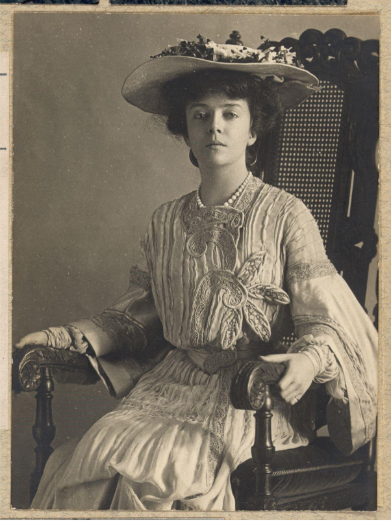
So, was Princess Alice the elephant named for Princess Alice Roosevelt? At some point, I stumbled across Alice’s entry in the Elephant Encyclopedia, which mentions that she was named after the famous first daughter. Additionally, the Hogle Zoo’s timeline (which is headed by a picture of Princess Alice and Prince Utah) makes the same connection. While I cannot be absolutely certain, given the popularity of Roosevelt and his daughter at the time of elephant Alice’s arrival in the United States, it is highly plausible. Thus, it would appear that being the namesake of a famous elephant is yet another item to add to human Alice’s list of accolades.
Very interesting find! Loved reading this article, Gemma!