
Friday Fun
Theodore Roosevelt on Fatherhood

This Sunday is Father’s Day, so much like we dedicated a Friday Fun post to motherhood earlier this year, we are devoting this post to Theodore Roosevelt and fatherhood.
Roosevelt’s own father, Thee Roosevelt, was one of his heroes alongside Abraham Lincoln. And Roosevelt regularly wrote about his deep respect for his father. As an example, Roosevelt wrote in an 1877 letter to his sister Bamie, “We have been fortunate, Bamie, in having a father whom we can love and respect more than any other man in the world.”
When Roosevelt became a father himself, he was very involved much like his own father and tried to model his own parenting after his father. During his elder daughter Alice’s early years, he was a more distant father as he healed from the untimely death of her mother and his wife, but by the time Ted was born in 1887, Roosevelt became a dedicated family man.
Just like Thee, Roosevelt was devoted to his children, writing in Chapter IX: Outdoors and Indoors of his Autobiography, “Books are all very well in their way, and we love them at Sagamore Hill; but children are better than books.” He loved being a father.
One of our favorite letters from Roosevelt to his children is from his time in Tampa, Florida, right before he set sail for Cuba during the Spanish-American War. He began a May 6, 1898 letter to the children with “Blessed Bunnies.” Later his own children, such as his daughter Ethel, would use the same language to refer to her children.
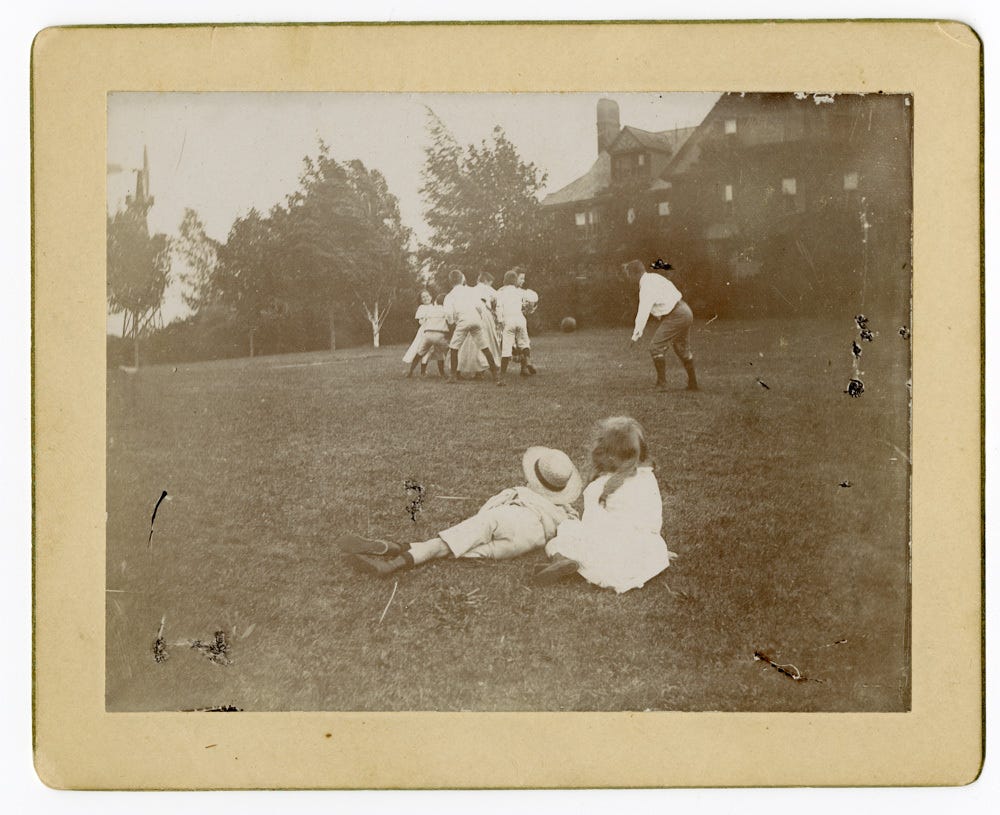
As you likely know, Roosevelt was a playful father. Sometimes considered the seventh child of the family, Roosevelt regularly participated in the children’s games. As Roosevelt wrote in a November 29, 1901 letter to his daughter Alice shortly after assuming the nation’s highest office, “I play with the children almost every night and some child is invariably fearfully damaged in the play; but this does not seem to affect the ardor of their enjoyment.”
There are countless examples in the digital library of Roosevelt’s interactions with his children. We’ve included quotations from a few of our favorites below. If there are other anecdotes that we missed that you particularly like, let us know in the comments!
January 17, 1903 letter to Lawrence F. Abbott: “Tell [your daughter] that last night I came very near being late for a formal dinner because I forgot and played bear vigorously to too late an hour with my smallest boys - Archie, who is eight, and Quentin, who is five.”
March 1, 1903 letter to Kermit: “Yesterday evening I took Archie for a good scramble down Rock Creek. He chose little Leonard Wood and the two Garfield boys as companions, and accordingly we brought along their fathers and also Gifford Pinchot. . . . One of the Garfield boys slipped into a small brook, and Mr. Gifford Pinchot fell into the creek, and we were all plastered with mud.”
Although Roosevelt had a more traditional understanding of the role of mothers, he also believed it was important for both parents to be involved in raising children. As he wrote in “Women’s Rights: And the Duties of Both Men and Women,” published in The Outlook on February 3, 1912, “There must be common parental care for children by both father and mother.”
Roosevelt had high expectations for his children to represent the name of Roosevelt well and was glad that he had several boys to carry on the Roosevelt name, particularly his eldest son Ted who was his namesake.
As Roosevelt wrote in a 1908 letter to William Kent, “Good for you; and for the five boys who are to keep the name of Kent alive! I have four who I hope will do the same thing by the name of Roosevelt.”
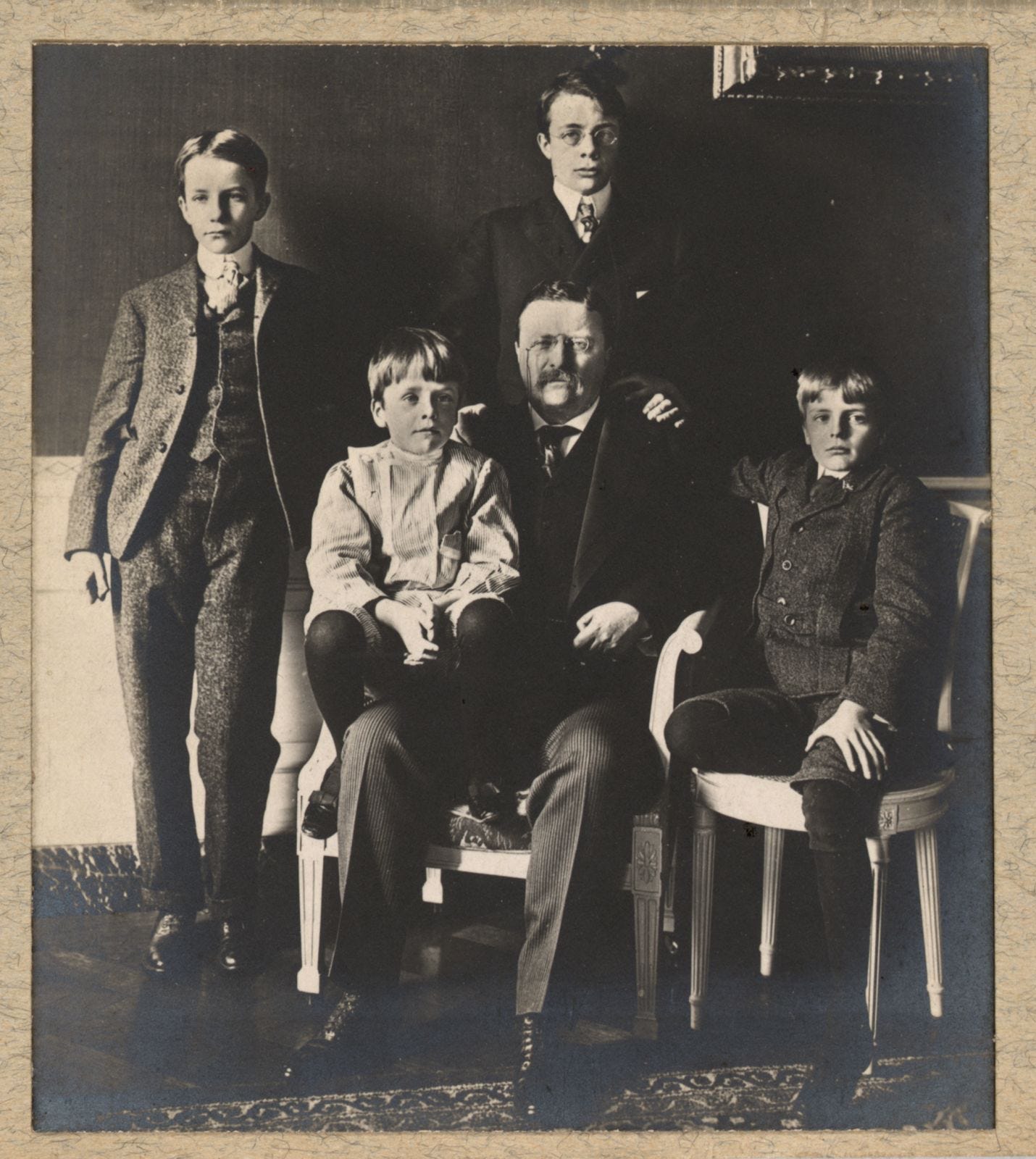
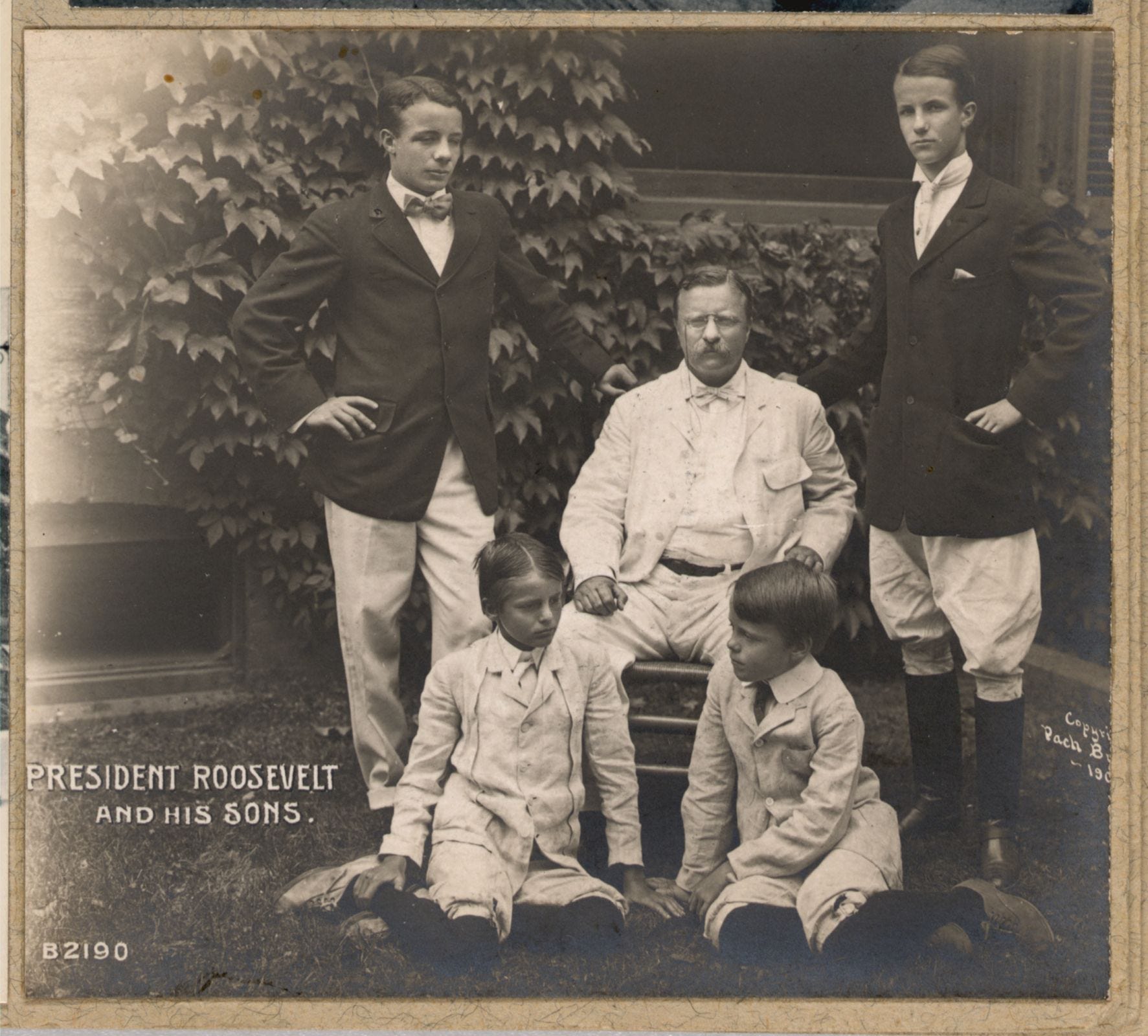
There were several photographs taken of Roosevelt and his sons during his presidency. We’ve included two below and invite you to compare and contrast the two photographs, the first from early in his presidency—likely 1901 to 1903—and the second from late in his presidency in 1907.
Roosevelt also had a special relationship with his daughters—each unique in her own way. Roosevelt’s relationship with his elder daughter Alice was more complicated, particularly since her mother died when Alice was only two days old.
But there were sweet moments with Alice like a delightful letter in the digital library from Roosevelt to his sister Bamie in 1888 describing life with four-year-old Alice and almost one-year-old Ted. We will include the quotation in its entirety.
“In the morning I always go into the nursery [to say] good morning to Alice first, play with Ted, who hails me with joy as a release from the monotony of crib existence, and then carry Alice down to breakfast pig-a-back. The last exercise has got Alice into the custom of invoking me, with unintentional irreverence, as “now, pig!”
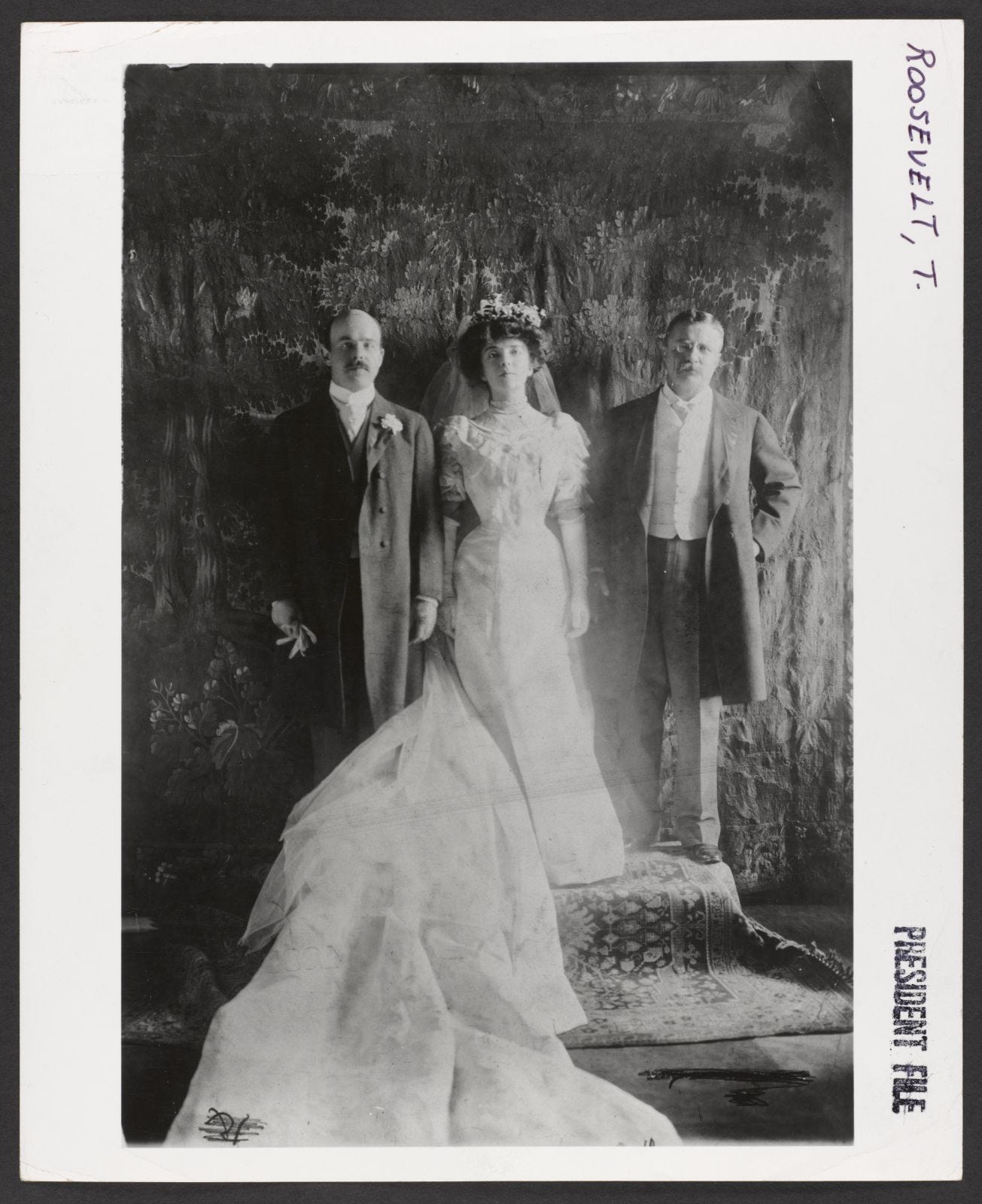
One of the few photographs of Alice and her father is from her wedding day in 1906 to Nicholas Longworth, which we’ve included below. (And for our readers local to the Dickinson area, we invite you to join us for Teddy and Alice over 4th of July weekend, a musical that explores the relationship between Roosevelt and his elder daughter starring our own Dr. William Hansard as Theodore Roosevelt!)
Roosevelt had a warmer relationship with his younger daughter Ethel. When she was younger, Ethel was a tomboy who tried to keep up with her two sets of brothers and who loved going for scrambles with her father.
As she got older, Ethel became one of Roosevelt’s closest confidants. When he was on the Smithsonian-Roosevelt Scientific Expedition to Africa, Roosevelt regularly wrote to Ethel and often mentioned how much he valued her as a daughter.
As he wrote in a December 23, 1909 letter to Ethel, “I am enjoying it all, but I think Kermit regards me as a little soft, because I am so eagerly looking forward to the end, when I shall see darling, pretty Mother, my own sweetheart, and the very nicest of all nice daughters—you blessed girlie. Do you remember when you explained, with some asperity, that of course you wished Ted were at home, because you didn’t have anybody as a really intimate companion, whereas Mother had ‘old Father’? It is a great comfort to have a daughter to whom I can write about all kinds of intimate things!”
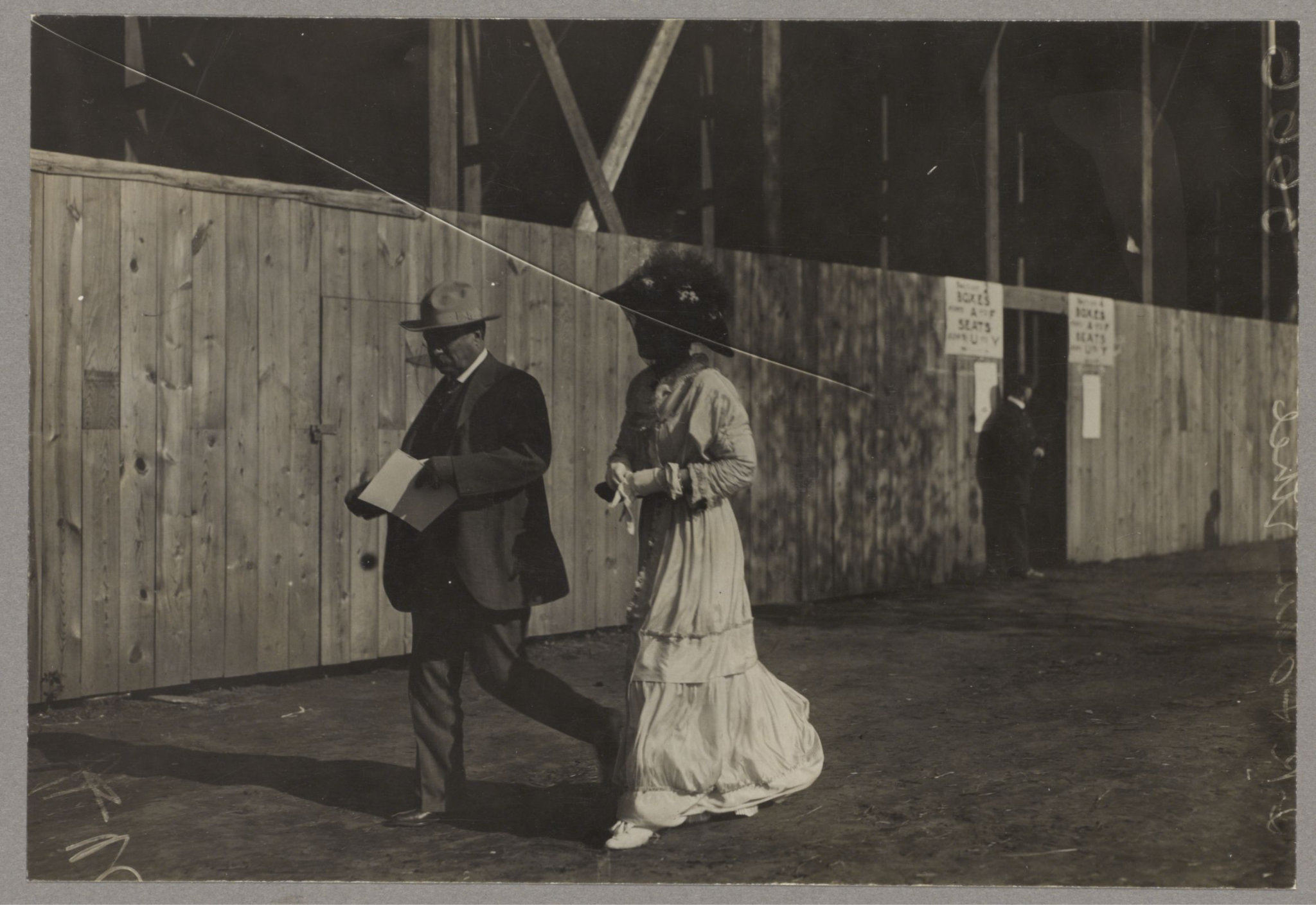
There aren’t very many pictures of Ethel and Roosevelt in comparison to pictures of Roosevelt and the boys, but there are a few like the one of Ethel and Roosevelt below from 1911. At the time, Ethel was just shy of turning twenty years old.
Roosevelt’s popularity as a father even extended beyond his own six children. Frederick E. Drinker and Jay Henry Mowbray gave an example in Theodore Roosevelt: His Life and Work: “On another occasion when he was out with a lot of children he tumbled into the water. ‘There goes our daddy,’ yelled the young son of General Leonard Wood. Every child who came into contact with the man felt that way—that he was daddy.”
We’ll conclude with a short reflection on Roosevelt as a father from his younger daughter Ethel who adored him. As she wrote in an August 8, 1910 letter to Edith H. Gregory, “I love Father so much that it frightens me sometimes.” Clearly not only did Roosevelt love being a father but also his children loved him as one!