

If you’ve spent a good amount of time in the digital library, chances are that you’ve run into a letter with a caption and/or title “Letter from Secretary of Theodore Roosevelt” like the one below.
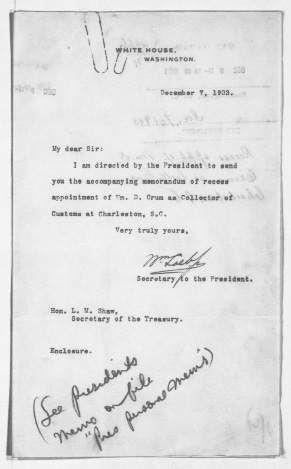
If you’re wondering, there are nearly 8,500 other letters in the digital library with the exact same title. In this post, we will highlight the people who served as Roosevelt’s secretary as well as briefly look at the variety of stenographers, clerks, and others who kept up with all of Roosevelt’s paperwork—much like we do today!
A brief note before we begin. As is the case for many of the posts we write, this post could have been much longer depending on how much material we decided to include. We made an intentional choice to highlight only Roosevelt’s secretaries from his governorship until his death to focus in on the people who supported Roosevelt during the most popular years of his life.
William J. Youngs (1898-1900)
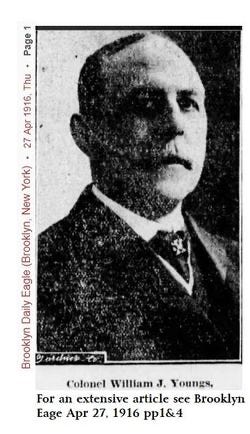
William J. Youngs served as Roosevelt’s secretary when he was governor. In fact, he was Roosevelt’s first appointment as newly elected governor, according to an 1898 newspaper article, observing, “Mr. Youngs has long been a neighbor of Col. Roosevelt at Oyster Bay.”
Youngs, who was an attorney and a politician from New York and who had also served in the Assembly, gave up his position as district attorney with a salary of $5,000 a year (roughly $200,000 today) to become Roosevelt’s private secretary with a salary of $4,000 a year (roughly $160,000 today).
The earliest letter we have in the digital library signed by Youngs is dated January 23, 1899, and includes a postscript in Roosevelt’s handwriting that says, “How I wish I wasn’t a reformer, oh Senator!”
Even though Youngs was only Roosevelt’s secretary while the latter was governor, Roosevelt appreciated his service. The last letter in which Youngs signs his name with the title “secretary” seems to be dated January 1, 1901, the day after Roosevelt left office as governor.
After becoming president, Roosevelt appointed him District Attorney for the state of New York in December 1902, a position he held until 1915, and the two remained in contact with one another. Shortly after Youngs’s death in April 1916, his widow, May Benson Emory Youngs, wrote to Roosevelt, “Your friendship meant everything to Billy.”
George B. Cortelyou (1901-1903)
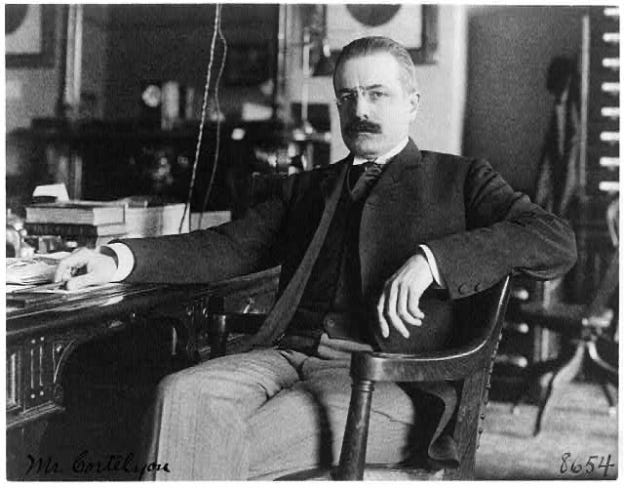
George B. Cortelyou initially served as President William McKinley’s secretary, and Roosevelt corresponded with him occasionally during the campaign. See, for example, this July 1900 letter from Roosevelt to Cortelyou informing the latter he couldn’t travel to Kentucky because he needed some rest in August.
Cortelyou also received correspondence from William Loeb, secretary to then Governor Roosevelt, who forwarded a letter to Cortelyou in late November 1900 after McKinley and Roosevelt had won the election.
When Roosevelt assumed office after McKinley’s death in 1901, the executive office included Cortelyou as secretary, two assistant secretaries (Benjamin F. Barnes and Octavius L. Pruden), two executive clerks (Rudolph Forster and William H. Crook), and eight clerks, according to the July 1901 Official Register.
Roosevelt kept Cortelyou on as secretary to the president. He began assisting Roosevelt with correspondence the day he became president on September 14, 1901, and you can see Cortelyou’s signature above the title “secretary to the president” on a September 23, 1901, letter.
Cortelyou worked as the principal secretary but had others in his office, including William Loeb (who later served as Roosevelt’s principal secretary during his presidency) and Benjamin F. Barnes, as Cortelyou noted in a January 26, 1901, letter to Police Chief Richard Sylvester. Cortelyou also assisted with Edith Kermit Carow Roosevelt’s correspondence before Isabella “Belle” Hagner was hired as the first social secretary.
Cortelyou served as Roosevelt’s principal secretary for less than two years, becoming Secretary of Commerce and Labor on February 18, 1903, and William Loeb assumed the role of principal secretary. (See more below in the section on Loeb.)
Even after Loeb became principal secretary, almost all of McKinley’s staff remained on Roosevelt’s staff when the 1903 Official Register was issued, all except for Cortelyou, Pruden, and one clerk.
The earliest correspondence in the digital library from Cortelyou after he became Secretary of Commerce and Labor to Loeb is a letter dated April 23, 1903, in which Cortelyou recommends Rudolph Forster as “an ideal Assistant Secretary” since he has handled everything in the Executive Office “with becoming dignity and with tact and discretion.”
Cortelyou held his position in the Commerce and Labor department for just over year (2/18/1903-6/30/1904). He then became chair of the Republican National Committee (1904-1907), Postmaster General (3/6/1905-1/14/1907), and Secretary of the Treasury (3/4/1907-3/7/1909). As Secretary of the Treasury, Cortelyou helped keep the economy stable during the Panic of 1907.
Cortelyou and Roosevelt corresponded occasionally for the rest of Roosevelt’s life. In one of the last letters from Cortelyou to Roosevelt in the digital library, Cortelyou sends Roosevelt a copy of a book he thought Roosevelt would like, remarking, “I used to know pretty well what you liked in the way of books.”
William Loeb (1899-1909)
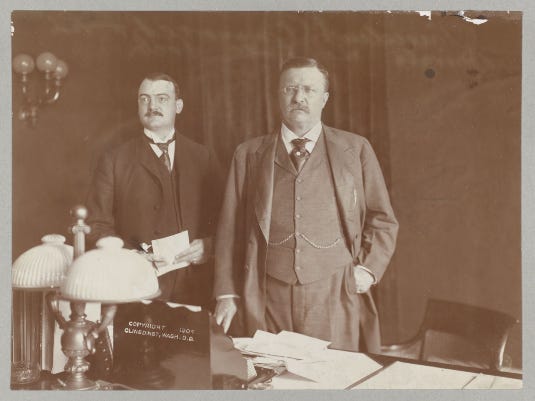
William Loeb—officially William Loeb, Jr.—initially served as one of four stenographers during the first few months of Roosevelt’s administration as Governor of New York. We have one letter in the digital library where Loeb listed his title as “stenographer” from February 1899.
As the story goes, Roosevelt asked his secretary William J. Youngs for a stenographer, and the group of stenographers sent Loeb because they had heard Roosevelt was a “terror to take” since he didn’t stop talking.
Loeb didn’t miss a word. When Roosevelt needed a stenographer the next day, he said, “[T]hat young fellow I had yesterday.” And thus began a years-long working relationship between Roosevelt and Loeb.
Loeb didn’t stay as a stenographer for long as Roosevelt quickly realized that Loeb knew New York politics well and recognized his abilities as a secretary. Roosevelt made Loeb his private secretary.
In less than two years, Loeb went from secretary to the governor to “secretary to the vice president” to secretary to the president. At first, Loeb was Roosevelt’s assistant secretary when Cortelyou was Roosevelt’s principal secretary from 1901 to 1903.
As one newspaper correspondent described Loeb, “[He] is in reality [Roosevelt’s] secretary, his stenographer and his confidential friend . . .”
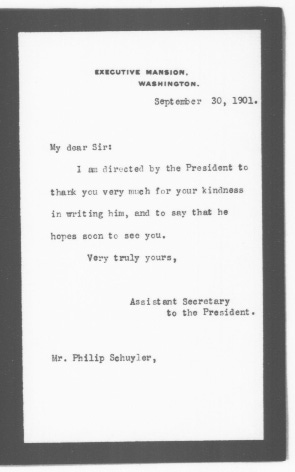
We don’t know for sure if William Loeb was the writer of the letter above since it is signed only “assistant secretary to the president,” but it is likely.
In 1903, Loeb became principal secretary and held that position until 1909 when Roosevelt left office. As principal secretary, Loeb oversaw an office of roughly fifteen clerks and messengers. They handled Roosevelt’s correspondence, which ranged from five hundred to a thousand letters a day, clipped newspaper articles for Roosevelt to review, and also worked with the press.
According to James Morgan in Theodore Roosevelt: The Boy and The Man (1907), clerks opened all of the mail even letters marked “private” or “personal,” except correspondence known to be from close friends and family marked with initials in the corner of the envelopes. HCL for Henry Cabot Lodge, for example.
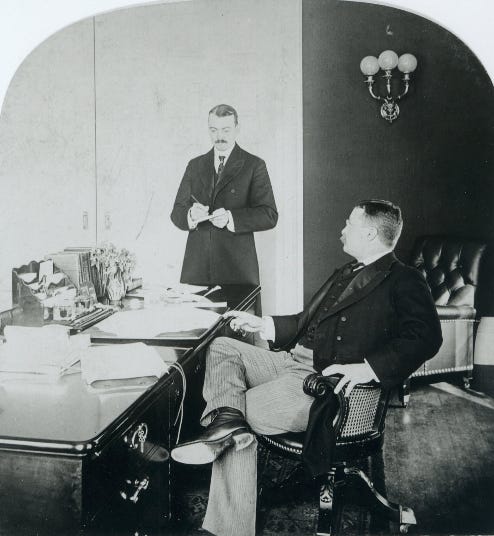
Roosevelt came to trust Loeb so much that he let him speak with journalists on his behalf, much like a modern-day press secretary. He controlled access to Roosevelt and gained the nickname of “Stonewall Loeb” due to his willingness to bar the door to the president if necessary.
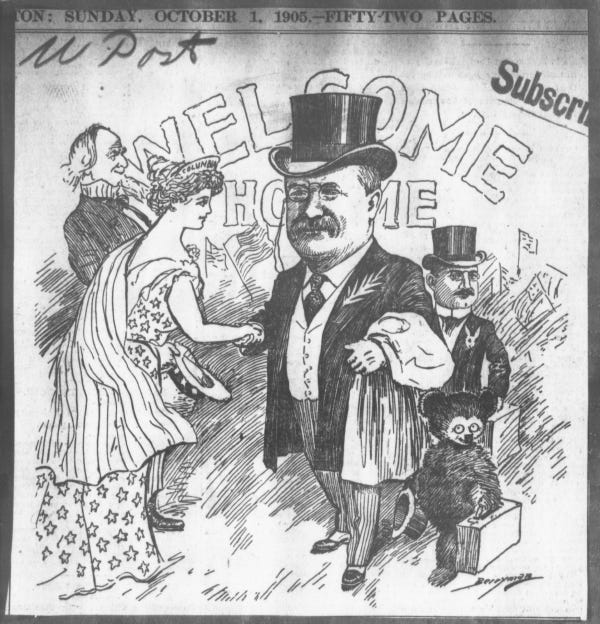
Cartoonists even depicted Loeb in their political cartoons. See the example below featuring Loeb drawn by Clifford K. Berryman, whose “Drawing the Line in Mississippi” cartoon led to the creation of the teddy bear.
Loeb served mainly as Roosevelt’s secretary but, like Cortelyou before him, also responded to correspondence addressed to Edith Kermit Carow Roosevelt. See the letter below, for example.
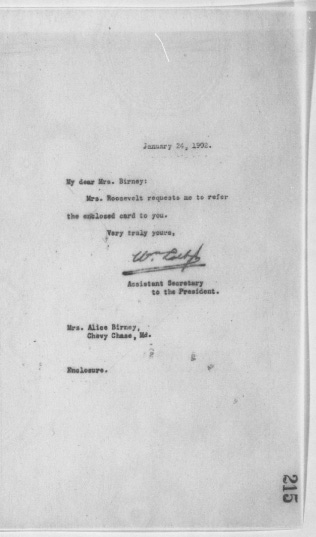
In recognition of his years-long service to Roosevelt, President William H. Taft appointed Loeb as Collector of the Port of New York shortly after Roosevelt left office, due in part to influence from Roosevelt.
In March 1910, Roosevelt wrote Loeb, “Every mail I got contains some account of the really great work you have done in the Custom House; it makes me feel very proud of you.”
Roosevelt considered Loeb his “right-hand man,” and the two men had a deep respect for one another. As James Morgan mentioned, Roosevelt once wrote on the flyleaf of a book for Loeb: “To William Loeb Jr., My Friend and Fellow Politician. Theodore Roosevelt.” And Loeb even made Roosevelt the godfather of his son William.
After Roosevelt died in 1919, Loeb became a founding member of the Theodore Roosevelt Memorial Association. Loeb himself became a businessman and served as vice president of the American Smelting and Refining Company in New York City in the 1920s before his death in 1937. Learn more about William Loeb in our TR encyclopedia here.
Frank Harper (1909-1914)
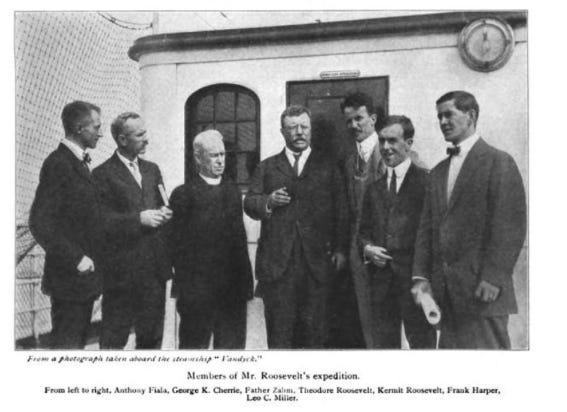
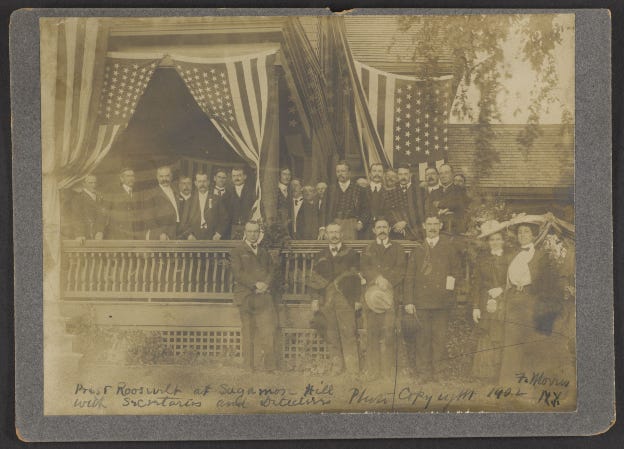
In the photograph above, Roosevelt is pictured in the middle with Frank Harper standing second from the right.
After Roosevelt left the office of president, Frank Harper became his private secretary. The earliest letter in the digital library written by Harper with the title “secretary” is dated March 16, 1909, to the Winchester Repeating Arms Company—less than two weeks after Taft had become president.
As far as when he became Roosevelt’s secretary, we’ve seen several dates, including from Roosevelt himself. In June 1914, Roosevelt said Harper became his secretary when “he came from New York to meet me at Rome early in 1911, and he has been with me as my secretary ever since then.” (See, for example, this 1911 letter with Harper’s signature above the title “secretary.”)
In that letter, Roosevelt noted that Harper traveled across the country with him and even accompanied him to South America. Harper even wrote a memoir about his time in South America with Roosevelt, which you can find in the digital library.
Moreover, Harper also notably served as Roosevelt’s secretary during the 1912 presidential campaign. But despite his years of great service to Roosevelt, he found himself without a job in 1914 when The Outlook “rearranged their affairs” shortly after the trip to South America. (Roosevelt worked as an editor for The Outlook, and British-born Harper was employed at The Outlook as his private secretary.)
In the aforementioned June 1914 letter, Roosevelt asked his former secretary William Loeb if either he had a position at his firm for Harper or if he knew of some firm that needed a secretary. As Roosevelt concluded his letter, “If I were able I should myself employ him permanently; but I cannot afford a private secretary . . .”
Roosevelt also followed up with a July 1914 letter to Loeb: “Don’t forget our conversation about Harper. As you know, I always like to do everything I can for the man who in intimate relations have served me faithfully.”
In late November 1914, when Roosevelt heard that Robert Watchorn and Harper might work together, Roosevelt reached out to Watchorn with a letter of recommendation for Harper. Ironically, in this letter as compared to the 1914 letter, Roosevelt stated “Harper has been with me now for over five years,” so we stand by our 1909 date!
John W. McGrath (1914-1916)
According to John W. McGrath’s obituary, he served as Roosevelt’s secretary for four years from 1912 and 1916. This is inaccurate. We already thought 1914 to 1916 was more accurate, given that much of the material in the digital library listing McGrath as the creator is from 1914 and forward. For example, see this August 1914 letter from McGrath to Roosevelt’s eldest son, Ted.
Moreover, we thought the date of 1914 made more sense given Roosevelt’s concern about finding Harper a new job and his comment to Loeb that he could not hire a private secretary permanently in the summer of 1914.
Our hunch was confirmed when we read McGrath’s cross-examination in the 1915 William W. Barnes case, in which McGrath indicates he had been Roosevelt’s private secretary since May 1914.
Going back, we found a May 21, 1914, letter to Roosevelt’s sister, Anna “Bye” Roosevelt Cowles, signed “Theodore Roosevelt,” but definitely not in Roosevelt’s handwriting. As the accompanying note from McGrath states, “Colonel Roosevelt dictated the enclosed letter and asked me to sign his name to it, so that it would reach out without delay.”
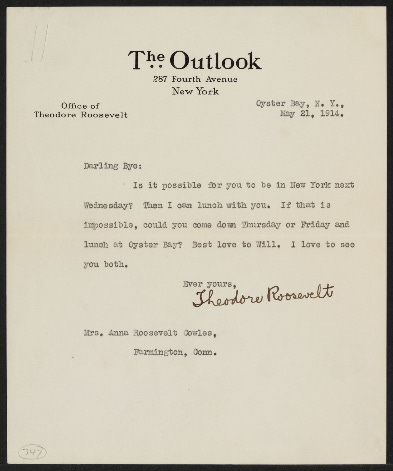
The end date given in the obituary does seem to be accurate, especially since one of the last letters in the digital library signed by McGrath with the title of “secretary to Theodore Roosevelt” is dated June 10, 1916.
Although McGrath was Roosevelt’s private secretary for a shorter amount of time, Roosevelt was quite fond of him. As he wrote in a 1915 letter to Frances Kellor, a social reformer, “Mr. McGrath occupies toward me the same kind of confidential position that Mr. Loeb once occupied.” High praise for McGrath comparing him to Roosevelt’s “right-hand man!”
Josephine M. Stricker (1916-1919)
Roosevelt’s final secretary was a woman, and she served as his private secretary from November 1916 until his death in January 1919. In October 1919, Stricker wrote a newspaper article about her experience working with Roosevelt and included an anecdote she thought would be “of great interest to women.”
After Roosevelt’s funeral, four of his close friends were talking about how several politicians had encouraged Roosevelt to replace Stricker on the basis that she was a woman.
As Roosevelt’s close friend relayed to Stricker, he said, “Miss Stricker is the first woman secretary I have ever had. I have never had better service than she has rendered. She shall continue as my secretary!”
John Joseph Leary likewise reported that Roosevelt had nothing but positive things to say about Stricker and was even open to her serving in the White House should he become president again.
Even after Roosevelt’s death, Stricker continued to assist the family in “clearing up Colonel Roosevelt’s work,” including sending letters to people who had requested autographed photographs, but they arrived “too late.”
After serving as Roosevelt’s secretary, Stricker became a “real-estate dealer” in Buffalo, New York. She also worked as a secretary for the late Albert J. Hooker of the Hooker Electro Chemical Company, according to her obituary.
Assistant Secretaries, Clerks, Stenographers, and More
We have highlighted just a few of the people who kept Roosevelt’s paperwork in order, but we wanted to make at least a brief nod to the countless others who assisted, especially while he was president.
As noted above, Roosevelt’s principal secretaries while he was president oversaw offices of around fifteen workers. Some of the more recognizable names include assistant secretaries Benjamin F. Barnes, who sometimes served as acting secretary to the president, and Rudolph Forster, both pictured below with Cortelyou. (Barnes is third from left, and Forster is fifth from left with Cortelyou in the middle.)
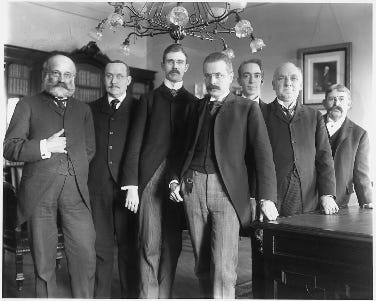
A name that is less well-known but, in our estimation, should be more well-known is William H. Crook, who served as executive clerk during much of Roosevelt’s administration.
He wrote a delightful memoir that includes his time in Roosevelt’s White House: Memories of the White House : the home life of our presidents from Lincoln to Roosevelt, being personal recollections of Colonel W.H. Crook, published in 1911.
In it, Crook records when Roosevelt first met his office staff after becoming president. According to Crook, Roosevelt said, “‘I’m glad to see you all, gentlemen . . . . But I didn’t know I had such a large office force!’ Then he came still nearer, and shook hands with each one.”
Given that Roosevelt himself thought he had such a large office force, we thought it would be helpful if we compiled lists of those who worked in the Executive Office during Roosevelt’s presidency, which we’ve included below. We drew on the biennial official registers as well as Washington, DC directories from his presidential years.
William Loeb, Secretary to the President
Benjamin F. Barnes, Assistant Secretary to the President
Rudolph Forster, Assistant Secretary to the President
Warren S. Young, Executive Clerk
William H. Crook, Executive Clerk
Arthur J. Leonard, Clerk
Nelson P. Webster, Clerk
Wilbur S. Hinman, Clerk
Clarence E. Ingling, Clerk
Maurice C. Latta, Clerk
John J. Malone, Clerk
John L. McGrew, Clerk
Thomas H. Netherland, Clerk
Edward W. Smithers, Clerk
Charles G. Forster, Clerk
Edward C. Heasley, Clerk
Jules A. Rodier, Clerk
Ira R. T. Smith, Clerk
According to the 1904 Washington, DC directory, all of the top staff remained the same (Loeb, Barnes, Forster, Young, and Crook).
William Loeb, Secretary to the President
Benjamin F. Barnes, Assistant Secretary to the President
Rudolph Forster, Assistant Secretary to the President
Warren S. Young, Executive Clerk
William H. Crook, Executive Clerk
Arthur J. Leonard, Clerk
Nelson P. Webster, Clerk
Edward W. Smithers, Clerk
Thomas H. Netherland, Clerk
Maurice C. Latta, Clerk
John L. McGrew, Clerk
Clarence E. Ingling, Clerk
John J. Malone, Clerk
Wilbur S. Hinman, Clerk
Ira R. T. Smith, Clerk
Edward C. Heasley, Clerk
Jules A. Rodier, Clerk
Miss Isabella L. Hagner
Again, according to the 1906 Washington, DC directory, all of the top staff remained the same (Loeb, Barnes, Forster, Young, and Crook) at the beginning of the year.
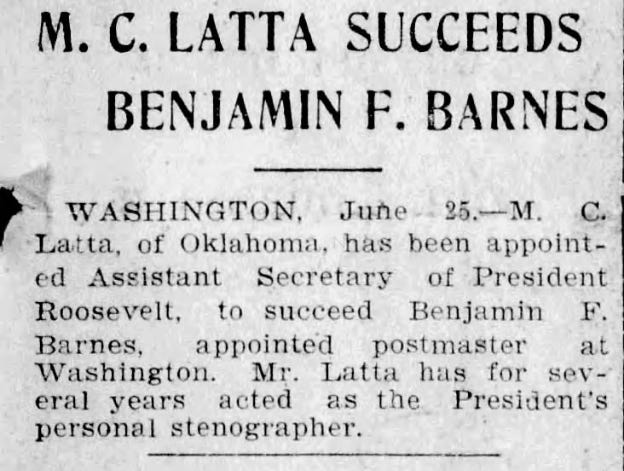
In June 1906, a change occurred when Latta—previously a clerk—replaced Barnes, who became Postmaster of Washington, DC, as assistant secretary to the president.
William Loeb, Secretary to the President
Rudolph Forster, Assistant Secretary to the President
Maurice C. Latta, Assistant Secretary to the President
William H. Crook, Executive Clerk and Disbursing Agent
Warren S. Young, Executive Clerk
Wilbur S. Hinman, Clerk
Clarence E. Ingling, Clerk
Arthur J. Leonard, Clerk
John L. McGrew, Clerk
Thomas H. Netherland, Clerk
Edward W. Smithers, Clerk
Nelson P. Webster, Clerk
According to the 1908 Washington, DC directory, no changes in the top staff took place in Roosevelt’s final year as president. When Taft became president in 1909, he kept many of Roosevelt’s staff, but he moved some of them around. Latta, for example, became executive clerk, while Warren S. Young returned to a clerk position, according to the 1909 Official Register.
Roosevelt had many great men and women who served in his office, and even people who never worked for him liked the idea of being his secretary. As Edgar Allen Forbes told Roosevelt in a January 28, 1911 letter, he planned to quit his job and asked Roosevelt, “Why not let me be one of your secretaries?”
Very informative. Thanks for all the details!