

As we’ve mentioned in several previous Substack posts (here and here, for example), Theodore Roosevelt deeply valued working hard. He didn’t believe in overworking (he loved to play!), but he also didn’t believe in underworking.
As Roosevelt stated in a 1903 address in Ventura, California, “Get all the enjoyment you legitimately can out of life, but remember that the only sure way of getting in the end no enjoyment out of life, is to start in to make it the end of your existence.”
Roosevelt also famously talked about the life of “ignoble ease” in his 1899 “Strenuous Life” speech: “A mere life of ease is not in the end a very satisfactory life, and, above all, it is a life which ultimately unfits those who follow it for serious work in the world.”
Rather, Roosevelt believed a good life had a nice mix of work and play. One of our favorite Roosevelt quotations on this topic comes from a May 29, 1903, speech in Idaho: “I believe in work and I believe in play. Play hard while you play; and when you work don’t play at all. That is good advice for children, and it is good advice for grown folks too.” He also made a similar comment in Nebraska in April 1903.
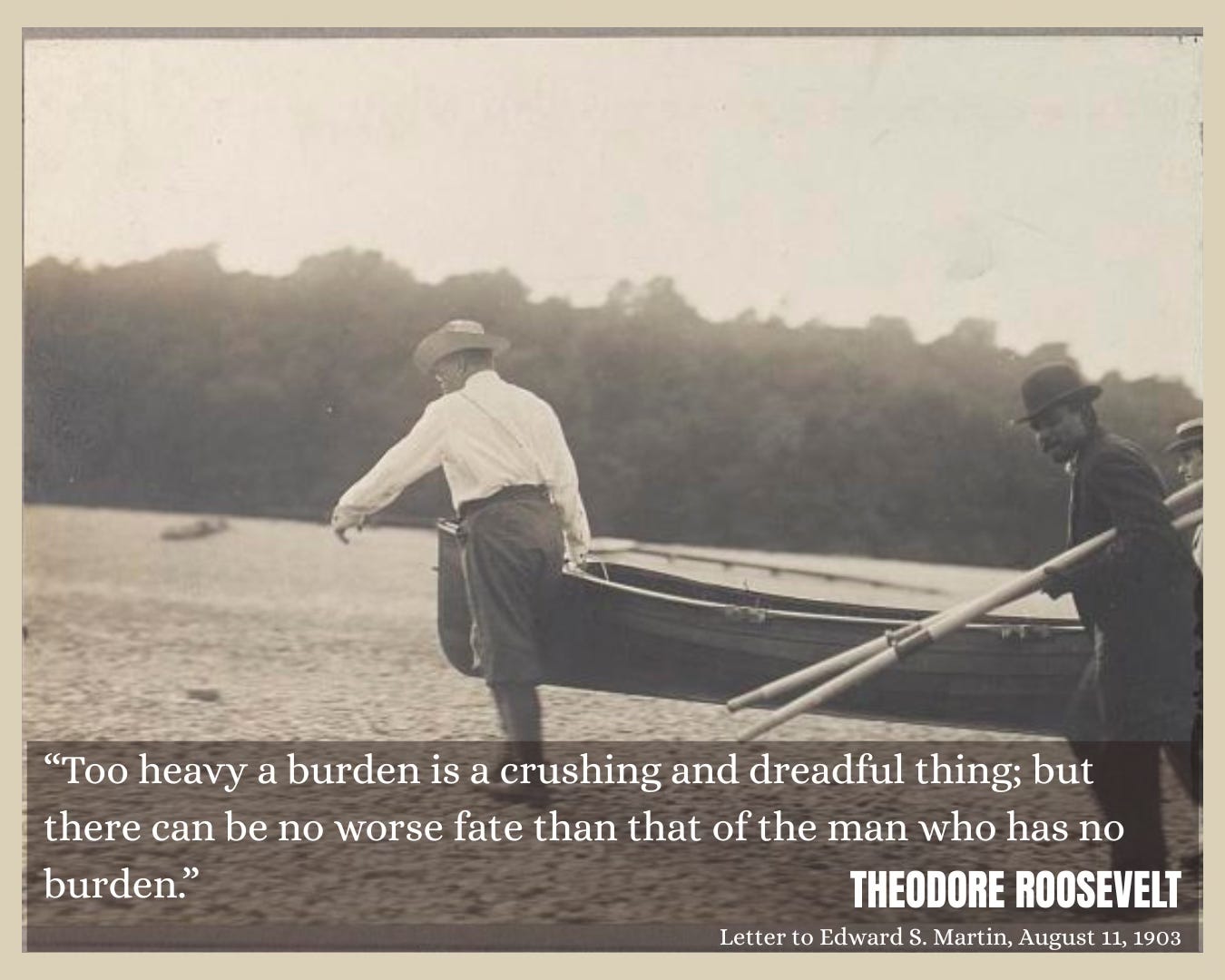
Given Roosevelt’s own reflections about work and play throughout his life, we were excited when we came across what we selected as today’s #WednesdayWisdom since it alludes to his conception of the right amount of work but with different language: “Too heavy a burden is a crushing and dreadful thing; but there can be no worse fate than that of the man who has no burden.”
This sentence, which comes from a brief 1903 letter to journalist Edward S. Martin, emphasizes the need to do something and have some sort of work. Roosevelt didn’t think work should be too heavy of a burden, but he believed too much work was better than doing nothing.
This reasoning was in fact why Roosevelt initially opposed the vice presidency. As he wrote in a February 1900 letter to Henry Cabot Lodge, “[I]n the Vice Presidency I could do nothing. I am a comparatively young man and I like to work. I do not like to be a figurehead.”
Roosevelt thought the world was better off when each person played an active role in their homes, in government, and in society.
As far as the rest of the letter, it’s an interesting—and quick—read. Roosevelt informed Martin he intended to “plagiarize” his work in an upcoming speech because he believed Martin “put the whole business admirably.”
So what did Martin write? We know because his original letter is in the digital library. After including a short clipping of his writing, Martin wrote, “The people who don’t work at some things worthwhile don’t develop & if they amount to anything at the start they degenerate.”
Everything was a potential source for Roosevelt in his speeches and writings. As we’ve said before, he was much like a stand-up comedian workshopping jokes. If he found a turn of phrase he liked (whether it was something he came up with or someone else did), he would use it again and again in different iterations. And it’s also fun to find a different variation of one of his tried-and-true beliefs.
Read the entire letter here in the digital library.